What Bobby Hajjaj got wrong about Dhaka University — and it wasn’t the insult
On a recent podcast, the State Minister for Primary and Mass Education, Bobby Hajjaj, sparked intense national debate by comparing Dhaka University to a coaching center. The backlash was instantaneous: students and alumni expressed profound outrage, and a teachers' body from his own political camp demanded a retraction. Within days, the minister apologized, claiming he had been misunderstood and had merely meant that the university should aspire to become a world-class research institution.
While that apology has been widely treated as the conclusion of the controversy, it should instead be seen as the beginning of a critical conversation. The loud insult itself is not the most significant aspect of this episode. The truly concerning element is what the minister did not take back—the specific, narrow standard he used to judge the country's oldest and most prestigious university: a pure tally of research output.
By defining the value of Dhaka University solely by its research volume, the minister—and the critics who rushed to defend its academic publication record—implicitly agreed on a flawed premise: that a university is merely a machine for producing research papers. This standard completely overlooks what a public university actually does long before it publishes a single journal article—it transforms lives. It takes a hesitant eighteen-year-old from a small district town and, four years later, sends forth a graduate equipped to think critically and navigate the world independently.
Furthermore, by targeting Dhaka University—the pinnacle of the public higher education system—the minister implicitly targeted every other public institution below it, from Chittagong and Rajshahi to Jahangirnagar. For the vast majority of Bangladeshis, public universities are not about chasing international rankings; they are the only accessible ladder for upward mobility. While private universities cater primarily to the affluent, public institutions, funded by the taxes of ordinary citizens, remain the only places where the children of farmers and day-laborers can dare to imagine becoming doctors, engineers, and leaders.
Beyond social mobility, a public university serves as the collective conscience of the nation. One needs to look no further than the student uprising of 2024—the historic movement that dismantled the previous regime and paved the way for the current administration—to see that it was not academic citations that ended an era of fear, but the immense courage of public university students. The very institutions the minister belittles are the ones that generated the political landscape allowing him to hold his cabinet post.
It is worth examining the academic and socio-political standing of the man who passed this sweeping judgment. The minister’s highest degree is an MBA; he holds no PhD, and his own contribution to academic research is minimal. He reached for a scholarly metric that he himself could not pass. His authority did not originate in the classroom, but rather from his background as the son of one of the country's wealthiest businessmen and a director in a major family conglomerate. His career path has been defined by business and strategic politics—founding his own political platform before joining the BNP-led alliance that eventually carried him into the cabinet.
His subsequent role as a teacher at North South University—an expensive private institution completely out of reach for underprivileged students—further highlights his isolation from the public education ecosystem. Nothing in his wealth, career, or academic identity passed through a public institution. Having never depended on a public good, he judged the public university entirely from the outside. From that privileged height, a crowded public classroom looks like waste rather than access, and a transformative social institution looks like a failing business.
This elitist distance is what makes the minister's comments deeply worrying beyond a temporary political slip. It is crucial to remember his actual portfolio: he is the State Minister for Primary and Mass Education. Higher education does not even fall under his jurisdiction. A minister tasked with overseeing village schools, midday meals, and basic literacy for millions of the country's youngest and poorest children has demonstrated a framework of judgment that misreads the fundamental purpose of public institutions.
The casual confidence with which he dismissed Dhaka University reflects a structural way of seeing public goods. Even his apology blamed the listeners for a misunderstanding, pleading that the talk was merely informal. Yet, it is precisely in such unguarded moments that a person's true worldview is revealed. The danger is not that Dhaka University's reputation will suffer; the danger lies in the millions of primary school children whose educational futures are now governed by a metric that values corporate efficiency over human transformation. The public must firmly refuse to let this cold, external standard become the country's measure for its collective future.
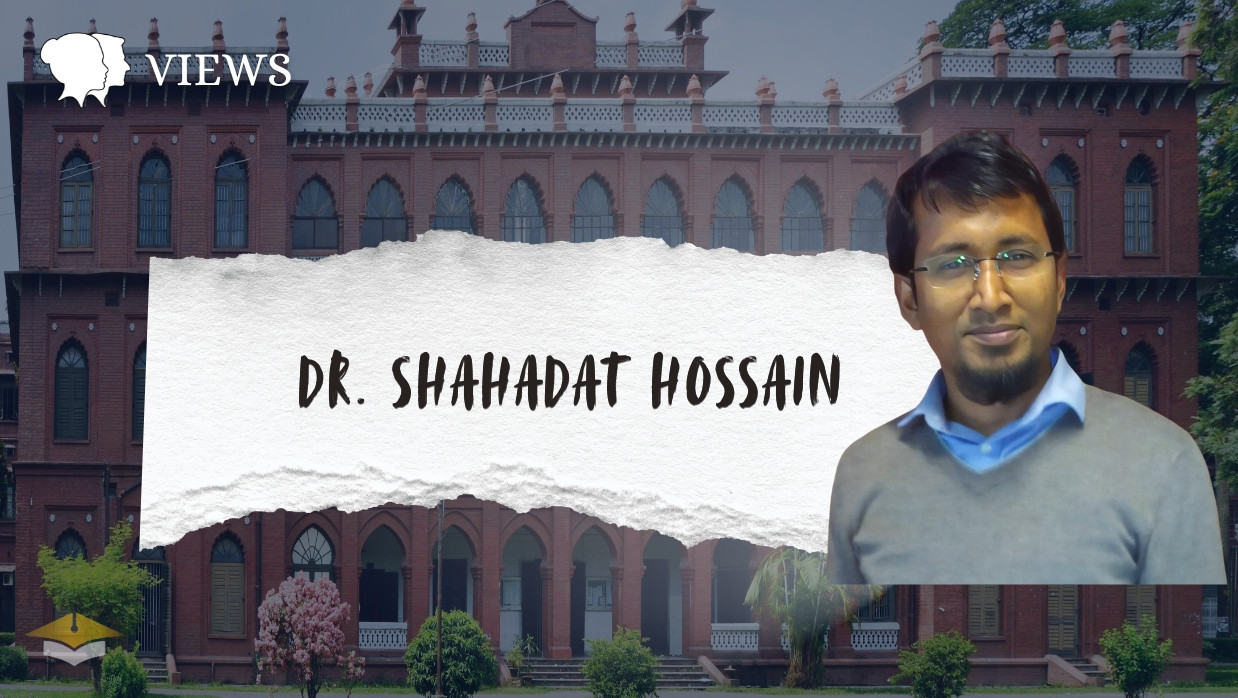
Disclaimer: The views expressed in the following op-ed are those of the author, Prof. Dr. Shahadat Hossain, and do not necessarily reflect the position or editorial stance of The Daily Campus.
 Follow The Daily Campus on Google News