Eight Commissions, Almost No Reform: Bangladesh's 54-Year Education Standstill
Chapter One traced the human cost of a system that trains students to pass exams but not to think, a crisis educators describe, without exaggeration, as an ICU case. That crisis was not an accident. It is the accumulated residue of five decades of commissions convened, recommendations filed, and reforms abandoned. To understand why the classroom looks the way it does today, it helps to understand the paperwork that was supposed to fix it, and never did.
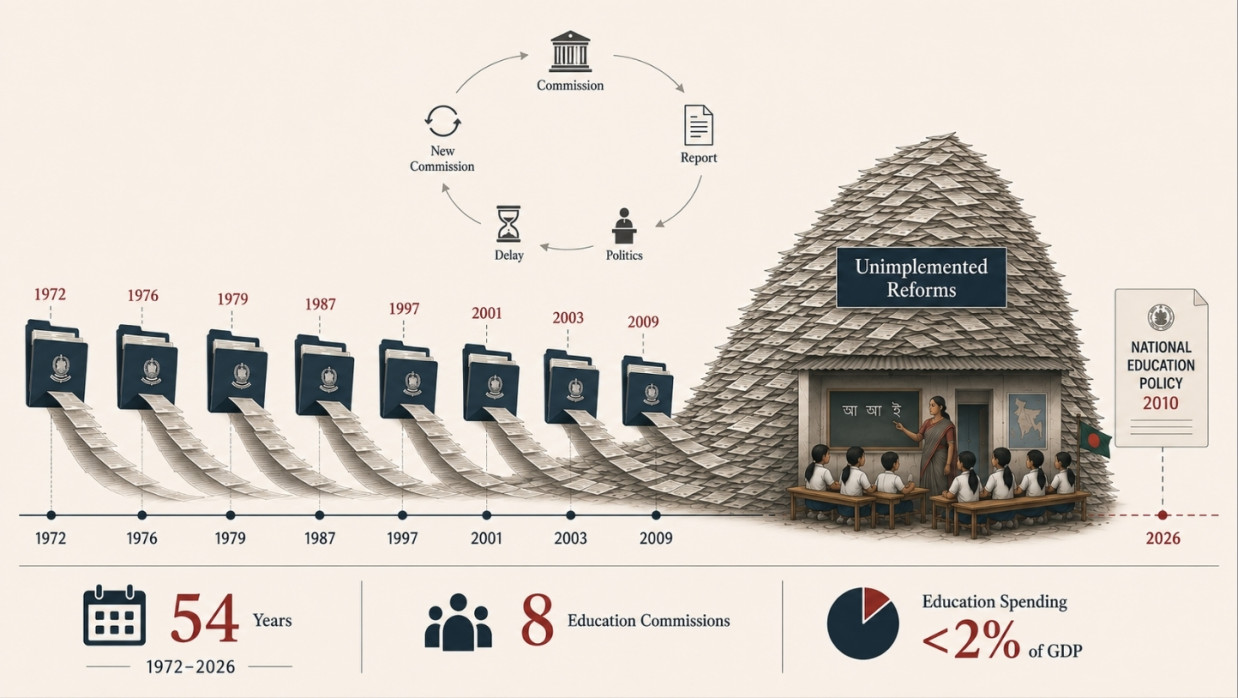
The Qudrat-i-Khuda Commission of 1972 is the foundational document. It recommended a secular system, technical and vocational emphasis, primary education through class eight, and a four-year undergraduate degree. It was forward for its time. It was never implemented. The assassination of Sheikh Mujibur Rahman in August 1975 ended not just a government but the institutional momentum behind that entire framework.
What followed was a procession of commissions, committees, and policy reviews, many revisiting ideas that had already appeared in earlier reports. The Qudrat-i-Khuda Commission of 1972 called for expanded compulsory education, curriculum reform, vocational pathways, improved teacher training, and modern assessment systems. The curriculum committee of 1976 and the Interim Education Policy of 1979 refined those proposals and shaped much of the educational structure that survives today.
Subsequent bodies, the Mofizuddin Ahmad Commission (1987), the Shamsul Haq Commission (1997), the MA Bari Committee (2001), the Moniruzzaman Miah Commission (2003), and the Kabir Chowdhury Committee (2009), returned to many of the same themes: longer compulsory schooling, teacher professionalization, curriculum modernization, vocational integration, administrative reform, and permanent oversight institutions.
The recommendations changed in detail but not in direction. Across four decades, successive commissions repeatedly identified similar problems and proposed similar solutions. Yet implementation remained uneven, reforms were frequently interrupted by political transitions, and many recommendations were carried forward only to reappear in the next commission's report.
The National Education Policy 2010, adopted by the Awami League government, was the most durable of these efforts. It was never formally repealed. Yet many of its central commitments remained unrealized. Primary education was never extended to class eight. Secondary education was never reorganized to include classes eleven and twelve within schools. A separate teacher pay scale was never introduced. A permanent teacher recruitment commission was never established. No comprehensive education law was enacted, and no permanent education commission was created.
What did happen was the 2022 curriculum revision, pushed through under the Awami League regime. The new framework reorganised learning areas, removed rigid science-arts-commerce streaming before class eleven, and introduced continuous assessment over high-stakes examinations. In concept, it borrowed sensibly from international reforms. In practice, rollout was chaotic. Teachers were not adequately trained. Parents and students were confused.
Following the 2024 July uprising, the new curriculum's implementation was effectively frozen, leaving schools in a state of genuine uncertainty about what to teach and how to assess it. The HSC pass rate in 2025 fell to 58.83 percent, the lowest in two decades. The SSC pass rate hit a sixteen-year low. Officials attributed this to the removal of "sympathetic marking." In practice, sympathetic marking was the only thing that had been hiding how little students were actually learning.
Since independence, Bangladesh has established at least eight education commissions. Each one promised transformation. Each one produced detailed recommendations. Each one was largely ignored.
"We've had so many commissions," says Professor M. Rezwan Khan of UIU, "but we haven't reached the desired level of progress."
The pattern is depressingly consistent. A commission is formed, often with impressive credentials. It spends months or years studying the problems and proposing solutions. It submits a report full of thoughtful recommendations.
Then nothing happens. Or, worse, the recommendations are partially implemented in ways that create new problems.
"Commission after commission has made recommendations, but full implementation rarely happens," Professor Khan notes. "Many times, change has been brought without sufficient research, based only on the assumption that 'doing this will be good.'"
The Political Problem
Why do commissions fail? The answers are both simple and complex. The simplest answer is politics. Education is too important to be left to educators, that seems to be the unspoken rule. Political considerations trump educational ones.
"Many commissions were not truly national commissions," argues Professor Mojibur Rahman of DU IER. "They were the ruling party's commissions. They included only party intellectuals and party loyalists."
The result is predictable: a commission that serves political interests, not educational needs.
"When a commission is formed this way, it doesn't become the country's commission," Professor Rahman continues. "Then when the government changes, the next government cancels everything and starts fresh."
This cycle has repeated for decades. Each new government wants to leave its own mark on education. Continuity is sacrificed for political credit.
The Research Deficit
There is another problem: commissions often do not do enough research.
"When making any change in education, you need to plan, research, and evaluate with extreme care," Professor Rezwan Khan explains. "Did we think about what problems might arise from implementation? Was our infrastructure ready? Were our teachers trained?" Too often, the answer is no.
"We implemented change after change," Professor Khan says. "Changes in SSC and HSC examination systems, changes in assessment methods, changes in curriculum. But we never evaluated the long-term consequences."
The Failure to Adapt
Another persistent problem is the uncritical adoption of foreign models. "We often import models from other countries without understanding their context," Professor A.S.M. Amanullah, VC of National University, observes. "Someone sees a good policy in England, Germany, or Finland, and wants to adapt it for Bangladesh. But the adaptation fails."
Why? Because Bangladesh is not England. Bangladesh is not Germany. Bangladesh is not Finland. "The social, cultural, and economic realities are completely different," Professor Amanullah explains. "A policy that works in Finland cannot be blindly applied here."
This observation is echoed by Jahangirnagar University VC Professor Dr. Mohammad Kamrul Ahsan, who points out that copying models without understanding the underlying context is "our long-standing tendency."
"We often think that if a country has built a good system, we can just adopt it and solve our problems," he says. "But it's not that simple. Every society is built on its own history, culture, economy, geography, and social reality."
The Adaptation Problem
East West University VC Professor Shams Rahman elaborates on this point: "When we see a good policy from another country and try to adapt it for Bangladesh, the adaptation doesn't work well. It doesn't align with our cultural, socio-economic realities, or with our education system's actual conditions."
The result is a paper policy that looks good but fails in practice. Professor Amanullah offers a crucial insight: the people on these commissions often lack connection to ground reality.
"There's a big reason for this," Professor Amanullah explains. "Many commission members have little connection to the soil and the people. They may have PhDs from America or other countries, but they don't understand Bangladesh. They don't understand our education system. They don't understand what people actually need."
The Implementation Gap
Even when good recommendations are made, implementation fails.
"The commissions' proposals were very ambitious," Professor Shams Rahman explains. "They wanted to bring structural change. But structural change requires funding."
Bangladesh spends less than 2 percent of GDP on education. This is among the lowest rates in the world.
"You can't build a world-class education system on a shoestring budget," says Professor Moninoor Roshid of the Institute of Education and Research (IER), University of Dhaka.
But money is not the only problem. There is also a coordination gap.
"Someone works on primary education, someone else on secondary, someone else on tertiary," Professor Shams Rahman explains. "Things are fragmented. There's no proper coordination."
The Student Experience
The victims of this chaos are students. Consider a child who starts school in 2010. By the time they finish higher secondary, they have experienced multiple curriculum changes, new textbooks, new exam systems, and new assessment methods.
"They go through six or seven major changes, and there are 10 or 11 different education systems from Class 1 to Class 10," Professor Mojibur Rahman observed. "This is not reform. This is chaos."
Students cannot build on their learning because the foundation keeps changing. Teachers cannot master any teaching method because the method keeps changing.
The Solution: Policy Continuity
What would break this cycle? Professor Shams Rahman has a simple but powerful answer: policy continuity.
"Whatever we do, we need to ensure policy continuity," he says. "Whether it's teacher recruitment policy, curriculum policy, or anything else, we need consistency."
This means establishing principles that transcend governments. It means building consensus across the political spectrum on what education should achieve.
"I'm hopeful," Professor Shams Rahman adds. "In the last three or four months, I've been invited to various forums. I've seen everyone, from the Prime Minister to the Education Minister, talking about education. This is a good sign."
What would a successful commission look like? The experts are remarkably consistent in their answers.
First, it must be a national commission, not a political one. It must include teachers, educators, students, parents, and all stakeholders.
Second, it must include people who understand both Western education and the education of the subcontinent. "People who can blend the two," as Professor Amanullah puts it.
Third, it must be based on research, not assumptions. "If we just decide without research, without experts, without evidence, it won't work," Professor Roshid warns.
Fourth, it must include an implementation plan with specific timelines. "When should be done within six months, what should be done within one year, what should be done within two years," Professor Amanullah explains.
Fifth, it must be accompanied by adequate funding. "We can't expect structural change without structural investment," Professor Shams Rahman observes.
Bangladesh has no shortage of education commissions. What it lacks is the political will to implement their recommendations and the continuity to sustain reform. Each new commission is an opportunity. Each new commission is also a potential failure.
Will the next commission break the pattern, or will it join the long list of well-intentioned initiatives that produced few results? The answer depends not on the commission itself, but on whether Bangladesh is finally ready to put education above politics.
Next in this series: inside the two-tier system that decides, almost from birth, which Bangladeshi children get an education and which get a certificate.
 Follow The Daily Campus on Google News