Inside Bangladesh's Teacher Crisis
The Lost Craftsmanship — Why Bangladesh's Best Students Never Become Its Teachers
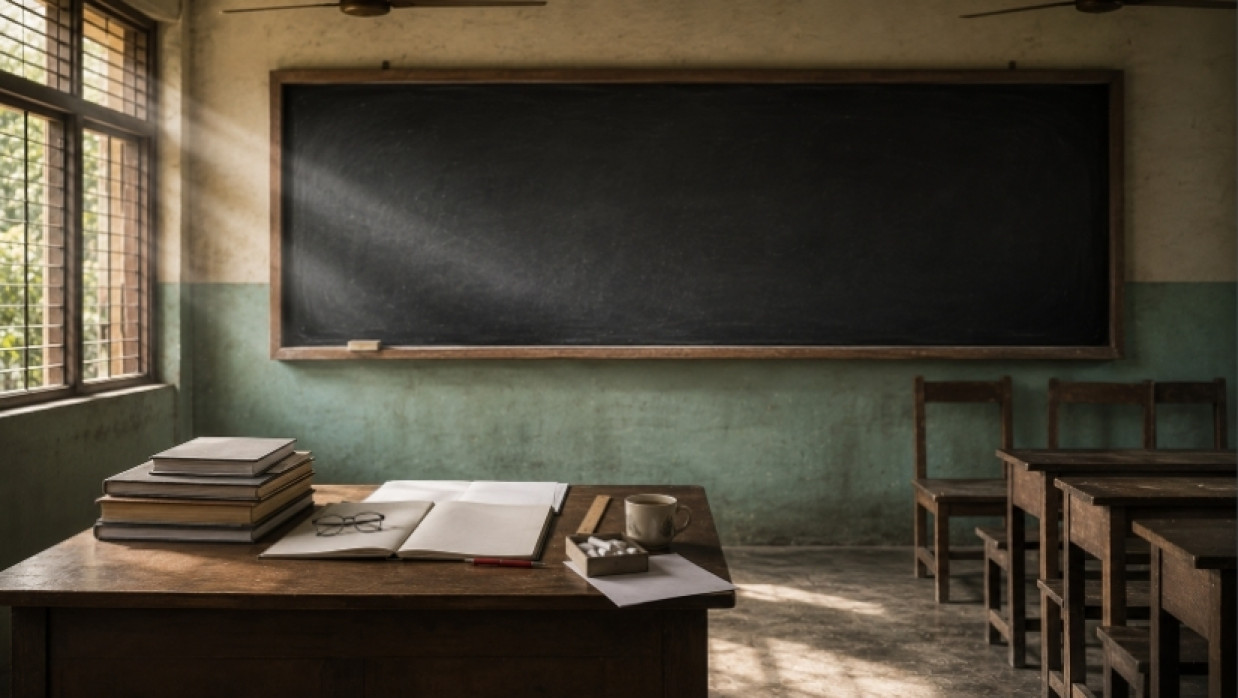
In a large share of the country's roughly seventy thousand government primary schools, the head teacher's post sits vacant. Across MPO-listed secondary schools, 60,295 teaching posts are empty. In other words, the person who is supposed to stand in front of a classroom either isn't there at all, or is single-handedly trying to manage more than one class at once.
Educationists say the real root of Bangladesh's education crisis lies buried inside these numbers.
Part three of this series showed how Bangladesh's parallel school systems sort children not by ability but by their parents' income and address. But unequal access is only half the story. Even the best-funded curriculum fails if there is no qualified teacher in the classroom to deliver it. That is where reform is supposed to begin, and educationists say it is exactly where every previous reform effort in Bangladesh has stalled.
Any policy that hopes to genuinely serve Bangladesh's education system over the next two decades needs to stop spreading itself across a dozen priorities and focus on four. The highest-impact of these is fixing teacher recruitment. If teachers are absent from classrooms, untrained in the subjects they teach, and not hired on merit, every other reform stays on paper.
That means finally creating the independent teacher recruitment commission the 2010 education policy promised and never delivered. It means filling the 60,295 vacant posts in MPO schools within a set timeframe, backed by quarterly progress reports rather than a single budget-speech pledge. And it means building a competitive pay structure that actually makes teaching attractive to talented graduates.
The quantity crisis
Professor M. Rezwan Khan, former Vice-Chancellor of United International University, says the teacher shortage is one of Bangladesh's biggest capacity gaps. We talk about new policies, new subjects, new curricula, he says, but not enough attention goes to the people who will actually have to deliver them, the teachers.
Two things matter when it comes to teachers, he says, numbers and quality. Bangladesh is behind on numbers alone. Among roughly seventy thousand government primary schools, a large number have vacant head-teacher posts. In some cases the shortage is severe enough that running the institution at all, even with the bare minimum of staff, becomes difficult.
This is not an exaggeration. Visit a rural government primary school and it's common to find a single teacher trying to manage more than one class at a time. Students get minimal attention. Learning suffers.
The quality crisis
Once the numbers problem is addressed, the question of quality follows, says Professor Khan. Teaching should be a profession that draws the most capable, most talented people. Have we actually built that environment? The honest answer is no.
Why aren't talented people drawn to teaching? Professor Khan's explanation: because the profession has never been given the prestige or incentives that would pull a talented young graduate toward it. Other government cadres come with various benefits; even where pay is comparatively modest, other perks make up the difference. Teachers don't get that kind of compensation, institutional prestige, financial security, career mobility, teaching lags on every front.
The result is predictable. The most capable students naturally gravitate toward other professions. Professor Khan argues that if Bangladesh genuinely wants its best people in classrooms, it needs a distinct salary structure for teachers, better professional benefits, and a policy built around professional dignity. Teaching, he says, has to be made an attractive profession again.
Professor Mohammad Mojibur Rahman of the Institute of Education and Research (IER) at Dhaka University frames this as part of a larger question. Before anything else, he says, you have to ask whether the teachers, students, and parents actually have the capacity to sustain the kind of education you're trying to deliver. On teachers specifically, both numbers and quality matter, and Bangladesh is short on both.
There's a lot of talk about new policies, new subjects, new curricula, but little attention paid to preparing the teachers who will have to carry them out. As a result, reforms stay on paper. They never reach the classroom. — Professor Mohammad Mojibur Rahman, Institute of Education and Research (IER), Dhaka University
The problem of political interference
Even committed teachers work in a hostile environment. Professor Mojibur Rahman says political interference in teacher recruitment and transfers has poisoned the entire system. In many cases, teachers are appointed based on political connections rather than merit, transferred based on influence, and promoted based on loyalty rather than ability.
This, he warns, breaks the morale of dedicated teachers. It rewards incompetence and erodes professionalism.
If an education commission is to be genuinely effective, Professor Mojibur Rahman argues, it cannot be run by bureaucrats, nor can it be staffed only with party loyalists. Recruitment itself needs to be designed and led by people who actually understand pedagogy, assessment, curriculum, textbooks, and teaching methods.
The training gap
Training is another major shortfall, says Professor Shams Rahman, Vice-Chancellor of East West University. Teacher training needs to be made far stronger, he says. We need to attract people who aren't just good students, but genuinely want to contribute to education. It isn't easy, but being deliberate about teacher recruitment can solve a lot of these problems.
Whatever curriculum is adopted, Professor Shams Rahman says, Finnish, Japanese, or anything else, it is ultimately teachers who implement it. Finland's education system is highly practical, built not on rote memorization but on applied knowledge. But delivering that requires trained teachers, and producing those teachers requires training, encouragement, and incentives.
People might reasonably ask, he says, why should I go teach in a village? That question needs both psychological motivation and financial motivation as an answer. Without providing both, the problem won't be solved.
Underpaid teachers often turn to private tutoring to supplement their income. This isn't a personal failing, if the system doesn't pay enough, looking for other sources of income is a natural response.
But it damages the education system as a whole. A teacher exhausted from evening tutoring cannot bring the attention to school the next day that the job requires. A teacher more invested in their own coaching classes cannot teach effectively in the classroom. Students who can afford private tutoring get ahead. Those who can't fall further behind.
What would fix it
National University Vice-Chancellor Professor A.S.M. Amanullah calls for an independent teachers' council, one that would handle recruitment, transfers, promotions, and pay, operating outside the Ministry. That would take politics out of teacher management and professionalize the system.
Professor Mojibur Rahman wants a separate pay structure. Teachers should have a distinct pay scale along with improved professional benefits, he says. If teaching is to genuinely become a respected profession, both compensation and status need to change.
Professor Shams Rahman emphasizes training and incentives. Teachers need training, encouragement, and financial incentives. He also offers a practical proposal, a rotation system. Rather than tying a teacher to a village for their entire career, they could be posted there for three years and then transferred. He recalls that there used to be a separate system for primary teacher training that worked well. It's unclear how effective it still is, but it needs to be revived and strengthened.
Professor M. Rezwan Khan stresses one more point, long-term thinking in recruitment. Will the teacher being hired today be able to prepare students for the demands of a decade from now? Technology and artificial intelligence, subjects that get relatively little attention today, will only grow more important over the next ten years. Teacher recruitment and training need to be built around tomorrow's demands, not just today's.
Seventy thousand institutions and atleast 60,295 vacant posts. Behind these numbers sit thousands of classrooms every single day, each one asking a single person to carry a load that was never meant for one pair of shoulders. Shortages in numbers, shortages in quality, missing incentives, political interference, absent training, all of it is stacked into those same empty posts. Fix everything else and leave this untouched, and it amounts to painting over a wall that is already coming down.
Bangladesh could have the best curriculum in the world. But if teachers are not trained, motivated, and properly valued, that curriculum is bound to fail. Education, in the end, is about people, says Professor Mojibur Rahman. Fail to invest in teachers, and what you're actually investing in is failure.
Until Bangladesh makes teaching a genuinely attractive profession for its best and brightest, those vacant posts across seventy thousand schools will stay vacant. And the system will keep producing graduates who can memorize, but cannot think.
Next in this series, the final installment: what the new government has promised, what the rest of the world's experience suggests about which of those promises will survive contact with reality, and what a workable vision for Bangladeshi education actually requires.
 Follow The Daily Campus on Google News