The Hidden Apartheid in Bangladesh's Classrooms
How Bangladesh Educates the Rich and Warehouses the Poor
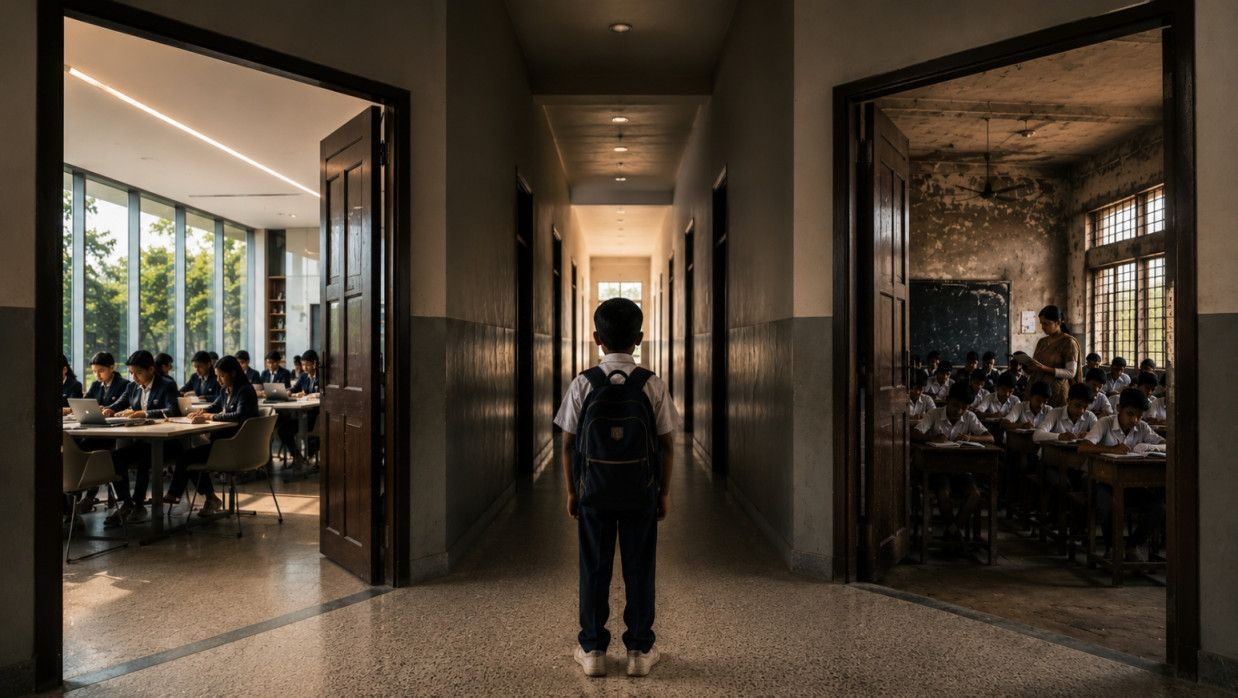
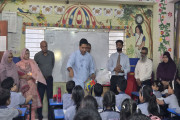
In an affluent neighborhood of Dhaka, a group of teenagers debate Shakespeare in flawless English. Their pronunciation is precise, their arguments sharp, their essays polished enough to impress a university professor. A few kilometers away, in a government school, another group of students is memorizing a passage from a textbook. They can recite it perfectly, but ask them to explain the meaning of a single sentence and they fall silent.
Same country, same age group, yet two entirely different futures. Educationists say this gap is not an accidental outlier. It is the design of an entire system.
Part two of this series explained why commission after commission has failed to change Bangladesh's education system. Bangladesh's policy documents have never honestly answered this question. But before any policy, there is a harder question to face: a policy for whom. The Kabir Chowdhury Commission stated that education should be "people-oriented, balanced, universal, well-planned, science-minded, and quality." The education system that has operated under that policy has failed to become any of those things in any consistent way.
That's because Bangladesh does not run one education system, it runs several in parallel, with essentially no coordination between them. Government primary schools. Non-government primary schools. Madrasa education at the primary and secondary level.
Government secondary schools and non-government secondary schools under the MPO system, where the government subsidizes teachers' salaries but has almost no control over quality or accountability. Beyond that sit private English-medium schools following British or international curricula, an entirely separate world of private English-version education.
Professor Mohammad Mojibur Rahman of the Institute of Education and Research (IER) at Dhaka University says that at the primary level alone, the country runs 11 distinct streams of education. This is precisely the stage at which students are supposed to build their basic foundation, yet countless students fall behind at this very stage. At the same time, there is no effective coordination between the different streams, and no integrated assessment system for students either.
National University Vice-Chancellor Professor A.S.M. Amanullah says every stream's students should emerge with employable skills. In his words, those who study in madrasas should also become employable, those who study in Bangla medium should also become employable, those who study in English medium should also become employable. But in practice, this minimum parity does not exist between the streams, and in the words of educationists, this gap is Bangladesh's greatest educational failure.
The result is, in effect, a two-tier system. For families who can afford it, whether through tuition at private English-medium schools, through coaching centers, or through private tutors at home, education actually works for their children. For the majority, what remains is a system that pushes children through exam after exam without any guarantee that they are actually learning anything.
A shortage of subject-specific teachers in government and MPO schools, combined with a culture where exam results determine everything, has created the parallel system of coaching centers. Families fund it out of their own pockets. Those who cannot afford it fall behind.
National vs. international, two different kinds of preparation
Professor Dr. Monira Jahan of the Institute of Education and Research (IER) at Jagannath University says students from class nine through twelve study within a structure that is extremely dependent on rote memorization. Textbooks are limited, syllabi are limited, there is no opportunity to read books by different authors, and little exposure to differing viewpoints. As a result, students can memorize specific content for exams, but the ability to think independently or express their own opinions with sound reasoning never develops.
She says this problem is not an individual weakness on the part of the student, it is the outcome of a long-standing structural education system.
The impact becomes most visible once students reach university. Professor Jahan says students coming from the national curriculum take a long time to adjust to the new academic environment. This is not just a language problem, it is the struggle of adapting to a new education system, new methods of learning, and a new culture of independent work. By contrast, students coming from the Cambridge curriculum often say they feel comparatively less pressure in their first or second year, because they were already accustomed to this kind of analytical study and independent academic culture.
Professor Jahan also says that gaps in language skills are a major problem. Many students cannot construct proper sentences even in their mother tongue, and the situation is the same with English, so they run into serious trouble when preparing for the job market or for higher education abroad.
Economic reality, and the question of mass-oriented higher education
But the issue isn't as simple as national curriculum bad, international curriculum good. Professor Mojibur Rahman emphasizes that our economic reality also has to be taken into account. There are urban students, and there are rural students. There are vast differences in access to private tutors, coaching, and other educational support.
He says Bangladesh's higher education has become extremely mass-oriented, whereas in many countries not everyone goes on to higher education, they have an ability-based curriculum instead. In England, for instance, general education, advanced education, grammar schools, and various alternative pathways run side by side. In Bangladesh, such alternatives are limited, some students are in the national curriculum, some in madrasas, some in English medium, but there is no easy path from one to another.
Asked about the need to unify the country's different streams of education, Professor Jahan says a full merger isn't necessary, but ensuring a common baseline for everyone is essential. In her view, whichever stream a student studies in, they should come out with at least a minimum standard of education.
But this does not mean forcing everyone into the same mold. Professor Jahan says the diversity within the country's education system has to be respected. There can be room for multiple models within education policy, but a common baseline must be guaranteed for everyone.
Madrasa education and the economic question
Bangladesh has roughly fourteen thousand Alia madrasas, and the number of Qawmi madrasas is far higher still. Alia madrasas follow a state-regulated curriculum that includes general subjects alongside religious education. Qawmi madrasas largely operate outside state regulation, following a traditional curriculum. Enrollment in both streams is substantial, and much of it comes from rural and low-income families.
The political sensitivity around madrasa education has made practical reform nearly impossible for one government after another. In 2025, a government plan to appoint physical education instructors in primary schools had to be withdrawn under religious political pressure, and that single episode illustrates exactly how this constraint operates in practice.
Educationists say this isn't a cultural or religious question at all, it's fundamentally an economic one. A child who spends ten years in a Qawmi madrasa and comes out without even minimal competence in math, science, or English is not someone the formal labor market can productively absorb. Whether Bangladesh can actually put this growing youth population, moving toward a demographic dividend, to productive use depends on what they are actually learning in school.
The teacher shortage, and the rural-urban divide
Inequality shows up most starkly in the quality of teaching. East West University Vice-Chancellor Professor Shams Rahman says the urban-rural divide is genuinely widening, and it cannot be fixed without reforming teacher recruitment. In his words, whatever the curriculum, Finnish, Japanese, or anything else, it is ultimately the teacher who implements it. So the government has to focus above all on teacher recruitment, training, and incentives.
He says people may well ask, why should I go teach in a village. What's needed here is financial incentive, and also a rotation system, so that a teacher doesn't have to stay in a village for their entire career, but has the option to transfer elsewhere after a fixed term.
Professor Emeritus M. Rezwan Khan, former Vice-Chancellor of United International University, also identifies the teacher shortage as the single biggest capacity gap. He says that among roughly seventy thousand government primary schools, a huge number have vacant head-teacher positions, and in many cases the shortage is so severe that it's difficult to run the institution even with the bare minimum of staff.
In his view, once the numbers shortage is addressed, the question of quality follows. The most talented people should be entering teaching, but in practice that environment hasn't been created, because teachers' salary structures and professional standing lag behind other government jobs. As a result, talented people naturally gravitate toward other professions.
Professor Md. Mojibur Rahman ties this shortage to a larger question. He says education cannot simply be about producing employees, the core purpose of education is to make a person socially responsible. If there isn't a system in place to produce skilled teachers, and if those who are teaching don't have adequate salaries and standing, many will turn to private tutoring for extra income, which pulls them even further from their core responsibilities.
In the words of educationists, this is exactly how a vicious cycle forms: poor students get poor teachers, poor teachers produce poor learning outcomes, and poor learning outcomes further entrench poverty.
Career-oriented education versus humanities education
Jahangirnagar University Vice-Chancellor Professor Dr. Mohammad Kamrul Ahsan believes that sorting students into science, humanities, and commerce at such a young age is itself a major structural problem. He says in many advanced education systems, this rigid division doesn't happen before class twelve, instead all students are given a basic grounding in science, history, literature, and social science. In his view, maintaining a common stream of education at least through class twelve would make it far easier for students to adjust once they reach university.
He also cautions that as much as vocational or career-oriented education is being emphasized these days, if values and humanities education are neglected at the same time, it will create an unbalanced education system. In his words, education is not merely a machine for producing jobs, education is the process of making a person.
National University Vice-Chancellor Professor Amanullah echoes the same point, saying skills-based education isn't complicated, what's needed is simply to ensure that students from every stream come out with skills that let them work in real life.
Bangladesh's education system is not failing everyone equally. It is failing the poorest and most vulnerable children the hardest. And as long as this system fails to provide quality education to every student regardless of background or location, this cycle of inequality will continue.
Educationists largely agree on one point: each of these four streams is really a ticket to a different future. A student coming from English medium goes abroad to study or enrolls in a private university. A student with good results from the national curriculum enters the fight to get into a public university, but without any preparation in analytical thinking. A madrasa student often comes out with skills that don't translate directly into the formal labor market. And for students in the technical and vocational stream, the path to higher education remains largely closed.
These four paths may run parallel on paper, but they are not equal in practice. Which path a student ends up on is decided, more often than not, not by their talent but by their parents' income. In the words of educationists, this is the real crisis: Bangladesh's education system is distributing futures based on ability to pay rather than on merit.
Let's go back to the picture of those two classrooms from the start. The student at the English-medium school in Dhaka and the student at the government school a few kilometers away are both citizens of Bangladesh, both roughly the same age, yet the gap in opportunity in front of them is vast. One has a university of choice, study abroad, and a good job ahead of them. The other has little beyond passing exams.
Educationists believe this gap will not be closed by changing one policy or forming one commission, because it is fundamentally the combined result of teacher numbers and quality, state investment, and the absence of even a minimal common baseline across the streams. Until these three areas are addressed, government schools, private English medium, madrasas, and vocational education will keep running side by side in the same country, but they will never converge on the same destination.
Bangladesh's education system, then, is not failing equally. It is failing the most vulnerable, low-income children the hardest, and working best for those who needed it least to begin with. Until this system delivers quality education to every student regardless of background or address, this cycle of inequality will not stop, and the few kilometers between those two schools in Dhaka will remain, in effect, the distance between two different Bangladeshs.
Coming up in the next part of this series: the story behind Bangladesh's teacher shortage, why the country's most talented people aren't entering the teaching profession.
 Follow The Daily Campus on Google News