BNP Govt's Biggest Test
10 Steps to Fix Bangladesh's Education System
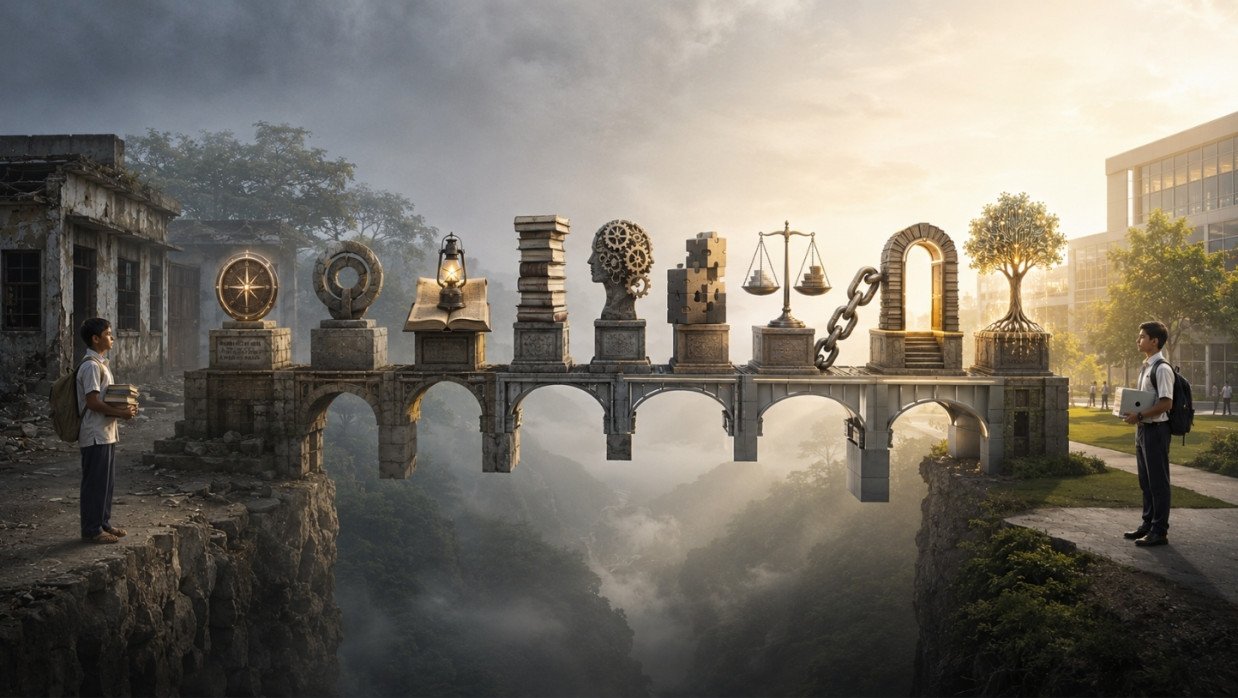
Bangladesh has long spent less than 2 percent of its GDP on education, one of the lowest rates in the world. The new government has now allocated 2 percent of GDP to education in its first fiscal year budget and has pledged to raise that figure to 5 percent before the end of its term, nearly tripling current spending. For the 2026-27 fiscal year, the education budget has been set at 2 percent of GDP. The question is whether this promise will remain on paper, like the recommendations of the eight previous education commissions, or whether it will actually be implemented.
The picture that has emerged across the previous four parts of this series is not reassuring. A generation has been taught to memorize, not to think. The recommendations of eight commissions have failed to survive the shock of changes in government. A two-tier education system has divided children by their family's income before they ever sit for an exam. And the teaching profession has been unable to offer either the salary or the status needed to attract talented people.
In 2010, too, Bangladesh received a national education policy that was praised by educationists at the time. Fifteen years later, much of that policy remains unimplemented. Eight commissions have made this same promise before, going back to the first one in 1974. Each arrived with its own diagnosis and its own fix. Each was shelved by the next change of government. This is the ninth attempt, and the question this series has been building toward is whether it will end differently, or whether it is simply the latest name in a list that already runs eight names long.
Read Part 1 here: Bangladesh Raised a Generation That Can Pass Exams But Cannot Think
Manifesto Promises, the Arithmetic of Reality
BNP's 2026 election manifesto presents education as a distinct strategic driver of national development. The target of allocating 5 percent of GDP would bring Bangladesh close to UNESCO's minimum benchmark of 4 percent. Prime Minister Tarique Rahman has confirmed this target and identified 43 priority areas.
As of this writing, a detailed revenue roadmap for reaching 5 percent has not been published. Moving from below 2 percent to 5 percent is not merely a budget-line decision. It requires either a major expansion of the tax base or the redirection of funds from other sectors.
East West University Vice-Chancellor Professor Shams Rahman adds a practical caution.
"The government is saying it will increase the budget. We hope there will be some increase. But that doesn't mean it will suddenly become 4 or 5 percent overnight. We need to increase it in a way that also ensures the capacity to use it effectively."
The manifesto's second major promise is free education up to the postgraduate level for women and up to the undergraduate level for men. IER Professor Mohammad Mojibur Rahman identifies an important weakness in this kind of promise.
"We often present free textbook distribution as free education. But truly free education is a much broader matter than that. Alongside books, a student's shoes, clothing, school bag, notebooks, pens, all the expenses associated with schooling, need to be taken into account by the state."
He also draws attention to what he calls opportunity cost.
"Suppose a child from a poor family could earn some money for the family by working instead of going to school. Ignoring this reality, universal education is not possible. Giving 100 or 200 taka a month in the name of stipends is not a solution."
On the question of up to which level education should be compulsory, Professor Mojibur Rahman also takes a clear position. Bangladesh has said for many years that primary education is compulsory, yet this still hasn't been fully ensured. Compulsory education up to grade eight has also been discussed for a long time without being implemented.
"Internationally, the common standard now is to ensure compulsory and free education up to grade twelve. In my view, Bangladesh should also move toward that goal."
Read Part 2 here: Eight Commissions, Almost No Reform: Bangladesh's 54-Year Education Standstill
Why Students Stumble When They Arrive at University
Professor Moninur Rashid traces the roots of this problem to the structure of the curriculum.
"A major limitation of our existing education system is that from grade nine to grade twelve, students study within an extremely limited and rote-memorization-based structure. Books are limited, syllabi are limited. There is no opportunity to read books by different authors, and exposure to different opinions or different perspectives is also very low. As a result, while it becomes possible to memorize specific content for exams, the ability to think independently, form one's own opinions, or express them logically does not develop."
He emphasizes that this is not an individual weakness of students, but a structural outcome. Many students cannot write correctly even in their mother tongue, with weaknesses persisting in sentence structure, spelling, and expression. The same is true of English, since many students are unwilling to read English books or reference material.
He also offers a comparison between the national and Cambridge curricula.
"Many of our students, when they go to good universities, especially coming from the national curriculum, take a long time to adjust to the new education system. On the other hand, those coming from the Cambridge curriculum often say they feel comparatively less pressure in their first or second year at university, because they are already accustomed to an analytical and independent learning environment."
Jagannath University's Professor Monira Jahan raises the same problem in her own words. Many students, she says, simply do not understand how to think about a subject or how to present it on their own. The root of this, in her view, lies in the excessively rote-memorization-based structure from grades nine through twelve. "We often see that many students cannot write well even in their mother tongue. There are problems even with very basic sentence construction."
On the difference between the national and Cambridge curricula, her assessment is direct.
"This is not fundamentally a language problem, but rather a problem of adjusting to a new education system, a new way of learning, and a culture of working independently."
United International University's former Vice-Chancellor Professor M. Rezwan Khan looks at the same crisis from the angle of assessment methods.
"At present we have reached a situation where, because of the assessment method, many students are achieving very good results. But those results do not always reflect their actual preparation or capability. Today we see many students enrolling in university with excellent results, but they lack the skills, analytical ability, or preparation needed for higher education."
Read Part 3 here: How Bangladesh Educates the Rich and Warehouses the Poor
There Is Something to Learn From Others' Experiences
Educationists believe that looking abroad is instructive, though not always in the way reformers assume. National University Vice-Chancellor Professor A.S.M. Amanullah speaks clearly about the danger of blindly adopting foreign models.
"Whenever we look at a commission's recommendations, we often find that they saw a good policy in some country, one that is working well in that country, and recommended adapting it for Bangladesh. But what we've seen is that a major reason behind various policy failures or implementation failures has been the problem of adaptation. The policy that was brought in was not made sufficiently consistent with our cultural adaptation, with our socioeconomic reality. As a result, a policy that looked good on paper did not work in practice."
Professor Mojibur Rahman makes the same point using a domestic example.
"Many subjects taught at Dhaka University are also taught at the world's top universities. There is overlap in various subjects with the curricula of Oxford, Harvard, or Princeton. So the question is, do we adopt their curriculum exactly as it is? No, we don't. Because we know Bangladesh's reality is different. Our society, culture, history, values, beliefs, emotions, everything is different."
Jahangirnagar University Vice-Chancellor Professor Mohammad Kamrul Ahsan compares this plurality to a natural principle.
"Just as diversity is a precondition for a healthy ecosystem in nature, every society in the world is also built on the foundation of its own history, culture, economy, geography, and social reality."
The example of Finland comes up most often in education-reform discussions. Professor Shams Rahman adds a practical caution.
"Finland's education system is much more practice-oriented. It's not rote-based, but rather emphasizes practical knowledge. But implementing that requires trained teachers on our part. Whatever the curriculum, Finnish, Japanese, or anything else, it is ultimately the teacher who will implement it."
Professor Kamrul Ahsan offers another caution about the Finland model, this time on the question of social inequality.
"Finland's education system is certainly admirable. But there, the economic condition of most families is roughly similar. Bangladesh's reality is completely different. Here, there is a wide gap in the family, social, and economic conditions among our students."
Read Part 4 here: The Lost Craftsmanship — Why Bangladesh's Best Students Never Become Its Teachers
What a Policy Suited to Bangladesh Actually Requires
Bangladesh in 2026 is not the Bangladesh of 1972, 1997, or 2010. The garment industry now employs about 4 million people, but automation is advancing globally in textile production. The next stage of industrial development requires a different kind of worker.
Given this reality, Professor Amanullah takes an important policy position on employment-oriented education: that vocational training is not meant for any one particular stream.
"We need to work on how skills-based education and employment-oriented education can be implemented. Those studying in madrasas will also be job-ready. Those studying in Bangla medium will also be job-ready. Those studying in English medium will also be job-ready. Everyone will be job-ready."
BNP's Test: The History of Eight Commissions
Every government that has come to power in Bangladesh since 1972 has announced education reform, but none has been able to sustain continuity. Professor Shams Rahman offers a clear explanation of this pattern, drawing on the history of the commissions themselves.
"In these five decades since independence, at least eight education commissions have been formed. Interestingly, even as the political backdrop changed, the goals of the commissions remained largely the same. But whichever government came to power formed a new commission. The Kudrat-e-Khuda Education Commission was formed under one government, and later the Shamsul Haque Commission under another. As a result, the continuity that should have existed broke apart with each change of government."
Professor Kamrul Ahsan offers a similar observation about the failure of the commissions.
"In our country, at least eight education commissions have been formed since independence. But the reality is, we have not seen the recommendations of any single commission become fully effective. The syllabus has changed again and again, textbooks have changed, but the core goal of education reform has not been achieved."
The Reform Blueprint of Those Concerned
After documenting a crisis spanning four parts, the question that remains is: what now? According to experts, ten steps are essential.
First, establishing a vision. Professor Mojibur Rahman says the country still lacks one.
"We do not have a clear national vision for education. The fundamental question of what we actually want to achieve through education has never been clearly determined."
Professor Amanullah puts the same problem in sharper terms.
"We have no educational vision. There is no vision for primary education. There is no vision for secondary education. There is no vision for higher education. This vision needs to be settled first."
Professor Moninur Rashid's assessment moves in the same direction.
"We still don't have a clear national vision, what kind of people we want to build, what kind of graduates we want, which sectors will need how much manpower in the future, what kinds of skills will be needed. There is no long-term plan on these questions."
Professor Rezwan Khan describes the crisis in similar terms.
"My personal assessment is that our education system has become extremely polluted. Changes have been made wherever and however possible, but not enough thought has gone into the long-term consequences of those changes."
Second, a genuinely national commission, not a political one. Professor Mojibur Rahman is emphatic on this point.
"Not a political commission, but a national commission. Education is not just for the government's own children. The children of 180 million people are part of this education system. From village to city, rich to poor, Hindu-Muslim, hill to plain, everyone's life is tied to it. So the commission must have representation from every kind of person."
In his view, the commission should be neither bureaucrat-dependent nor composed solely of party intellectuals. It should instead be led by experts who understand pedagogy, assessment, curriculum, textbooks, and teaching methods.
Professor Amanullah attaches a condition regarding the qualifications of commission members.
"Just bringing in a few well-known scholars and seating them, someone with a PhD from America, that alone won't do. The question is whether they understand the reality, whether they understand Bangladesh's education. There's a big reason behind this, many of those placed on commissions have little connection with the soil and the people."
He also believes the commission should draw from every section of society, from professionals to parents, and should include people who understand both Western and South Asian education well enough to balance the two. In his view, past commissions were not entirely ineffective. "Were not fully implemented" is the more accurate description, he says.
Professor Amanullah also believes an implementation plan should accompany the formation of any commission.
"Forming a commission alone will not be enough. If a commission is formed this time, it must come with an implementation plan, what needs to be done within six months, within one year, within two years."
Third, starting with philosophy, before writing policy. Professor Mojibur Rahman frames this as the fundamental question.
"What do we want from education, what do we want in five years, in ten years, in fifty years, in a hundred years. Do we want to produce only laborers to send abroad, or do we want to produce poets and intellectuals?"
His deeper observation goes to the purpose of education itself.
"The most fundamental task of education is to turn a human being into a social being, that is, to transform a biological being into a social being."
In his view, philosophy must be settled first, then policy, then curriculum built on that policy, then textbooks built on that curriculum. In practice, things are often done in reverse order.
"We often start work from the wrong end, changing textbooks first, then changing the curriculum, but the clear educational philosophy and education policy that should stand behind these is often absent."
Professor Rezwan Khan sees the same problem as a shortage of research.
"Before making any change in education, planning, research, and evaluation need to be done with extreme care. Commissions have been formed, recommendations have come in, but the implementation process has not been carried out properly. In many cases, it seems changes were made without adequate research, based simply on the assumption that 'this will be good.'"
Fourth, the quality and quantity of teachers. Professor Mojibur Rahman puts it plainly.
"You cannot produce a good product without the right craftsman. At present, among roughly 70,000 government primary schools, a large number have vacant headteacher positions. We have not been able to give teaching the dignity and incentives that would attract talented young people to this profession."
To reduce the urban-rural gap, Professor Shams Rahman offers a practical solution.
"It's not that a teacher has to stay in a village for their whole life. Suppose there's a five-year appointment, they work in the village for three years, then move elsewhere. This kind of arrangement is possible."
Fifth, analytical ability and reasoning. Professor Kamrul Ahsan believes two capacities should be central to reform.
"The main focus of education should be building two fundamental capacities in students, first, analytical ability, second, cognitive capacity. Many countries around the world now use a method called Philosophy for Children, whose central goal is to build critical reasoning in children from an early age."
He also stresses the importance of moral education.
"Talent or skill alone does not make a person effective. A person also needs moral stability, social responsibility, critical thinking, reasoning ability, and self-control."
Sixth, a common framework, but not full unification. Professor Monira Jahan draws this distinction directly.
"I'm in favor of a common framework, not full unification. A student in a coastal area may need to know about cyclones and disaster management. A student in a hilly area may need different skills."
Professor Mojibur Rahman speaks of a similar common framework, keeping fundamental subjects such as language, math, science, and civic education common for everyone, while leaving the rest flexible according to local needs.
Seventh, financing and coordination. Professor Shams Rahman is blunt about the requirement.
"Structural change requires structural investment."
Professor Mojibur Rahman speaks of coordination between policy and budget.
"There must be clear coordination among the education philosophy, the education ministry, the finance ministry, and the national budget. We often make big policy announcements, but those announcements have no connection to financing."
Eighth, continuity. Professor Shams Rahman considers this the single most important issue.
"If I had to name just one thing, it would be ensuring policy continuity. Whether it's teacher recruitment policy, curriculum policy, or any other policy, whatever we do, it needs continuity."
Professor Amanullah says the same thing in the language of a roadmap.
"If the current government wants to form a commission, it must come with a roadmap. What needs to be done in six months, in one year, in two years, the roadmap has to be clear."
Ninth, keeping the student at the center. Professor Rezwan Khan is direct about the priority.
"To me, the most important thing is properly preparing students for university-level education. For this, if necessary, the curriculum needs to change, the assessment method needs to change, teacher training needs to improve, whatever needs to be done, all of it needs to be done."
Professor Moninur Rashid arrives at the same conclusion in his own words.
"In my view, properly preparing students for university-level education is the most important thing."
Tenth, looking toward the future. Professor Shams Rahman frames this as unavoidable.
"The Fourth Industrial Revolution has changed everything. AI is now at the center of every discussion. We need to think about how technology will affect education. This technology-driven preparation should begin from the primary level itself, and for that, building teachers' skills, providing incentives, and ensuring an appropriate pay scale are essential."
Toward a Vision
Bangladesh's education crisis is deep, but not hopeless. According to educationists, the solutions are well known, widely discussed, and recommended many times over. The question is no longer a lack of knowledge. It is a question of political will.
Bangladesh has the numbers on its side: a young population, a growing economy. But a population boom that is not educated is not a dividend, it becomes a liability. The BNP government has identified this challenge and has also described what is needed to address it. Now comes the part where every previous government has failed.
Professor Shams Rahman offers a note of cautious optimism, one not heard in quite this way under any previous government.
"Over the past three and a half months, I've been invited to various forums. I've seen everyone, from the prime minister to the education minister, talking about education. That's a good sign."
But the gap between discussion and implementation remains the central question of this entire series. Bangladesh's students have been waiting since 1974 for that work of implementation. Whether this ninth attempt will learn from that history, or repeat it, the coming years alone will answer.
Editor's note: This five-part series was produced based on UNESCO, UN, World Bank, and Education Ministry data, peer-reviewed journals, and interviews with the country's leading educationists, including Professor Mohammad Kamrul Ahsan (Vice-Chancellor, Jahangirnagar University), Professor A.S.M. Amanullah (Vice-Chancellor, National University), Professor Shams Rahman (Vice-Chancellor, East West University), Professor M. Rezwan Khan (former Vice-Chancellor, United International University), Professor Mohammad Mojibur Rahman (IER, Dhaka University), Professor Mohammad Moninur Rashid (IER, Dhaka University), and Monira Jahan (Jagannath University).
 Follow The Daily Campus on Google News