Why Bangladesh Needs President Zia’s ICTVTR Vision More Than Ever
The economies of developed countries such as Australia largely rely on Technical and Further Education (TAFE), whereas we are producing a large number of unemployed graduates by establishing universities in large numbers. In our country, TAFE is known as polytechnic. However, even for engineering positions we are gradually reducing practical education in polytechnics and placing greater emphasis on theoretical education.
About 45 years ago, in 1981, the late President Ziaur Rahman established the Islamic Centre for Technical and Vocational Training and Research (ICTVTR) in Gazipur to address the shortage of skilled manpower among the 57 Muslim countries of the Organisation of Islamic Cooperation (OIC). His foresight and emphasis on work-oriented education remain a truly unique example even today.
ICTVTR was later renamed as the Islamic Institute of Technology (IIT) and subsequently the Islamic University of Technology (IUT). The proposal to establish this institution was raised at the 9th Islamic Conference of Foreign Ministers (ICFM) held in Dakar, Senegal, from 24-28 April 1978. Later, the foreign ministers of OIC approved the establishment of the institution in Dhaka, Bangladesh.
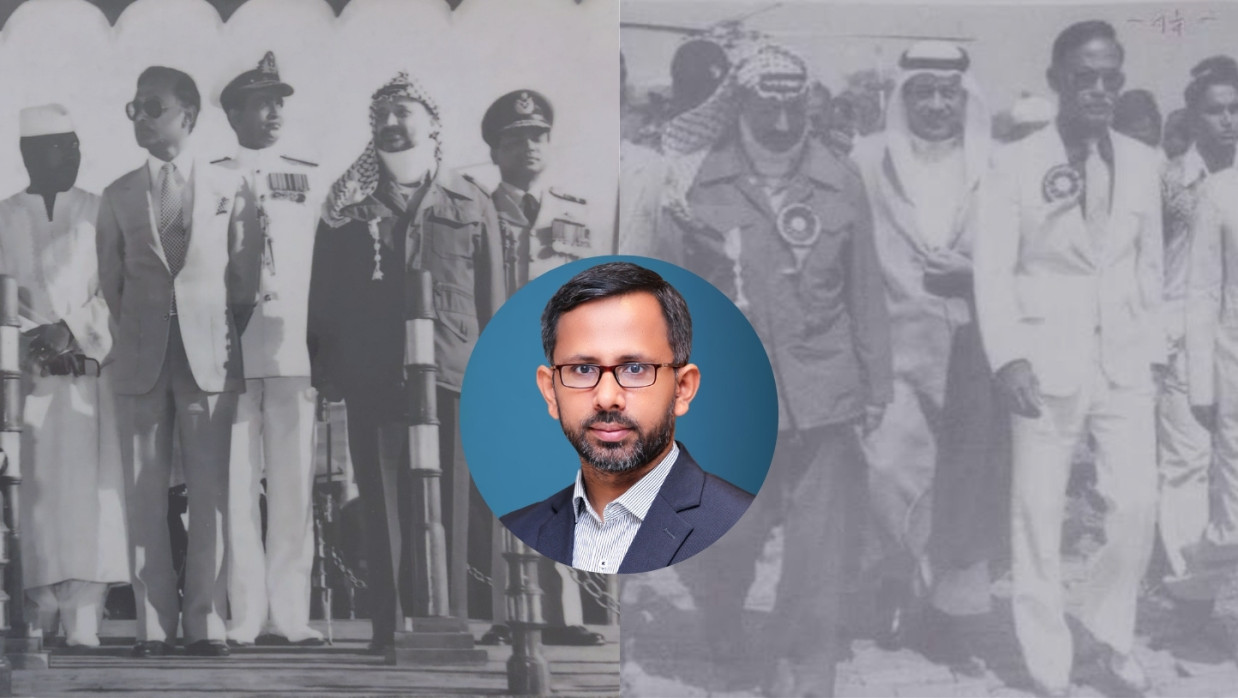
In June 1979, the Government of Bangladesh acquired 30 acres of land at Board Bazar in Gazipur and started the work of building the infrastructure. On this day, 27 March 1981, the then President of Bangladesh, Ziaur Rahman, laid the foundation stone of ICTVTR. Palestinian leader Yasser Arafat and the then Secretary-General of the OIC, Habib Chatti, were present at the time.
The construction of the campus was completed in 1987 at a cost of about 11 million US dollars. Later, on 14 February 1988, ICTVTR was formally inaugurated. At the 22nd session of the Islamic Conference of Foreign Ministers held in Casablanca on 10-11 December 1994, the name of ICTVTR was changed to IIT.
On 21 September 1995, the then Prime Minister of Bangladesh, Begum Khaleda Zia, formally inaugurated IIT. Later, at the 28th session of the ICFM held in Bamako from 25-29 June 2001, it was decided to rename IIT as the Islamic University of Technology (IUT). In the same year, on 29 November, Prime Minister Begum Khaleda Zia formally inaugurated IUT. The university started its regular activities in December 1986 and has so far completed about 37 academic years.
President Ziaur Rahman deeply realized that there is no alternative to technical and vocational education for the socio-economic development of Bangladesh as well as the 57 countries of the OIC. He understood that skilled human resources could be the greatest driving force of development.
From that visionary thinking, he took initiatives to connect Bangladesh’s national identity more closely with the Islamic world and the Muslim Ummah so that new opportunities for economic cooperation and labor markets could be opened. After Saudi Arabia recognized Bangladesh in 1975, the initiative of his government facilitated the recruitment of Bangladeshi workers in Saudi Arabia starting in 1976.
His first visit to Saudi Arabia in 1977 as the President of Bangladesh and the formation of a Joint Economic Commission in 1978 further strengthened these relations, which expanded opportunities for exporting skilled manpower.
At the same time, he moved Bangladesh away from a socialist economic structure and advanced the country toward a private sector based economy, which made participation in international labor markets easier. Today more than 3.5 million Bangladeshis are working in Saudi Arabia. This is the largest expatriate Bangladeshi community abroad, and the remittances they send play an important role in Bangladesh’s economy. The pathway for this development was created through the visionary initiatives of President Zia.
Even after 45 years, President Zia’s visionary thinking about work-oriented education remains highly relevant and time-driven. Let me explain this briefly. Over the last decade, I have been following how educational institutions in developed countries from secondary level to higher education operate and contribute to the national economy, and how we operate ours.
Through several fellowships, I have had the opportunity to visit many renowned universities as well as numerous schools and colleges in the United States, Europe and Australia and exchange ideas. Based on these experiences and observations, it seems that a change in our educational strategy is urgently needed.
If one difference between our education system and that of developed countries is to be identified, it would certainly be the way employment is considered. In our country, we do not think about employment without completing a bachelor or masters degree, nor have we created opportunities for it. In contrast, in developed countries students acquire two or three vocational skills alongside regular courses while studying in grades 8-12 in high school.
These may include skills such as medical assistance, automobile work, carpentry, electrical work, plumbing, nursing or other trades. If we think in this way in our country, then on one hand our remittance workers — many of whom go abroad while studying in school or college — will have increased work efficiency and higher wages, and on the other hand a huge skilled workforce will be created in the country. If work that should be done at an earlier age is delayed until later, on average five to ten years of productive working time is lost.
After independence, the biggest mistake in our education system was granting approval to universities on a large scale. Currently, there are 57 public universities, 116 private universities, and 3 international universities in the country — a total of 176 universities. It is not possible to suddenly change, merge, or abolish this system. Therefore, an integrated method of general and technical education may be adopted. Under such a system, students would have to complete two internationally recognized skills or certification programs alongside communication skills.
In the first year of admission, English courses should enable students to achieve IELTS or equivalent proficiency. Two classical or sector-specific certificate programs could then be completed in the second and third years. For example, a mechanical engineering student could complete two trade courses in automobile and driving. An electrical engineering student could complete two trade courses in electrical wiring and plumbing.
A social science student could complete two courses in graphics, animation and video editing or carpentry. In the final year, students could consider internships and gaining proficiency in another language such as Arabic, French, or German. Students may choose from a pool of courses for these proficiencies, but the skills obtained must meet international standards.
Under this integrated method, every university should have approved or affiliated polytechnic and strong industry connections. For example, in Australia, Victoria University has Victoria Polytechnic, RMIT University has RMIT TAFE, Swinburne University has Swinburne TAFE, and Federation University has Federation TAFE.
Similarly, most universities in the United States have affiliated community colleges for technical and vocational education. These polytechnics, TAFEs, or community colleges have pools of skill-based certification programs from which anyone, even a PhD graduate or a high-level official, can enroll in courses at any time, either online or offline, to develop their skills. The demand for graduates from these institutions is so high that many secure employments even before completing their studies; in many cases employers provide advance demand.
Large universities such as Harvard or Oxford may not have affiliated polytechnics, but they maintain strong industry networks. Therefore, to produce job-ready graduates based on the demands of local, national, and international markets, we should consider such approaches.
In addition, the curriculum under this integrated method would be flexible, demand-driven and time-appropriate. Universities could introduce flexible block modes from the third year of bachelor programs and from the beginning of masters programs, where two courses can be completed in eight weeks of full-time study or one course in part-time mode during the same period. Such flexibility enables students to work part-time alongside their studies, which is very common in developed countries.
This allows students to gain experience while studying and helps them perform better in the workplace after graduation. The concept of an Academic Bank of Credits (ABC) scheme could also be considered.
Under such a system, obtaining a certification could waive certain related courses — for example, a basic computer networking course could be waived for Cisco Certified Network Associate, or a basic database course for Oracle certification. Students should be encouraged to obtain at least two certifications at the bachelor level.
The foundation of work-oriented education that the late President Ziaur Rahman established through his visionary thinking has become even more relevant in today’s reality. Even in the era of the Fourth or Fifth Industrial Revolution, many practical professions will continue to depend on human skills. Therefore, if we can build an integrated system of general and technical education, our young people will become not only job seekers but also skilled professionals and entrepreneurs.
If this path is followed, the country will produce a large skilled workforce, Bangladesh’s position in the international labor market will become stronger, and remittance inflows will increase significantly. If President Zia’s visionary initiative of work-oriented education can be implemented anew, an effective connection between education, employment, and the economy can be created — ensuring national prosperity and a meaningful future for the younger generation.
Disclaimer: The views expressed in the following op-ed are those of the author, Prof. Dr. Md. Aktaruzzaman, and do not necessarily reflect the position or editorial stance of The Daily Campus. This piece has been shared from the author’s public Facebook post and is reproduced here for informational purposes only. The Daily Campus has no involvement in its authorship, content, or publication.
Prof. Dr. Md. Aktaruzzaman is a Technical Education, Digital Learning and Cyber Security Expert, Melbourne, Australia.
 Follow The Daily Campus on Google News