Brain Drain and Systemic Segregation: Why Bangladesh is Failing Its Brightest Minds
Every year, thousands of Bangladeshi students leave the country to pursue higher education at the world’s most prestigious universities. Yet, a haunting question remains: Is Bangladesh utilizing this elite talent to build the nation?
If you look at the Bangladesh Civil Service (BCS) cadres—Administration, Tax, Police, or Education—you will struggle to find a single officer who graduated from a top-tier Western university. I firmly believe that if these individuals were integrated into our bureaucracy, their global exposure and vision would have significantly elevated the quality of our public services.
The "MIT-Harvard" Barrier in BCS
The tragedy lies in our recruitment system. The current format of the BCS examination is designed in such a way that even the highest achievers from institutions like MIT or Harvard would likely fail to pass. Our system does not test for global competence or specialized brilliance; it tests for a specific type of localized memorization.
This segregation begins much earlier, at the undergraduate level. A large portion of students who study abroad come from English Medium or English Version backgrounds. While these students secure admission to world-class Western universities, they often fail the admission tests of our own public universities, such as Dhaka University.
The Flaw in Admission Strategy
The reason for this discrepancy is simple: our public university admission tests strictly follow the Bengali Medium syllabus. I once suggested to a Dean at Dhaka University that we should adopt a common syllabus—similar to the IBA (Institute of Business Administration) admission model—that caters to both Bengali and English medium students. Unfortunately, this advice went unheeded.
If our universities adopted a diversified admission process, our classrooms would become a melting pot of students from Bengali, English, and Madrasa backgrounds. Diversity is a cornerstone of quality education. Institutions like Harvard and MIT actively seek students from different economic, cultural, and religious backgrounds because they understand that learning to coexist and collaborate with "the other" is essential for leadership.
A Legacy of Segregation
Over the last 54 years, Bangladesh has created an environment where students from different educational streams never overlap. Instead of integration, we have institutionalized segregation. When I entered Dhaka University in 1982, the classes were far more diversified than they are today. Now, that diversity has dwindled to nearly zero. If our youth do not learn coexistence in the classroom, where will they learn it?
The Cost: Brain Drain and Money Drain
These English medium students are our children. When they are forced to go abroad for quality education, we aren't just facing a "Brain Drain"; we are facing a massive "Money Drain." Families are spending 30 to 50 lakh BDT annually to send their children to Canada or the US.
If we improved our own institutions—even by hiring world-class foreign faculty to maintain international standards—we could retain both this talent and this capital. Imagine a civil service where the children of the elite, the middle class, and the underprivileged work side-by-side in the same government offices.
I believe the current decline of Bangladesh is largely rooted in our failure to integrate these brilliant minds into the national fabric. I hope the current government recognizes this systemic failure and takes bold steps to bridge the gap before we lose another generation to the West.
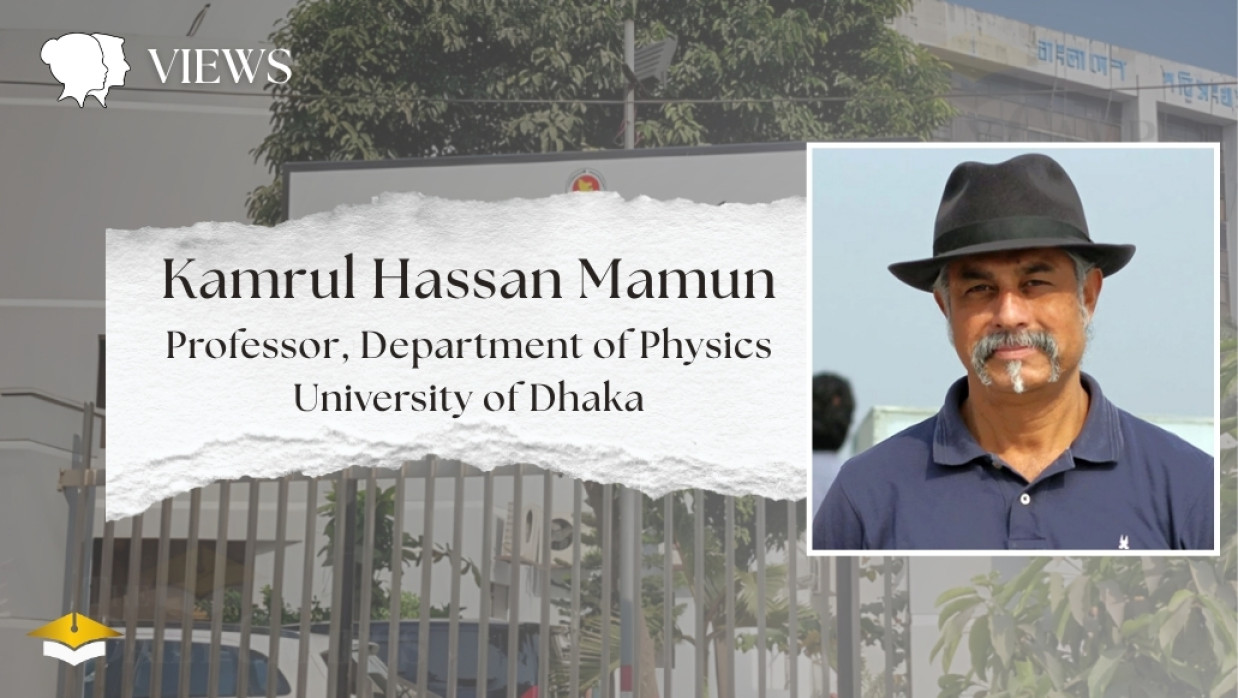
Author: Dr Kamrul Hassan Mamun is professor in the Department of Physics at Dhaka University. He can be reached at [email protected]
 Follow The Daily Campus on Google News