Bangladesh Ranks Lowest Globally in Duration of Free Education: UNESCO
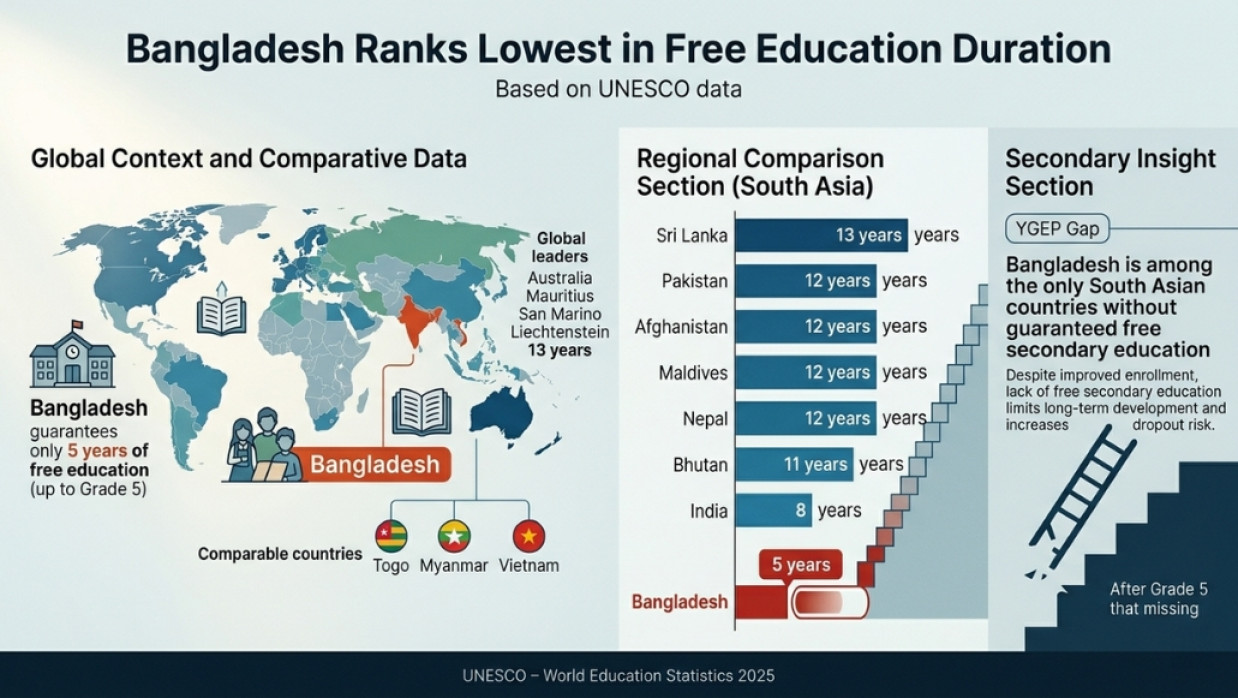
Bangladesh has been ranked at the bottom of the world regarding the duration of free primary and secondary education guaranteed within legal frameworks. According to the recently published "World Education Statistics 2025" report by UNESCO, Bangladesh provides only five years of free education, the lowest duration compared to global peers.
The report, prepared by the UNESCO Institute for Statistics and the Education Data and Statistics Commission, reveals a stark contrast between Bangladesh and other nations. While many countries guarantee free education up to the 13th grade, Bangladesh’s legal guarantee ends at the primary level (Grade 5).
Global and Regional Comparison
Bangladesh shares this bottom ranking with Togo in West Africa, and Myanmar and Vietnam in Southeast Asia. In contrast, countries like Australia, Mauritius, San Marino, and Liechtenstein offer 13 years of guaranteed free education.
The disparity is particularly notable within South Asia, where most of Bangladesh’s neighbors significantly outperform it in this metric:
| Country | Years of Free Education Guaranteed |
| Sri Lanka | 13 Years |
| Pakistan | 12 Years |
| Afghanistan | 12 Years |
| Maldives | 12 Years |
| Nepal | 12 Years |
| Bhutan | 11 Years |
| India | 8 Years (Up to Grade 8) |
| Bangladesh | 5 Years (Up to Grade 5) |
The "YGEP" Gap
According to the report’s Years of Guaranteed Education Program (YGEP) data, Bangladesh is the only country in South Asia, aside from India, where free education is not guaranteed at least through the secondary level. However, even India provides free education up to the eighth grade, three years more than Bangladesh.
Educationists suggest that while enrollment rates have improved, the lack of a legal guarantee for free secondary education remains a significant barrier to achieving long-term human capital development and reducing dropout rates after primary school.
The UNESCO report underscores the urgent need for policy reforms in Bangladesh to extend the legal framework for free education to align with global standards and neighboring regional benchmarks.
 Follow The Daily Campus on Google News