Exclusive Interview with The Daily Campus
Huge Challenges Ahead for the Government: MP Shahidul Islam Babul
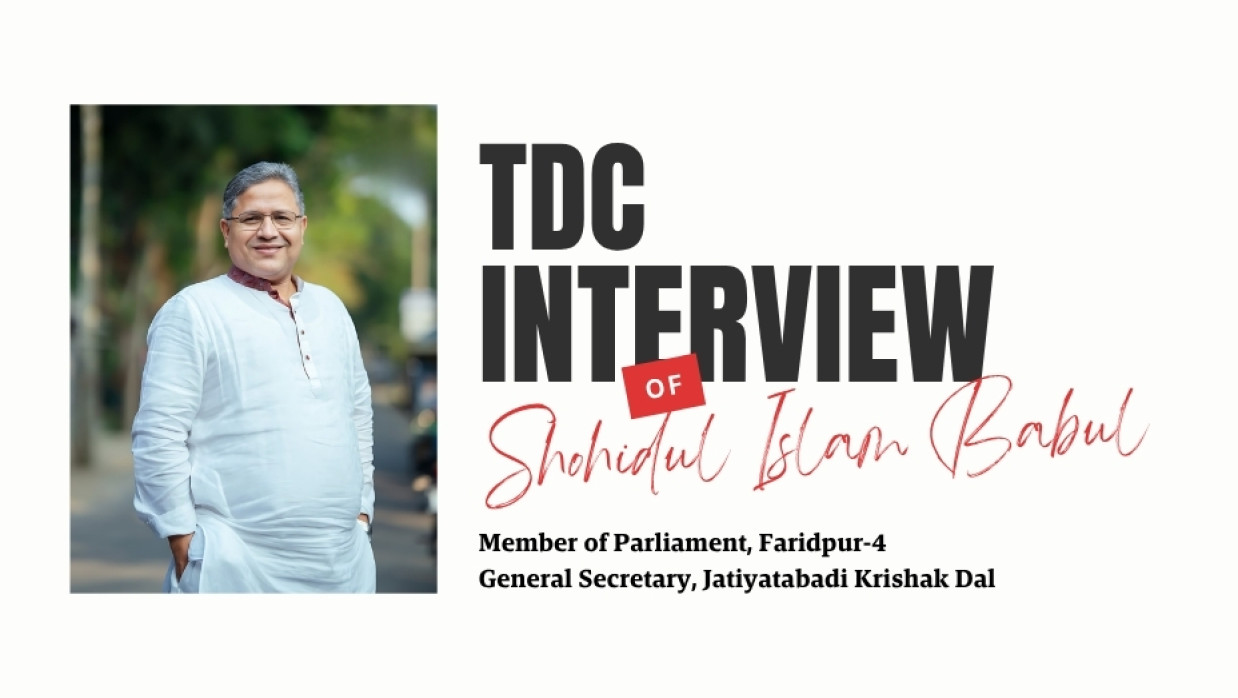
Shahidul Islam Babul has been elected as a member of the 13th National Parliament from Faridpur-4 (Bhanga-Sadarpur and Charbhadrasan), defeating his rival candidate by a margin of 53,000 votes. His main rival, Sarwar Hossain, the candidate from Jamaat-e-Islami (the largest opposition party in the previous parliament), received 75,805 votes. On the other hand, BNP-nominated candidate Md. Shahidul Islam received 1,27,443 votes and was elected.
Babul was the Senior Vice-President of the central committee of the Bangladesh Nationalist Students' Council (Jatiyatabadi Chhatra Dal), the main student wing of the BNP, during the historic political turning point of 'One-Eleven' in 2007. The President of that committee was Sultan Salahuddin Tuku (who has been elected from Tangail-5 (Sadar) in the 13th National Parliament and has been appointed as a State Minister in the current cabinet), and the General Secretary was elected as a Member of Parliament from Sirajganj-5 (Belkuchi-Chauhali).
Apart from being a member of the 13th National Parliament, Shahidul Islam Babul is also the General Secretary of the central committee of the Jatiyatabadi Krishak Dal, an important associate organization of the ruling BNP.
In an exclusive interview with The Daily Campus, Babul spoke about various issues, including the new government formed under the leadership of BNP Chairman Tarique Rahman, the cabinet, the government's promised Agricultural Card, the distribution of agricultural equipment across the country (especially fertilizer and fertilizer dealers), and rumors regarding the new committee of Chhatra Dal. The interview was conducted at Babul's residence on Central Road in the capital by The Daily Campus special representative Tareq Salman, staff reporter Sajjad Hossain, and multimedia reporter Sadia Akter.
As General Secretary of Krishak Dal, Shahidul Islam Babul expressed the view that the government, which has come to power after a fair election following a long gap of one and a half decades, faces enormous challenges.
He said, "There is a huge challenge before the government. The responsibility of fulfilling the expectations of a vast population has fallen on the government. We are a democratic government. But unfortunately, at this time, a Gulf War or war in the Gulf has started. We believe this will have a massive impact on the global economy, from which we will not be spared either. We are truly passing through a turbulent and unstable time."
He added, "Even in the midst of this, we have to take responsibility through a devastated reality — both globally and domestically. This government has to shoulder that responsibility."
Babul said, "There is a saying: 'Morning shows the day.' The ink marks on the voters' fingers have not even dried yet, but you have already seen how sincere the government is in implementing its promises. We have implemented the promised Family Card within just a few days of assuming power. Then, agricultural loans for farmers were waived. After that, imams, priests, and pastors of religious institutions have been brought under the allowance scheme. These works have already started. Next is the matter of the Agricultural Card."
He continued, "Moreover, the biggest issue is that the global oil market is unstable. So far, the government has not increased the price of oil even once. In almost every country in the world, oil prices are comparatively much higher than in Bangladesh. Yet the government has not increased the price of oil by even a single paisa. Every day, the government has to provide a huge amount of subsidy for this, which is putting massive pressure on the national treasury. Still, only a people-friendly and mass-friendly government can think about the common people in this way. Otherwise, the price of oil should have been increased at least three times by now — but it has not."
Babul told The Daily Campus, "That is why I believe this government is the only government that is truly accountable to the people. That is why, from the Prime Minister downwards, everyone has adopted a policy of austerity in government spending to satisfy the people. We are doing that, and we are optimistic that if only this war stops, it will be even more positive for our economy and the country."
When asked whether he considers the decision not to increase oil prices as a major success of the government, Babul replied, "I don’t know if it’s a success or not, but the government has taken this effort so that people do not suffer and no extra pressure falls on them. Of course, the government has to compensate for this in other ways."
Regarding the fact that five members from the central committee of Chhatra Dal led by Tuku-Alim have been elected to the 13th National Parliament, and when asked if he considers it a mere coincidence, Babul (who served as Senior Vice-President of that committee) said, "No, no. Thank you. You have been a direct witness, colleague, and partner in our long struggle. We (BNP) consider you as such. After a lot of blood, sacrifice, and struggle, the journey of a democratic government has begun today.
By the grace of Allah, we now have a sovereign parliament. I have been given the opportunity to serve as a member of that parliament. For this, I express my gratitude to Almighty Allah. I am also grateful to the people of my constituency who have given me unconditional support, loved me, and voted for me. I am grateful to my party, especially to the person who is the Prime Minister today and who was the Acting Chairman earlier. He has always shown me affection and kindness and gave me the party nomination. I am grateful to him for that."
Babul said, "Our election as Members of Parliament cannot be called a coincidence. You know everything about our committee. You are a bold and prominent journalist. It was almost 14-15 years ago. I was the Senior Vice-President in the last central committee of Chhatra Dal that I served in. Along with my President, Secretary, and a few others — about 6-7 of us from that committee — have come to this parliament. And everyone who has come here has proven their merit and capability.
They have come here through their contributions. If you look at the background of these leaders, you will see that each of them has been involved in jail, repression, cases, attacks, persecution, and a long process of movement and struggle. They have played their role for the people in their respective areas. That is why the party has evaluated them, and the people of their areas have voted for them and sent them to parliament. I do not consider this a coincidence. This has happened through a continuous and natural process."
Question: You got the opportunity and the party nomination. But many of your devoted and persecuted comrades were expelled from the party for the 'crime' of contesting as independents after not getting party support. Yet they also endured jail, torture, attacks, and cases to restore democracy in the country. What is your opinion about them?
In reply, this new MP said, "Yes, those who have been expelled also have many contributions — that is true. But sometimes the party has to consider the overall environment, situation, context, and reality while giving nominations. In such cases, the party sometimes remains helpless or in an underdog position. However, if they accept the party's decision, the party could certainly honor them through some other process.
I believe that. Everyone should obey the party's decision. If someone does not follow party discipline, the party has no choice but to take action. Sometimes the party is forced to take harsh and cruel decisions unwillingly for the sake of party discipline. The party has done what it had to do. However, if they express regret, considering their past contributions, the party may certainly consider them and honor them in different ways."
He added, "Regarding party nominations, I would say that the party actually takes decisions after evaluating the sacrifices, contributions, and merits of many people. Our Acting Chairman took extremely farsighted and realistic decisions. Many might have thought that so-and-so would get the nomination. But the party nominated those whom it considered worthy. We should all respect this decision of the party. Those who defied the party's decision and became rebel candidates or worked against it — the party has taken strict organizational action against them. This was necessary. Because without discipline in politics, the party suffers."
Question: If the expelled leaders apologize or want to return to the party, will you support them?
Babul replied, "This is not my personal statement. I am not the party. The party is an institution. The party is made up of all of us together. No one takes decisions individually. BNP is a large political party. They (the expelled) made a mistake, and the party needed to set an example. The party has done that. Now, how the party will consider their applications in the future will be a collective decision, and time will also be needed. I believe that if they realize their mistake, apologize, and show remorse, the party may consider it."
"However, I believe that those who have realized their mistake and want to return to the party by seeking forgiveness — the party will certainly consider their case. Because forgiveness is a noble virtue, and the party also wants everyone to work together in unity. But for this, there needs to be a process, and as you know, time is also required."
About his own constituency (Bhanga-Sadarpur-Charbhadrasan), the MP said, "As you know, I did not get the nomination in my original area, which is also my birthplace. I was given the nomination in a neighboring different constituency by the Chairman. At that time, I was upset — that is true. But later I realized that my Chairman had taken an extremely clever and skillful decision. Since two candidates from the same area were there, the party perhaps wanted both of us in different ways.
I went there as a new face. Although it is not very far — it is right next to my area, starting from the adjacent union. I went there completely empty-handed. The people supported me overwhelmingly. They gave me with both hands. They loved me with open hearts. That is why I was elected by a huge margin — more than 53,000 votes. This is a record. There are three upazilas in my area, 25 unions, and one municipality. In the middle, there are two rivers — the Padma and the Arial Khan. It is a vast area, 76 kilometers in length and about 68 kilometers in width, touching the boundaries of several districts. It is such a difficult constituency for a new person to contest in.
However, I got some time because my party had sent me there in advance. So I worked day and night with inhuman effort to win the love of the people. I tried to go to them, to gain their trust — and they accepted me as their own son. Now, all my plans, thoughts, love, and focus are centered on this area. Because they have given me a huge trust in the form of votes — a record number of votes.
That is why I want to dedicate my entire existence, my dreams, my efforts, and my love to Faridpur-4 (Bhanga-Sadarpur-Charbhadrasan). I want to stay with their joys and sorrows, happiness and tears, for the rest of my life. Even after the election, I am working accordingly. I am visiting every area and working with the people."
"I know an MP cannot do everything at once. It is not a matter of pressing a switch. But previously, development in this rural area has not been satisfactory. There is unemployment, there is distress, there is deprivation of women, and there is a severe and widespread problem of drugs.
I am working on all these issues in this large constituency. Actually, before 2008, this was two separate constituencies that were later merged into one. Still, I am trying to fulfill the expectations of the people. It is a third-world poor country, and a war has started again.
People have huge aspirations and expectations. Within our limited capacity, I am trying to coordinate. I have spoken to the Honorable Prime Minister. I have also met the Local Government Minister and the LGRD Secretary. They have assured me and are helping me. They have promised all-out cooperation to fulfill the commitments I made to the people of my area. Inshallah, I am optimistic."
He further said, "Actually, we fought movements and struggles to establish the rights of the people. Our main goal was to have a free and fair election in the country so that people could exercise their voting rights. People have got that opportunity and have spontaneously gone to the polling centers to vote. I thank all the voters for that. Especially the people of my constituency who elected me with a massive vote, gave me the love of their hearts, and unconditional support.
I remain eternally grateful to them. I have many dreams for my constituency. It is a huge area with many problems — river erosion, unemployment, poor roads and communication, and the widespread spread of drugs. We have to work on all these. During the election campaign, I went door to door, listened to their sorrows and sufferings. The love and trust they have given me — I will try with all my ability to live up to that trust. I have not come with a magic wand to change everything overnight.
But I am optimistic. We have our government, and our Honorable Prime Minister is extremely sincere. I have spoken to the concerned ministers. They have assured me. If we all work together with honesty and dedication, we will definitely be able to change the fate of the people of this area. I want to serve the people of this area until my last breath."
Question: You are a leader who rose from the Bangladesh Nationalist Students' Council (Chhatra Dal). Today you have come to the National Parliament and have also become the General Secretary of Krishak Dal. However, there is criticism that your student organization, Chhatra Dal — one of the major associate organizations of BNP — has failed to play its due role according to its previous tradition, both during the fall of the fascist Hasina government and afterwards. As a former Chhatra Dal leader, what is your comment on this?
Shahidul Islam Babul said, "Look, I still consider myself a member of Chhatra Dal. You have seen us very closely in student politics. I believe — once Chhatra Dal, always Chhatra Dal. Many may think that the current Chhatra Dal has not been able to play a role in politics like before.
But you have seen that during the previous fascist regime, we were not even allowed to do peaceful politics. The country was run by the single decision of autocratic Hasina. Yet the leaders and activists of Chhatra Dal were in the field. They played their role, as much as possible, in the restoration of democracy. They were victims of attacks, cases, persecution, enforced disappearance, murder, jail, and torture. They remained on the streets for years after years to bring the country back to the path of democracy. So I do not think Chhatra Dal has failed."
He added, "The current committee of Chhatra Dal has expired its tenure. I believe — although the decision will be taken by our Chairman — he knows who is worthy of leading Chhatra Dal, who is acceptable to the general students in all educational institutions of the country, who has leadership qualities, and above all, who is devoted and persecuted. I believe new leadership will emerge from among them."
When asked whether he wants the new leadership of Chhatra Dal to come from actual students (those who still have student status), like other student organizations, the former leader said, "Look, Chhatra Dal is a large organization. To lead this organization, having student status is not the only main thing. Experience is also needed to lead an organization like Chhatra Dal. Moreover, look — how many top leaders of any student organization actually have current student status?
Does the top leadership of Islami Chhatra Shibir (the secret student wing of Jamaat) have student status? No. The same is true for others. Leadership in Chhatra Dal should come in the light of experience. However, if leadership comes from those who still have student status, it is better for the organization. Because such leadership remains in 'touch' with the general students, can understand their mindset, and can take organizational steps accordingly."
When asked about Chhatra Dal’s poor performance (heavy defeat) in student union elections at Dhaka University and other public universities, Babul said, "Chhatra Dal could not even carry out its own politics on any campus. They could not stay in the halls, could not stay in the educational institutions, and could not mix with the general students. You have seen all this from very close. The reason other organizations (like Shibir) did well is because they were with the fascists.
They were their collaborators and worked secretly. They could stay in the halls and mix with general students. So the general students could not find Chhatra Dal near them. They found those secret operators. They thought these people were with them and beside them in the past, participated in various social activities — so they voted for them. That is why the secret groups won. I believe Chhatra Dal will rise from this. In the future, Chhatra Dal will become acceptable to the general students in all educational institutions of the country."
Regarding the new cabinet giving preference to 'loyal' and relatively younger people over senior leaders, Shahidul Islam Babul said, "Our Chairman has been looking after the party for a long time. This party... for 17 years, every kind of conspiracy was made to destroy it completely and break it into pieces. Even before that.
But our Chairman has faced all these issues with great skill and intelligence. He has kept BNP united and intact. He knows everything about this party from top to bottom. No one has given more time than him. That is why, in forming the new cabinet, he has surely thought of combining young, senior, and experienced people, including academicians. I believe he has formed an excellent cabinet overall."
He said, "This is not the final word. If necessary, he can expand it or make changes according to performance and time. We believe the people of the country are becoming optimistic about the activities and the journey of the government. Many people-oriented programs that were promised during the election have already started, and people are gaining confidence. The Prime Minister and the cabinet members, including MPs, are being repeatedly cautioned.
They are being told that we do not want any kind of rule like the previous era. Since the people have voted, this government elected by the people's vote must work day and night to fulfill public aspirations — and that is exactly how the work has started. The politics of plunder, murder, and coercion that happened in the past will not return to Bangladesh. We expect this, and the way the Prime Minister has started... like the lines of a train — the front line goes and the back line follows the same path. I hope that even if this government cannot fulfill 100% of the people's expectations, it will be able to fulfill a huge portion of them."
Regarding the exclusion of some senior leaders, Babul further said, "No, perception is one thing, practical reality is another. Whoever becomes Prime Minister has to consider various national and international contexts and realities. He has done so after careful thought. Yes, as you said, some seniors have been left out. That is true. He probably has plans for everyone. Everyone has contributions. Surely he can engage each of them in different party work or may have different plans for them. I believe everyone will be honored and evaluated according to their merit and capability in due course."
When asked what steps he would take or what he would urge the government to do for the welfare of farmers as General Secretary of Krishak Dal, Babul said, "My thinking is for my organization. The government is one thing, the organization is another. By the grace of Allah, this large farmers' organization has now expanded much more than before. We have done that. This is an organizational matter. My point is that nothing can happen in Bangladesh without the farmers.
Whether you talk about garments or remittances — if the agriculture sector of Bangladesh does not exist, everything will collapse. A large part of our economy — still more than 50% or 60% of our GDP — depends on agriculture. Yet these farmers are often neglected and ignored. It is said that if the farmer survives, the country survives. But in reality, farmers have to endure neglect and oppression. Truly farmer-friendly governments have rarely come to power."
He said, "I thank the Honorable Prime Minister. As soon as he came to power, in the first cabinet meeting, he waived 15,500 crore taka in agricultural loans for 1.2 million farmers of Bangladesh. And the Agricultural Card for farmers will be inaugurated this month... in April. Whatever needs to be done from the government's side to change the fate of Bangladesh's farmers will be done. Our job is to work with the farmers' organization — to build the organization, to make farmers conscious, to organize them around their rights, and to raise voices collectively for their demands.
Just like workers have trade unions — they can strike, protest, call hartals, and realize their demands. But farmers cannot do that. Farmers cannot call hartals or strikes. They die slowly in silence. A farmer cannot treat his old father, cannot send his children to good schools. Every year he has to sell land to run his family. This is a pathetic reality. Our job in the farmers' organization is to make them aware of this reality and their rights, to organize them, and to remain vocal about their rights."
When asked who will get the government's promised Farmers' Card, Babul said, "The Farmers' Card is for real farmers of Bangladesh. Every genuine farmer will have a card. The card will contain a database of how much land the farmer owns. Union Agriculture Officers and their colleagues have already started working. More manpower will be recruited if needed. It will show how much land each farmer owns — who is a marginal farmer, who is a medium farmer, and who is a rich farmer.
Sometimes a farmer with very little land loses everything and becomes destitute. The government is thinking about how to provide some support to them. There are also plans regarding which crops farmers produce, especially those that put pressure on our foreign currency (imports). For example, soybean. If soybean production increases in Bangladesh, the pressure on imports will decrease. There are vast char (riverine) areas in Bangladesh. How to encourage farmers to cultivate soybean there. Also, ensuring that farmers can sell their produce at fair prices, and can buy agricultural inputs at fair prices. The government has such thoughts."
When asked what kind of assistance farmers will receive through the Farmers' Card, the General Secretary of Krishak Dal said, "For farmers with less land, the government has plans to provide some incentives to keep them in farming — incentives or support for the cost of producing one crop out of three. The idea is to give production cost support to marginal farmers in phases. Besides, the card will help farmers get respect and dignity when they go to government offices. The government and we are working with this in mind."
He added, "Basically, incentives are already given to farmers to some extent. The card will ensure that the real farmers receive those incentives directly. Another aspect is that there is no other easy way to give cash directly. For those who need it — especially marginal farmers — the government is thinking of providing production cost support for one crop out of three in phases."
The Daily Campus: Thank you...
Shahidul Islam Babul: I also extend my sincere thanks from my side to The Daily Campus — a very popular and widely accepted online portal in all circles.
 Follow The Daily Campus on Google News