At the Bottom of the Class
How Bangladesh’s Teachers Are the Least Qualified in South Asia
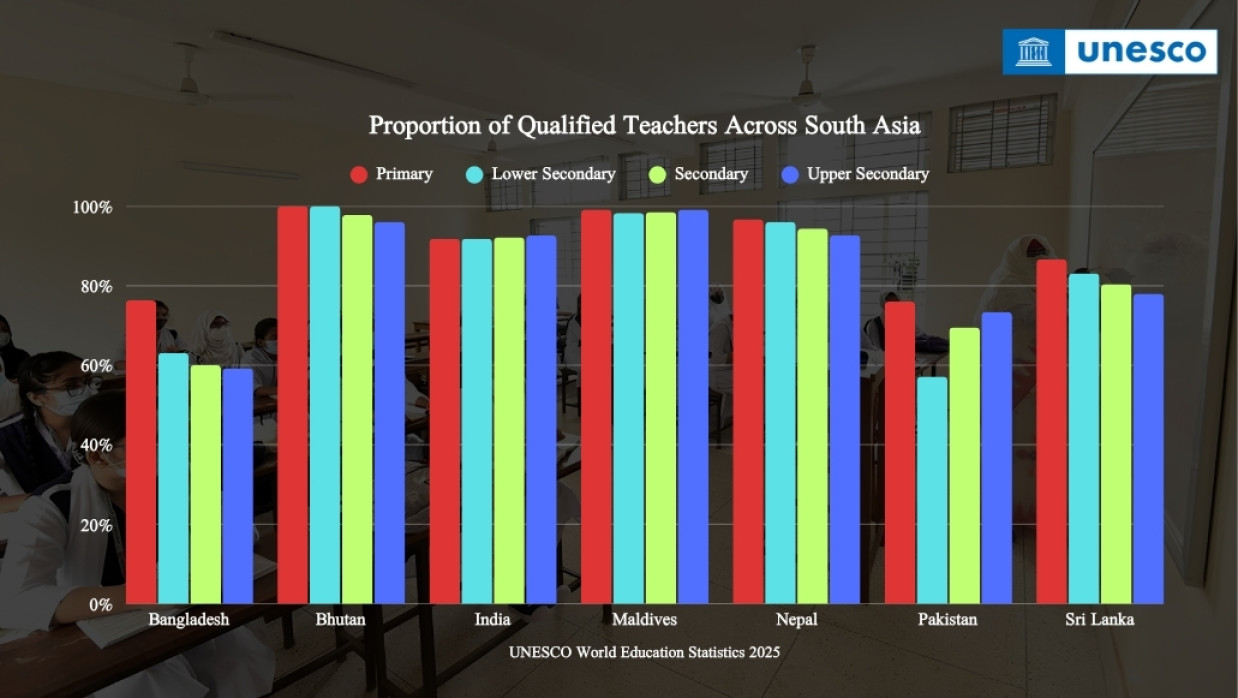
Walk into a secondary school in Dhaka, Sylhet, or Rajshahi and the odds are roughly one in three that your child's teacher does not meet the government's own minimum qualification threshold. Walk into a comparable school in neighbouring India or Nepal, and that risk falls to less than one in ten. The gap is not marginal. It is, by any serious measure, a crisis that has persisted — largely unremarked — across the better part of a decade.
World Education Statistics 2025 report compiled by the UNESCO Institute for Statistics (UIS), covering the period from 2015 to 2025, places Bangladesh at or near the foot of the South Asian table at every level of schooling. Whether one examines primary education, lower secondary, secondary, or upper secondary, the story remains the same: Bangladesh trails its neighbours by a margin that should alarm policymakers and parents alike.
A Region That Has Moved On — Without Bangladesh
Consider the most recent period for which regional data is available — roughly 2022 to 2024. In India, more than nine in ten teachers at every level of schooling hold the minimum required qualifications. Nepal, despite its far more limited resource base, maintains rates above 92 per cent from primary all the way up to upper secondary. Bhutan, a country with a fraction of Bangladesh's population, has effectively achieved full qualification across its teaching workforce, reporting a perfect hundred per cent at the primary and lower secondary levels.
Bangladesh, by contrast, recorded a 2022–24 average of just 59.2 per cent of upper secondary teachers meeting minimum qualifications — meaning that in a country of 170 million people, approaching four in ten teachers at the college level (highest tier of school education) are operating without the baseline credentials their own government requires of them. At the primary level the picture is marginally better, at 76.3 per cent, but even this figure leaves a substantial share of the youngest learners in the hands of under-qualified instructors.
Even Pakistan — a country whose education statistics are frequently cited as a cautionary tale across the region — surpasses Bangladesh at the upper secondary level, with a qualification rate of 73.4 per cent compared with Bangladesh's 59.2 per cent. The Maldives, despite a sharp and unexplained collapse in its primary teacher qualification rate in recent years, remains above Bangladesh in most secondary categories. Sri Lanka, which itself shows a mild downward trend over time, still manages rates well into the eighties at the primary level.
TABLE 1: REGIONAL COMPARISON

A Decade of Underperformance, Not a Passing Phase
One might argue that a single snapshot is unfair that recent improvements or data gaps skew the picture. The decade-long averages, however, tell a consistent story. Between 2015 and 2024, the average share of qualified teachers in Bangladesh across all levels hovered between 60 and 63 per cent. India's decade average, by comparison, sits between 83 and 86 per cent depending on the level and is rising. Nepal's decade average exceeds 86 per cent even at the levels where it is weakest. Bhutan has maintained near-perfect rates throughout.
This is not, in other words, a blip caused by a difficult year or a quirk of measurement. It is a structural feature of Bangladesh's education system one that has shown only modest and inconsistent improvement across governments, policy cycles, and education sector plans.
The significance of teacher qualification rates extends well beyond bureaucratic compliance. Decades of research in education economics consistently find that teacher quality is among the most powerful determinants of student learning outcomes. A teacher who does not meet the minimum qualification threshold is, by definition, one who has not been assessed as possessing the foundational knowledge and pedagogical training the state itself considers essential.
For Bangladesh a country that has made considerable gains in school enrolment and gender parity the persistent shortfall in teacher qualifications represents a structural ceiling on quality. Children are in school. But what happens once they are there, and who stands in front of them, may determine whether those enrolment gains translate into genuine learning.
The question of how Bangladesh closes this gap and how urgently it chooses to try is one that reaches into the heart of its development ambitions. The data, at least, is unambiguous about the scale of the challenge.
 Follow The Daily Campus on Google News