
From Hormuz to Dhaka: Bangladesh’s Supply Chain at Risk in the Gulf Crisis
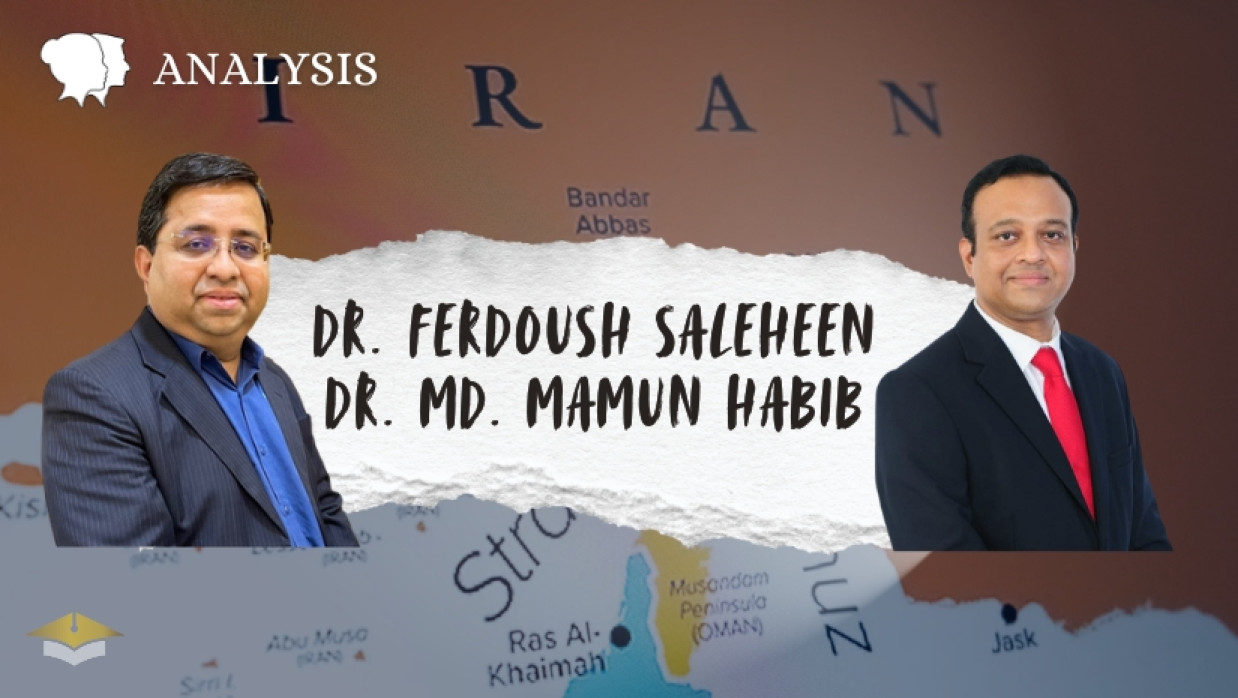
Uncertainty in the Gulf region is commonly viewed as geopolitical volatility or a distant hotspot, yet for Bangladesh, the repercussions are immediate and substantial. The national economy, particularly its energy security, trade logistics, and overseas income streams, is closely tied to the Gulf’s maritime routes and migrant labour. When tensions escalate in the Middle East, Bangladesh encounters the effects through disrupted logistics networks, higher energy costs, and potential pressure on remittance inflows.
The Strait of Hormuz, one of the world’s most critical maritime gateways, is at the heart of this vulnerability. The Strait transports 18–19 million barrels of oil daily, representing about 20 percent of global petroleum consumption. Oil is shipped by Gulf energy producers from this strategic passage to markets in Asia, Europe, and other parts of the world. Bangladesh depends heavily on the same route to secure much of its imported fuel.
Energy Dependence: The First Shock
Bangladesh’s energy structure remains highly import-dependent. The country imports most of its petroleum products and a significant share of its liquefied natural gas (LNG) from Middle Eastern suppliers. More than 80 percent of Bangladesh’s crude oil imports, roughly 6 to 7 million tonnes annually originate from the Gulf region.
Any instability in the Hormuz Strait would directly impact the energy security of Bangladesh. Even without interruptions in cargo flow, geopolitical tensions often raise energy costs worldwide. Shipping routes might change, insurance premiums for vessels could rise, and energy markets may react strongly to perceived risks. Recently, Bangladesh faced this issue when the government had to buy emergency supplies of liquefied natural gas (LNG) from the spot market at prices about three times higher than the rates in the contract.
The energy industry is not the only one that will be affected by these kinds of hikes. Volatility in the price of fuel affects the entire economy. The cost of generating electricity goes up, transportation becomes expensive, and all industrial sectors that rely on imported fuel face higher production costs.
Energy disruptions also cascade into other sectors. For example, fertilizer factories in Bangladesh have previously reduced production during gas shortages in order to prioritize electricity generation. Such decisions demonstrate how energy instability can affect agriculture, manufacturing, and food supply chains simultaneously.
Logistics Networks and Export Vulnerability: Second Shock
The logistical networks that are serving the country’s export sector are the source of the second layer of vulnerability. It is estimated that Bangladesh's ready-made garments (RMG) sector generated more than $47 billion in export revenues during the fiscal year 2023–24, making it the second-largest exporter of RMG in the world. Given the fact that apparel exports represent roughly 84 percent of the national exports of the country, this sector remains the highest contributor to the country’s export basket.
Still, the growth of Bangladesh's exports is strongly dependent on the availability of reliable and seamless shipping and aviation cargo networks that connect South Asia to markets in Europe and North America at large. A significant number of these logistics routes depend on marine corridors and aviation hubs in the Gulf.
Air cargo operations connecting South Asia to Western markets often pass through Dubai, Doha, and Abu Dhabi, which serve as major international logistics centres. When geopolitical tensions force airlines to reroute flights or temporarily suspend operations in certain corridors, cargo delivery times increase and freight costs rise.
Even a minor disruption in the shipping itinerary can cause significant repercussions in this sector which focuses on exporting and operates under strict time constraints. When it comes to sustaining relationships with suppliers, reliability is an extremely important factor to consider. Global retail customers often impose stringent fines for late delivery. As a result, disruptions in logistical networks have the potential to impair Bangladesh's export competitiveness, even if manufacturers continue to produce without interruption.
Remittances and the Demand Side: Third Shock
Bangladesh's exposure to the unstable situation in the Gulf region is compounded by the fact that the latter is closely linked with the issue of labour migration.
More than five million migrant labourers from Bangladesh are employed in the countries of the Gulf Cooperation Council (GCC), including Saudi Arabia, the United Arab Emirates, Qatar, Kuwait, and Oman. Through remittances, these labourers play a significant role in the economy of Bangladesh.
Bangladesh received over $32 billion in remittances in 2025. A significant portion of this comes from the Gulf countries. Remittances help in the improvement of foreign exchange reserves and provide stability in the balance of payments situation. However, geopolitical tensions can affect the labour market in the host countries. Economic slowdowns, reduced construction activities, and changes in migration policies can affect the jobs of migrant labour. A reduction in the level of remittances will have a direct impact on the purchasing power of the people and the rate of economic growth.
The Limits of Efficiency-Based Supply Chains
The combined exposure to energy, logistics, and remittance shocks shows a structural challenge in Bangladesh’s economic system. For decades, global supply chains, including those in Bangladesh, focused mainly on efficiency. Businesses reduced inventory, clustered suppliers in low-cost areas, and depended on stable trade routes. While this approach boosted competitiveness in stable times, recent global disruptions, from the COVID-19 pandemic to geopolitical conflicts, have demonstrated that efficiency on its own is not enough. Supply chains designed solely for cost-cutting often lack the flexibility needed to handle external shocks.
Bangladesh must therefore shift toward a more balanced approach that integrates efficiency with resilience.
Adopting Strategic Supply Chain Performance Attributes
Strengthening Bangladesh’s supply chain resilience requires attention to a set of strategic performance attributes that guide modern supply chain management.
Financial Health is the first requirement. Strong financial capacity enables governments and businesses to absorb temporary spikes in fuel prices, freight rates, and logistics costs. Adequate foreign exchange reserves and liquidity buffers are essential during periods of global volatility.
Collaboration is equally important. Cooperation among government agencies, port authorities, logistics businesses, and private enterprise is critical. Whenever there is a disruption in the supply chain, coordinated decision-making helps ensure that actions are taken quickly.
Velocity, or the speed at which logistics operations are carried out, is another important consideration. Ports that are efficient, customs procedures that are streamlined, and transportation networks that are reliable ensure that cargo continues to move even when there are delays on international routes.
Resilience requires diversification. Bangladesh must diversify its energy sources, develop alternative logistics routes, and reduce reliance on a single geographic corridor.
Reliability is essential for maintaining export competitiveness. Despite external uncertainties, global customers place a high value on suppliers who are able to supply products on a continuous basis.
Continuous Improvement enables supply chains to learn from crises. Each disruption provides lessons that can strengthen future policies and operational strategies.
Visibility is increasingly important in modern logistics systems. Digital tracking technologies and real-time data monitoring allow businesses and governments to detect risks early and respond more effectively.
Workplace Health also plays an important role. Logistics workers, port operators, and transportation personnel form the backbone of supply chain operations, and their safety and productivity are essential during crises.
Sustainability offers long-term protection against energy volatility. Investments in renewable energy and energy-efficient infrastructure can reduce dependence on imported fossil fuels.
Service Excellence ensures that Bangladesh’s exporters maintain strong relationships with international buyers through consistent delivery performance and high service quality.
Building Resilient Supply Chains for Bangladesh
The regional instability in the Strait of Hormuz demonstrates that the country’s economy is deeply integrated into the global trade networks. Bangladesh is nevertheless exposed to geopolitical tensions that emerge outside of its borders. It depends significantly on Gulf energy supply and receives more than $32 billion in remittances and more than $47 billion in garment exports.
But these difficulties also give us an opportunity. The country can turn its vulnerabilities into strengths by enhancing its supply chains to become more resilient through financial preparedness, upgrading its logistics system, enhancing digital visibility, and exploring diversified energy sources from multiple countries.
In a world that is increasingly uncertain, a country's competitiveness will depend not only on how much it can produce or how much it pays its workers, but also on how strong and flexible its supply chains are. The route from Hormuz to Dhaka teaches Bangladesh an important lesson: supply chain strategy is no longer simply about operations; it is also a key part of economic security.
Disclaimer: The views expressed in the following op-ed are those of the author, Prof. Dr. Md. Aktaruzzaman, and do not necessarily reflect the position or editorial stance of The Daily Campus. This piece has been shared from the author’s public Facebook post and is reproduced here for informational purposes only. The Daily Campus has no involvement in its authorship, content, or publication.
Author Profile
Dr Ferdoush Saleheen, Head of the Department of Maritime Logistics and Supply Chain Management at Sharjah Maritime Academy, UAE. [email protected].
Dr Md Mamun Habib is a Professor and Head of the Department of Management at the School of Business and Entrepreneurship (SBE), Independent University, Bangladesh [email protected].
 Follow The Daily Campus on Google News