Thousands in 12 Districts Across Bangladesh Celebrate Eid-ul-Adha Today
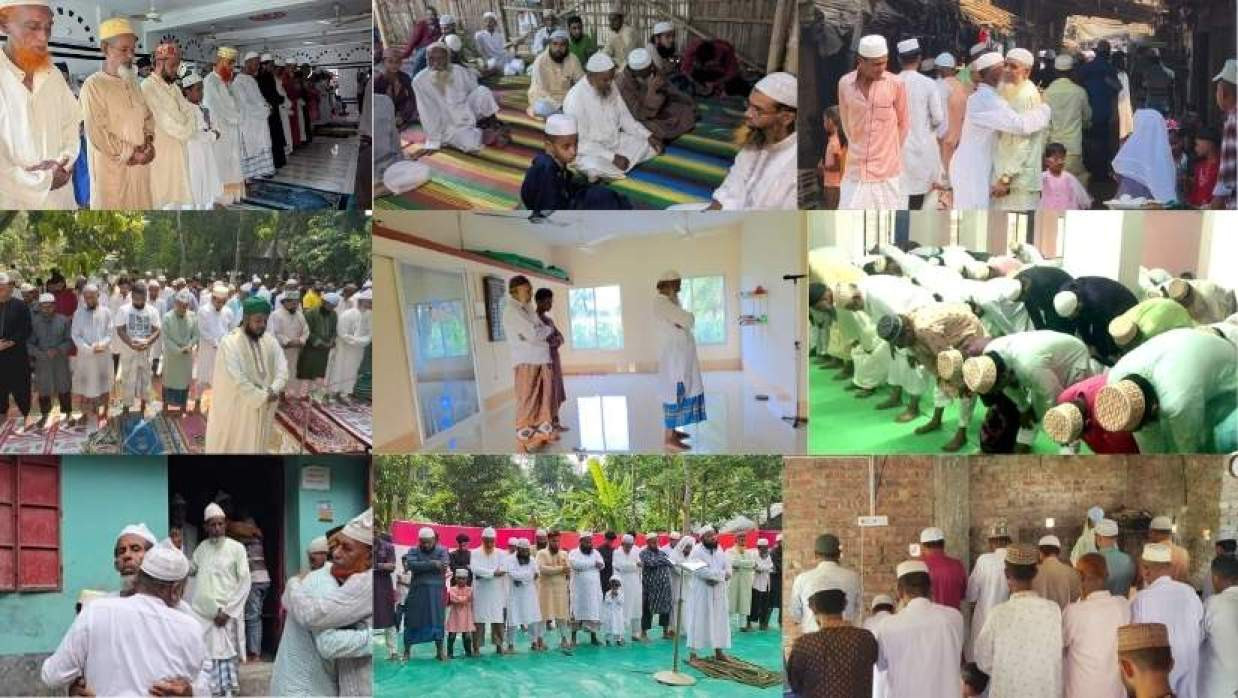
Thousands of Muslims in at least 12 districts across Bangladesh celebrated Eid-ul-Adha today, Wednesday, aligned with the timing of the pilgrimage and celebrations in Saudi Arabia and the broader Middle East. Faithful in various pockets of Chandpur, Laxmipur, Faridpur, Jhenaidah, Barguna, Satkhira, Rajshahi, Jhalakathi, Patuakhali, Bhola, Noakhali, and Cox’s Bazar performed their
Eid prayers and executed ritualistic cattle sacrifices one day ahead of the state-scheduled national celebration. The early celebrations, rooted in historical allegiance to specific Sufi orders, the Qadiriyyah tariqa, and the global sighting of the moon, took place seamlessly, with congregations defying inclement weather and rain in multiple locations.

The practice spans decades, and in some areas generations, with local religious leaders advocating for a unified global Islamic calendar rather than relying on localized horizon sightings. In Chandpur, over 50 villages across Hajiganj, Faridganj, Matlab, and Kachua celebrated the festival, with the earliest congregations held at the Sadra Darbar Sharif, which initiated this tradition in 1928.
Similarly, around 35 villages in Patuakhali, centered around the Badarpur Darbar Sharif, marked their 100th year of following this convention, while 16 villages in Barguna adhering to the Qadiriyyah Chishtia order cited a 150-year-old regional legacy.

In Laxmipur, eleven villages following the teachings of Maulana Ishak (Rh) gathered for early morning prayers, and 10 villages in Faridpur’s Boalmari aligned their festivities with the Mirzakhil Sharif of Chattogram. Meanwhile, more than 20 villages in Satkhira performed congregation prayers at Kushkhali Baukola, while over 50 families in Jhalakathi’s Rajapur held integrated, gender-segregated prayers at the Darus Sunnah Jamia Mosque.

In Rajshahi's Puthia upazila, the early celebration saw a minimal turnout at the Krishnapur Muslim Jamia Mosque, where a congregation of only five devotees performed the rituals. Explaining the stance, Imam Rahim Gazi explained that their celebrations are based on global lunar trajectories rather than strict regional alignment. He argued that the moon rises for the entire planet simultaneously, and scientific or geographical variations should not dictate artificial divisions in observing major Islamic events.

In sharp contrast to the festivities elsewhere, the atmosphere across the Rohingya refugee camps in Cox's Bazar remained deeply somber. Severe rollbacks in international funding and domestic food aid have left the displaced population largely incapable of purchasing sacrificial cattle. For the vast majority of refugee households, securing even a basic portion of meat for the holiday has become an unattainable luxury.
Aid workers operating within the humanitarian grid noted that the reduction in nutritional support is triggering secondary crises across the camps. The visible lack of festive capability has compounded psychological distress, with field monitors reporting sharp increases in childhood malnutrition, acute family stress, and systemic despair throughout the sheltered blocks.
 Follow The Daily Campus on Google News