Banning Second-Time University Admission Tests May Ignore Students' Interests and Abilities

For many students competing for admission into higher education, a single failure completely shatters their dream of studying at their desired university. Thousands of admission seekers face this harsh reality every year due to the absence of a second-time admission test opportunity at several top-tier universities in the country.
Conversely, a good number of public universities allow the 'second-time' option under specific conditions. Consequently, questions have arisen over such discrimination in admission policies among public universities of the same nation, prompting many to ask whether there should be a uniform policy for higher education admissions.
Universities without 'Second-Time' option
A second chance at admission tests is unavailable at several top higher education institutions. These institutions include Dhaka University, Jagannath University, Bangladesh University of Engineering and Technology (BUET), Rajshahi University of Engineering and Technology (RUET), Chittagong University of Engineering and Technology (CUET), Khulna University of Engineering and Technology (KUET), and Bangladesh University of Textiles (BUTEX).
On the other hand, the opportunity to sit for the examination a second time is available at Chittagong University, Rajshahi University, Jahangirnagar University, Shahjalal University of Science and Technology, Khulna University, Comilla University, Hajee Mohammad Danesh Science and Technology University, Bangladesh University of Professionals (BUP), Bangabandhu Sheikh Mujibur Rahman Maritime University, Bangabandhu Sheikh Mujibur Rahman Aviation and Aerospace University, 19 universities under the general cluster system, and universities under the agricultural cluster system.
However, the same rules do not apply to everyone across these institutions. At Chittagong University, 3 marks are deducted from the total score of second-time examinees. Similarly, 3 marks are deducted for second-time candidates in government medical and dental college admission tests.
Students deprived, merit-skill-eligibility ignored
Meanwhile, students have expressed deep frustration over the lack of a 'second-time' option or the opportunity to take admission tests twice at several public universities. According to them, university admission tests take place shortly after the Higher Secondary Certificate (HSC) examinations, often before they can fully comprehend the situation, leaving little room to perform well.
Furthermore, maintaining expected preparations during the first attempt becomes difficult due to various familial, mental, or financial reasons. Yet, despite preparing better the following year, they lose the opportunity to sit for the admission test at their preferred university solely due to policy constraints. As a result, many students are deprived of their dream of getting into their desired university despite possessing interest, merit, and capability.
Abdullah Al Masum, a student who missed out on a seat after appearing for the Dhaka University admission test in the 2023-24 academic session, said, "A single poor result or a bad exam does not mean the end of a student's potential. Had there been a second chance, I might have had the opportunity to prove myself." Out of compulsion, Masum is currently studying at a private university.
"The opportunity to enter higher education should not be confined to a specific batch. Due to various familial, financial, physical, or mental reasons, a student might not be able to get admitted immediately after passing the HSC. If they can prove their capability later through proper preparation, there is no justification for depriving them of that opportunity. A university is not an age-based institution like a school; students of various ages and experiences study here. Therefore, the avenue to enter higher education should be more open." — Professor Mujibur Rahman, Teacher, Dhaka University
Demands of the students
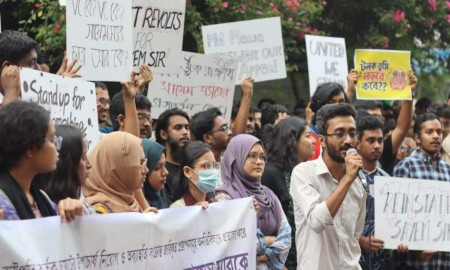
Admission seekers launch movements every year demanding the reinstatement of the second-time admission test opportunity. They regularly campaign through human chains, submission of memoranda, press conferences, and social media platforms. They complain that if they fail to secure their desired result once, they lose the scope to sit for exams at many universities altogether.
Consequently, they do not get a chance to get admitted into those universities even after waiting for an entire year. In their view, many cannot perform well on their first attempt due to illness, mental pressure, or lack of adequate preparation, but the absence of a second chance leaves them with no way to prove their qualifications.
Tasnim Fariha, an admission seeker targeting Dhaka University, said, "I missed out by a very narrow margin on my first attempt. I had the mindset to prepare again, but many universities do not offer a second chance to take the test. It seems as if a single exam determines the entire future. If there were a second-time option, the competition would be much fairer."
Safin Hasan, an aspirant looking to get into an engineering university, said, "It is disheartening not to be able to sit for the exam despite working hard for a year, just because of a batch-based rule. We want equal opportunities to be ensured across all public universities."
Why some universities disallow the option
The universities concerned point out a few reasons behind not keeping the second-time admission test option. According to them, this policy is followed to ensure a level playing field for first-time examinees, mitigate the risk of admission fraud, and avoid administrative complexities such as seats falling vacant after the conclusion of the admission process.
University authorities argue that if a student gets admitted somewhere and then switches to another university the following year, a seat falls vacant at the previous institution. This complicates the entire admission process. Moreover, if the opportunity to take the test multiple times remains open, the competition becomes tougher for fresh candidates.
Regarding the return of the second-time option at Dhaka University, Vice-Chancellor Professor Dr. A. S. M. Maksud Kamal stated in an interview with The Daily Campus, "This is not my standalone decision. This is a major decision for the university. Those who stopped it previously must have done so for a reason, and that needs to be looked into.
When this decision was made, I myself was facing various adverse environments within the university." He further added, "Different bodies of the university work with the admission test; I will now discuss the matter with those bodies. I will see if it can be brought back in some way, but it is not possible to give a decision right away. This is a massive decision."
How the second-time option was phased out
Over the last decade, policy changes regarding the second-time admission test option have occurred multiple times across various public universities in the country. The opportunity was abolished in some places, while it was reinstated in others through student movements and administrative decisions.
Dhaka University abolished the second-time admission test option starting from the 2014–15 academic session. According to the university authorities, this policy was adopted to ensure a level playing field for first-time examinees. Following suit, Jagannath University made the same decision effective from the 2016–17 academic session, closing the second-time admission opportunity.
The second-time admission test option has long been absent at the Bangladesh University of Engineering and Technology (BUET), where it is considered an established part of the university's admission policy. Following the launch of the integrated engineering cluster admission test in the 2020–21 academic session, KUET, RUET, and CUET jointly adopted a new admission structure.
According to that decision, the second-time admission test opportunity was halted at these three universities as well. The administration explained that the decision was aimed at maintaining a uniform competitive environment for all candidates under the integrated system.
On the contrary, some universities have shifted their stances over time. Chittagong University abolished the second-time admission test option in the 2017–18 academic session. However, following prolonged student movements, demands, and administrative reviews, the opportunity was reintroduced five years later in the 2022–23 academic session.
Similarly, Rajshahi University stopped the second-time option in the 2016–17 academic session. Later, considering the impacts of the COVID-19 pandemic, student demands, and a re-evaluation of the admission policy, the second-time option was revived from the 2021–22 academic session.
At Jahangirnagar University, an initial proposal to abolish the second-time admission test option was raised in the Academic Council in 2022. However, following student feedback and policy reviews, it was ultimately decided to maintain the existing system.
"Many countries around the world, including India, China, and Japan, offer opportunities to sit for admission tests multiple times. Higher education opportunities in Bangladesh should also be designed in such a way that the result of a single exam does not dictate a student's entire future."
International scenario
While debates persist over the second-time admission test option across different universities in Bangladesh, a different picture is observed in the higher education policies of various countries globally. In most nations, the opportunity to try again after failing remains open in one way or another, albeit with differing structures and conditions.
In Japan, the higher education admission system comprises two types of exams: national and university-specific. A student can take the admission test multiple times. Many take one or more years to prepare, earning themselves the distinct identity of 'Ronin,' which is a recognized social reality within the country's education system.
The cornerstone of higher education admissions in China is the national entrance examination, 'Gaokao.' Students can participate in this exam every year. If they do not achieve their desired result, the opportunity to sit for the exam again the following year remains open, which is considered a normal and acceptable process there.
A similar structure exists in South Korea as well. The country’s national College Scholastic Ability Test (CSAT) is held annually. Students can take the exam multiple times as needed to secure a better score in the subsequent year.
In India, admissions into higher education are conducted through multiple national and university-specific examinations. Exams like JEE Main and JEE Advanced are used for engineering education, NEET for medical education, and CUET for central universities. Students can generally reappear for these exams the following year, provided they meet the specified eligibility criteria, though certain exams carry a fixed limit on attempts.
In Pakistan, most universities admit students through their own entrance exams or tests approved by the Higher Education Commission (HEC). There, students can generally reapply and sit for the admission tests the following year. Thus, even if they fail once, the opportunity to try again in the subsequent year remains open in most cases.
'Access to higher education should be more open'
Professor Mujibur Rahman from the Institute of Education and Research at Dhaka University believes that the opportunity to enter higher education should not be confined to any specific batch. In his words, a student might fail to get admitted immediately after passing the HSC due to various familial, financial, physical, or mental reasons.
If they can prove their eligibility later through proper preparation, there is no logic in depriving them of that opportunity. He stated that a university is not an age-based institution like a school; rather, students of different ages and experiences study here. Hence, the avenue to enter higher education needs to be more open.
While acknowledging the administrative limitations behind keeping the second-time option closed, he suggested alternative solutions. In his view, if a student is already admitted to a university, their opportunity to take the admission test at that same university a second time can be restricted. This would minimize the issue of seats falling vacant while still allowing qualified students a second chance to compete.
In the words of Mujibur Rahman, many countries around the world, including India, China, and Japan, provide opportunities to take admission tests multiple times. Higher education opportunities in Bangladesh should also be structured in such a manner that the result of a single exam does not seal a student's entire future.
 Follow The Daily Campus on Google News