Eid-ul-Adha Road Deaths Rise Nearly 4%, 402 Killed Nationwide: Jatri Kalyan Samity
Road accidents during the festive period of Eid-ul-Adha have recorded a 3.95 percent increase compared to the previous year, leaving 402 people dead and 1,294 others injured across the country. A comprehensive report compiled by the Road Accident Monitoring Cell of the Bangladesh Jatri Kalyan Samity (Passenger Welfare Association) revealed that a total of 394 road traffic accidents occurred during a 15-day period tracking the festival.
The report, which accounts for accidents from the beginning of the Eid journey on May 21 until the return of workers on June 4, also detailed casualties across other modes of transportation. During this time frame, 31 railway accidents resulted in 23 deaths and 30 injuries, while 17 maritime accidents claimed 13 lives and left 16 people injured. Across roads, railways, and waterways combined, a total of 442 accidents caused 438 fatalities and 1,340 injuries.
A Comparative Surge in Traffic Casualties
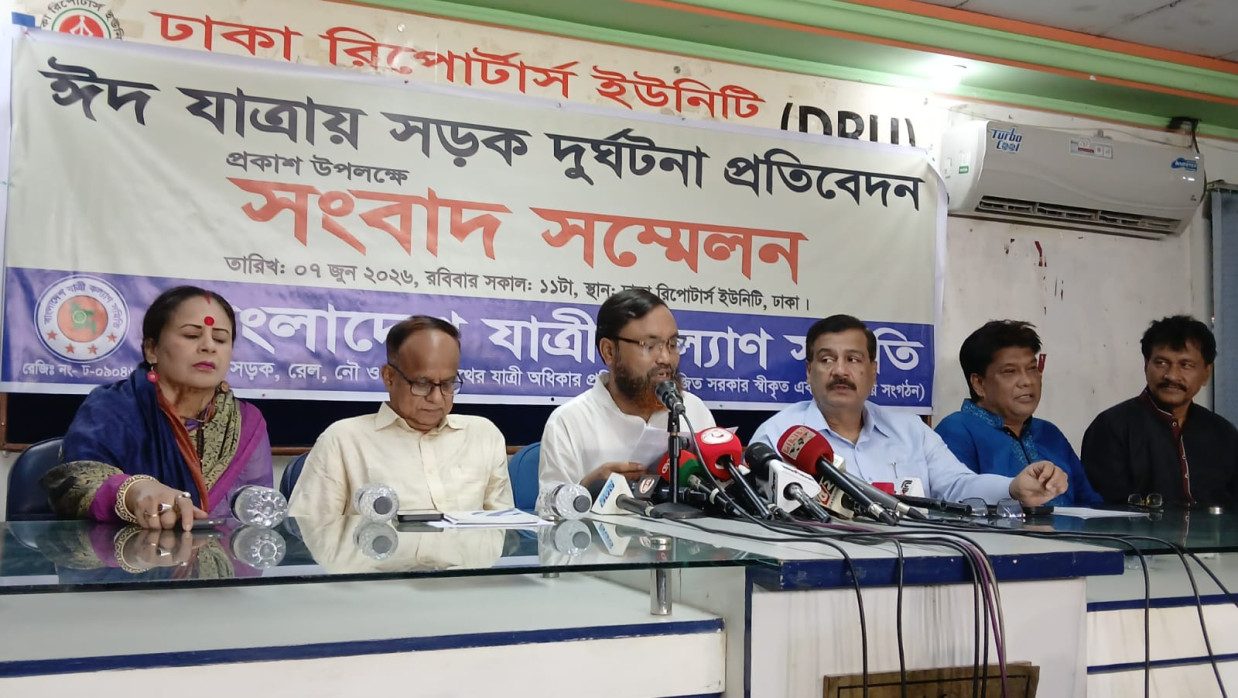
The statistics were presented by the Secretary General of the association, Md. Mozammel Hoque Chowdhury, during a press conference held at the Dhaka Reporters Unity (DRU) auditorium on Sunday morning. Comparative data indicates a visible degradation in road safety when aligned with the Eid-ul-Adha statistics of 2025, which saw 390 deaths and 1,182 injuries across 379 road accidents. Year-on-year, the number of road crashes rose by 3.95 percent, while fatalities and injuries ticked up by 3.07 percent and 9.47 percent respectively.
Motorcycles continued to top the casualty charts, accounting for 38.83 percent of the total road accidents. The association registered 153 motorcycle-related crashes that alone caused 159 deaths and 180 injuries. Among the identified victims of these various road accidents were 80 drivers, 89 transport workers, 59 pedestrians, 64 women, 45 children, 66 students, 5 law enforcement personnel, 3 teachers, 3 journalists, 1 physician, 1 engineer, and 4 political leaders.
An analysis of the vehicles involved showed that motorcycles made up 28.90 percent of the total, followed by trucks and covered vans at 21.40 percent, buses at 16.56 percent, battery-operated rickshaws at 12.34 percent, private cars and microbuses at 7.81 percent, locally made three-wheelers (Nasimon-Karimon) at 6.56 percent, and CNG-driven auto-rickshaws at 6.40 percent. Geographically, half of the catastrophes occurred on national highways.
| Accident Location | Percentage of Total Crashes |
| National Highways | 50.50% |
| Regional Highways | 30.71% |
| Feeder Roads | 14.46% |
| Dhaka Metropolitan Area | 2.53% |
| Chittagong Metropolitan Area | 0.25% |
| Railway Crossings | 1.52% |
In terms of the nature of these accidents, head-on collisions accounted for 46.44 percent, pedestrians being run over or hit by vehicles made up 29.18 percent, vehicles losing control and plunging into ditches accounted for 17.25 percent, train-vehicle collisions stood at 1.52 percent, and other unknown causes accounted for 5.58 percent.
Underlying Systemic Failures and Malpractices
The monitoring cell identified several prominent factors that consistently fueled the surge in holiday road accidents. Heavy pre-Eid rains left substantial potholes across vast segments of the highway network, a factor that triggered severe accidents for speeding motorcycles and destabilized larger transports. Furthermore, due to an acute shortage of commercial drivers during the holiday rush, approximately 80 percent of mass transits were operated continuously by a single driver without any rest or relief shifts.
The association also strongly criticized a segment of transport owners driven by excessive profit motives. Many operators pushed fitness-compromised, expired buses onto long-distance routes without fixing underlying mechanical issues. This aggressive rush to complete maximum "Eid trips" resulted in numerous passenger-laden buses losing control and veering off into roadside canals and ditches—a recurring sight during this year's travel season. Additionally, exorbitant fare hikes forced low-income travelers to risk their lives by commuting on the open roofs of buses and cargo trucks, which further spiked the casualty rates.
Other identified causes included the unrestricted movement of slow-moving three-wheelers on main highways, a lack of road signs, marking, and streetlights, blind spots caused by roadside overgrowth, extortion on roads, and driving on the wrong side of the road.
A Call for Structured, Long-Term Reforms
Addressing the press conference, Md. Mozammel Hoque Chowdhury emphasized that the government must move away from brief 10-to-12-day ad-hoc operations surrounding the holidays. Instead, the state needs to implement short, medium, and long-term blueprints to protect lives and reduce commuter suffering. He stressed that a radical overhaul of the public transport sector remains an urgent requirement, suggesting the formation of modern bus networks through public-private partnerships alongside technology-driven traffic management.
To curb the annual loss of lives, Jatri Kalyan Samity outlined a series of targeted recommendations:
-
Formulating and executing short, medium, and long-term transport strategies specifically for Eid travels.
-
Developing modern, centralized bus networks and technology-dependent traffic control systems.
-
Implementing rigorous, technology-backed training for drivers before issuing professional licenses.
-
Constructing dedicated service lanes and sidewalks alongside major national highways.
-
Executing structural reforms to eradicate institutionalized road extortion while securing fixed working hours and wages for drivers.
-
Modernizing vehicle fitness tracking systems and permanently removing expired public vehicles from operation.
-
Enhancing the institutional capacity of the Bangladesh Road Transport Authority (BRTA) and establishing specialized traffic training academies.
-
Breaking the monopolistic control exercised by bus owner associations and worker federations over the management of the transport sector.
The press briefing was attended by prominent figures, including former government secretary Dr. A.Y.M. Ekramul Hoque, the association's Vice President Md. Mohsin, Joint Secretary General Aparna Ray Das, Finance Secretary Mahmudul Hasan Russel, and Office Secretary Md. Alamgir Kabir Bitu, among others.
 Follow The Daily Campus on Google News