Tarique Rahman Announces Major Reform Blueprint and 5-Year Plan in Parliament, Vows Strict Accountability
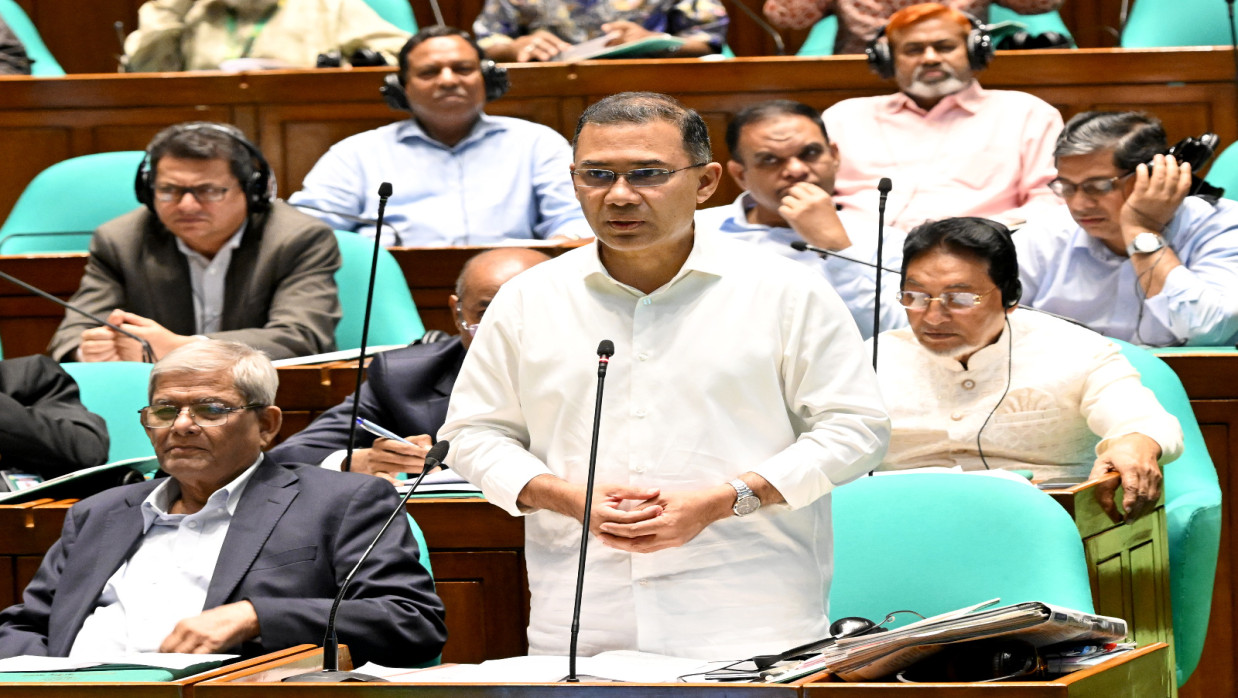
Prime Minister Tarique Rahman has placed the highest emphasis on ensuring efficiency, transparency, and structural accountability across all tiers of public administration. Delivering policy statements during the fourth day of the national budget session on Wednesday, the Prime Minister ordered field-level administrators to deploy rigorous preventive and punitive measures under a strict "zero-tolerance" policy against institutional corruption. The parliamentary session was chaired by Speaker Hafiz Uddin Ahmed Bir Vikram.
The Prime Minister shared the floor to address multiple parliamentary queries, detailing an extensive array of governance, investment, and social safety net reforms aimed at rebuilding the national economy.
Zero Tolerance Against Administrative Corruption
Responding to a structured query tabled by Member of Parliament Abul Kalam from the Cumilla-9 constituency regarding directives issued during the recent District Commissioners (DC) Conference 2026, the Prime Minister detailed the strict mandates conveyed directly to divisional commissioners and district magistrates.
"Ensuring efficiency, transparency, and structural accountability remains our topmost priority. The field administration must rigorously enforce a zero-tolerance policy against all forms of corruption by combining proactive prevention with firm punitive actions. We must eliminate unnecessary bureaucratic red tape to ensure rapid, pragmatic, and public-interest-driven decision-making. Furthermore, honesty, merit, and technical competence must stand as the sole criteria for all public sector recruitments, transfers, and postings."
— Tarique Rahman, Prime Minister of Bangladesh
The Prime Minister informed the parliament that the government is enforcing strict monitoring to ensure that public services remain completely free from harassment and intentional delays. He added that the administration is accelerating comprehensive digital transformation across state organs to render services transparent, efficient, and highly time-bound.
Equitable Development Across Opposition Areas
Addressing separate queries from lawmakers Barrister Mir Ahmad Bin Quasem and Anisur Rahman regarding constituency development frameworks, Prime Minister Tarique Rahman assured the house that his administration is deeply committed to geographically balanced national development. He explicitly stated that opposition-held constituencies will receive identical state cooperation and development banking as treasury portfolios.
Citing a recent high-level coordination meeting led by the Speaker, the Prime Minister noted that when the Leader of the Opposition mentioned that certain opposition lawmakers did not receive standard Local Government Engineering Department (LGED) allocations prior to Eid, he immediately directed both the Minister and State Minister for LGED to rectify the gap. Reaffirming his democratic stance, the Prime Minister welcomed constructive criticism from all legislative benches to guide state corrections.
Economic Discipline and a Business-Friendly Budget
Responding to a question from lawmaker Md. Mobaswer Alam Bhuiyan, the Prime Minister reflected on the economic damages inherited by his administration following the ouster of the previous authoritarian regime. He highlighted how systematic corruption and illicit capital flight had severely hollowed out the sovereign financial ecosystem, making the restoration of macroeconomic discipline the principal state challenge.
The Prime Minister announced that the upcoming national budget for the 2025–2026 fiscal year—representing his administration's inaugural fiscal presentation scheduled for tomorrow, June 11—has been explicitly engineered to stabilize commerce. He emphasized that the budget will introduce a robust framework of structural incentives designed to protect wealth generation, facilitate stable trading environments, and drive massive local employment opportunities.
Investment Deregulation: Agency Mergers and Capital Repatriation
To attract substantial domestic and Foreign Direct Investment (FDI), the Prime Minister detailed a suite of regulatory reforms designed to elevate the ease of doing business across Bangladesh.
The state has initiated a historic consolidation process, merging the Bangladesh Investment Development Authority (BIDA), the Bangladesh Economic Zones Authority (BEZA), the Public Private Partnership Authority (PPPA), and the Bangladesh Hi-Tech Park Authority into a single corporate state entity to provide a unified platform for global investors.
Furthermore, a high-level National Committee operating alongside Bangladesh Bank has finalized sweeping regulatory reforms to simplify the Capital Repatriation process, eliminating bureaucratic delays for foreign firms remitting profits or assets overseas following corporate transitions.
To remove data asymmetry, BIDA has teamed up with the Japan International Cooperation Agency (JICA) to deploy the "Banglabiz" digital single-window platform for rapid enterprise licensing. On the logistics front, the state has eliminated non-tariff barriers for re-export imports, extended Letters of Credit (L/C) exemptions, and accelerated deep-water construction at the Matarbari Deep Sea Port, the Bay Terminal, and the Laldia Terminal.
Sovereign Commitments Handed 5-Year Mega Blueprints
In response to a written query by Pabna-5 lawmaker Md. Shamshur Rahman Shimul Biswas, the leader of the house announced that all ministries and executive divisions have finalized comprehensive 180-day, fiscal year 2026–27, and five-year mega action plans to execute the socio-economic commitments declared in the ruling party’s electoral manifesto.
The targeted social security net includes the rollout of the "Family Card" system, which provides a monthly cash transfer of BDT 2,500 directly to female-headed marginalized households, already sheltering 60,044 families during its pilot run. Concurrently, the "Farmer Card" scheme was launched on Pohela Boishakh (April 14) to secure unique digital identities for agrarian workers, alongside a massive BDT 1,567.96 crore budget allocation to wave up to BDT 10,000 in agricultural loans for 1.3 million farmers.
Digital medical integrations are under way via the "E-Health Card" electronic patient management platform across five pilot districts, while the Ministry of Religious Affairs has authorized monthly honorariums for clergy across 4,908 mosques, 990 temples, 144 Buddhist viharas, and 396 churches.
Educational and job development plans include the recruitment of 500,000 public servants, free uniform distributions for 200,000 primary school children, and free high-speed Wi-Fi across 2,336 technical institutes and 8,232 madrasas. The state has also expanded collateral-free language student loans to BDT 10 lakh, finalized committees to initiate full PayPal operations, launched the "Notun Kuri Sports-2026" youth tournament, and integrated 35 megawatts of clean energy into the national grid ahead of a 250-million tree plantation drive.
 Follow The Daily Campus on Google News