The Diplomatic Handcuffs
Inside Bangladesh’s $3.7 Billion Boeing Deal Signing 72 Hours Before the Election
On the morning of February 9, in a conference room in Washington, D.C., a Bangladeshi delegation is set to sign a bilateral trade agreement that will lock the country into a geopolitical and financial orbit for the next decade. The ceremony, just 72 hours before Bangladeshis vote in a defining national election on February 12, crowns a frantic diplomatic sprint by an interim government whose mandate was supposed to be a brief, neutral bridge to democratic renewal.
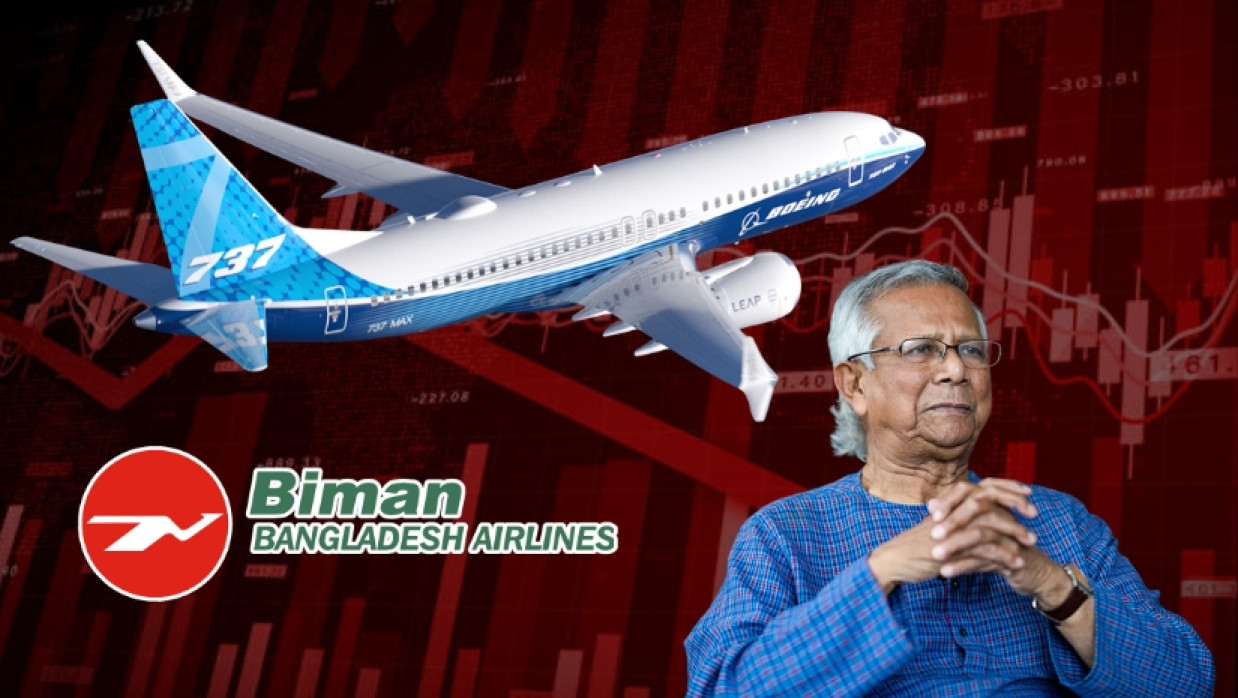
Central to the agreement is a $3.7 billion (about BDT 45,000 crore) commitment for 14 Boeing aircraft—a deal that critics, economists, and legal scholars call a “fundamental breach of principle” that effectively handcuffs the incoming elected administration.
The order covers eight Boeing 787‑10 Dreamliners, two 787‑9s, and four 737‑8 MAX jets. State‑owned Biman Bangladesh Airlines frames it as essential to resolve a chronic fleet crisis and secure the flag carrier’s future. A closer look shows a transitional government using multi‑billion‑dollar state liabilities as “diplomatic currency” to navigate an aggressive U.S. trade regime, while bypassing domestic competition laws, overlooking a grim global safety record for the aircraft, and masking a mountain of debt that threatens the national treasury.
The move reverses Bangladesh’s recent aviation strategy. In September 2023, during a visit by French President Emmanuel Macron, the Awami League government decided to diversify Biman’s fleet with 10 Airbus A350 wide‑bodies. The goal was to end over‑reliance on Boeing, reduce vulnerability to systemic groundings, and gain leverage in maintenance and spares. Financing was backed by a joint communiqué with UK Export Finance.
That plan collapsed after the fall of Sheikh Hasina’s government in August 2024. The interim administration of Muhammad Yunus was quickly caught in a tariff war launched by the Donald Trump administration: Washington initially threatened a 37% reciprocal tariff on Bangladeshi exports, jeopardizing a ready‑made garment sector that supplies 90% of U.S.‑bound exports. Three rounds of talks cut the threat to 20%, but Dhaka has pushed for 15% to stay competitive.
Pressure intensified when reports said India secured an 18% rate, raising fears that U.S. buyers would shift orders across the border. Commerce ministry sources and Centre for Policy Dialogue analysts say the price for tariff relief was narrowing Bangladesh’s nearly $6 billion U.S. trade deficit through a “cotton for garments” logic and committing to buy 25 Boeing aircraft. The 14 now being finalized are the first tranche. This pivot was made under a June 2025 non‑disclosure agreement, sidelining industry stakeholders and European diplomats who had sought a level playing field.
The fiscal base is alarming. To finance the $3.7 billion loan, the interim government agreed to a sovereign guarantee, making the treasury liable if Biman defaults. In August 2025, Biman touted a record net profit of Tk 9.37 billion for FY 2024‑25, but auditors have long qualified its accounts for failing to recognize huge liabilities. By late 2025, Biman owed more than Tk 81 billion to state entities: Tk 63 billion to the Civil Aviation Authority of Bangladesh for landing charges and surcharges, and Tk 18 billion to Bangladesh Petroleum Corporation for fuel.
Even if Biman devoted its entire annual profit to debt, it would take over 15 years to clear those state‑body dues. Its debt‑to‑equity ratio is roughly 4:1 versus an industry norm of 1.5:1. A sovereign guarantee for $3.7 billion (about BDT 45,000 crore) swells contingent liabilities, while tax‑to‑GDP sits at a historic low of 6.8% and external debt stands at $112 billion. Economists call this moral hazard: an effectively insolvent state enterprise expanding on public credit while ignoring structural decay.
Safety risk adds another layer. The 737 MAX family is under global scrutiny after multiple accidents linked to manufacturing quality. On December 4, 2023, Ryanair Flight 1269, a 737 MAX 8‑200, dropped more than 2,000 feet in 17 seconds on approach to London Stansted; the UK Air Accidents Investigation Branch cited autopilot complexity. On January 5, 2024, Alaska Airlines Flight 1282 suffered a blowout when a door plug detached at 14,830 feet; the NTSB later found four retaining bolts missing at delivery.
In May 2024, a Southwest 737 MAX had an uncontrolled Dutch roll at 34,000 feet due to vertical stabilizer damage. In June 2024, a Korean Air 737 MAX 8 lost pressurization and plunged 25,000 feet in about 15 minutes, hospitalizing 17 passengers. Biman reported 35 technical glitches in a recent ten‑week span and lacks enough skilled engineers and proactive maintenance; inducting complex MAX jets heightens operational and consumer risk. Legal scholars argue this may violate the Protection of Consumer Rights Act, 2009, which forbids services that endanger life or security.
Competition concerns loom. The Competition Act, 2012 seeks to prevent abuse of dominance and deals that harm competition. Scrapping diversification and effectively granting Boeing a monopoly over Biman’s future fleet without a competitive tender may restrict the market. Section 4 allows exemptions for national security or defense, but analysts question shielding a commercial airline’s expansion from scrutiny, especially with opaque decision‑making.
Governance worries deepen skepticism. Weeks before the election, Biman’s board was reshaped to include the National Security Adviser and special assistants to the Chief Adviser. Aviation Adviser Sheikh Bashiruddin also chairs Biman, raising conflict‑of‑interest concerns. Critics allege he concluded the Boeing agreement while in the United States without formal board approval or fleet‑planning clearance—an inversion where procurement drives policy instead of policy guiding procurement.
As voters approach the February 12 polls to ratify the July Charter—a reform roadmap meant to restore accountability after the previous regime’s legacy—the interim government’s rush to lock in a 10‑year, $3.7 billion contract seems at odds with the spirit of the uprising that brought it to power. First deliveries are due in October 2031, with completion in 2035, so operational gains will accrue to governments two or three cycles away, while financial burdens and the sovereign guarantee begin immediately.
The problem is not only the manufacturer choice but the process: a multidimensional policy failure that trades short‑term geopolitical appeasement for long‑term fiscal and operational stability. By turning Biman into a tool of trade diplomacy, the government undermines the airline’s commercial independence and piles contingent liabilities onto an already strained treasury. The next elected government will inherit a deal that ties its hands and narrows fiscal room for years.
To truly modernize aviation, Bangladesh must move past politically driven procurement, set clear performance targets, clear the Tk 81 billion owed to state bodies, and ensure fleet purchases follow commercial demand, not diplomatic need. Without such reforms, adding 14 Boeing jets under a sovereign guarantee and signed on the eve of an election could simply enlarge an already insolvent state enterprise. The interim administration is ending its tenure with multi‑billion‑dollar contracts, but the real cost will be borne by Bangladeshis long after the delegation returns from Washington.
Ultimately, the Boeing deal highlights the risk when an unelected transitional mandate attempts “revolutionary” change: it can replace one form of overreach with another. Whether this becomes a strategic shield for the garment sector or diplomatic handcuffs on future democracy will emerge in the coming decade. As February 12 nears, the rush to sign in Washington suggests the interim government was willing to pay the price of diplomatic currency with the nation’s long‑term fiscal health.
 Follow The Daily Campus on Google News