HSC Candidates Brave Floodwaters to Reach Exam Centers, Parents Voice Anger
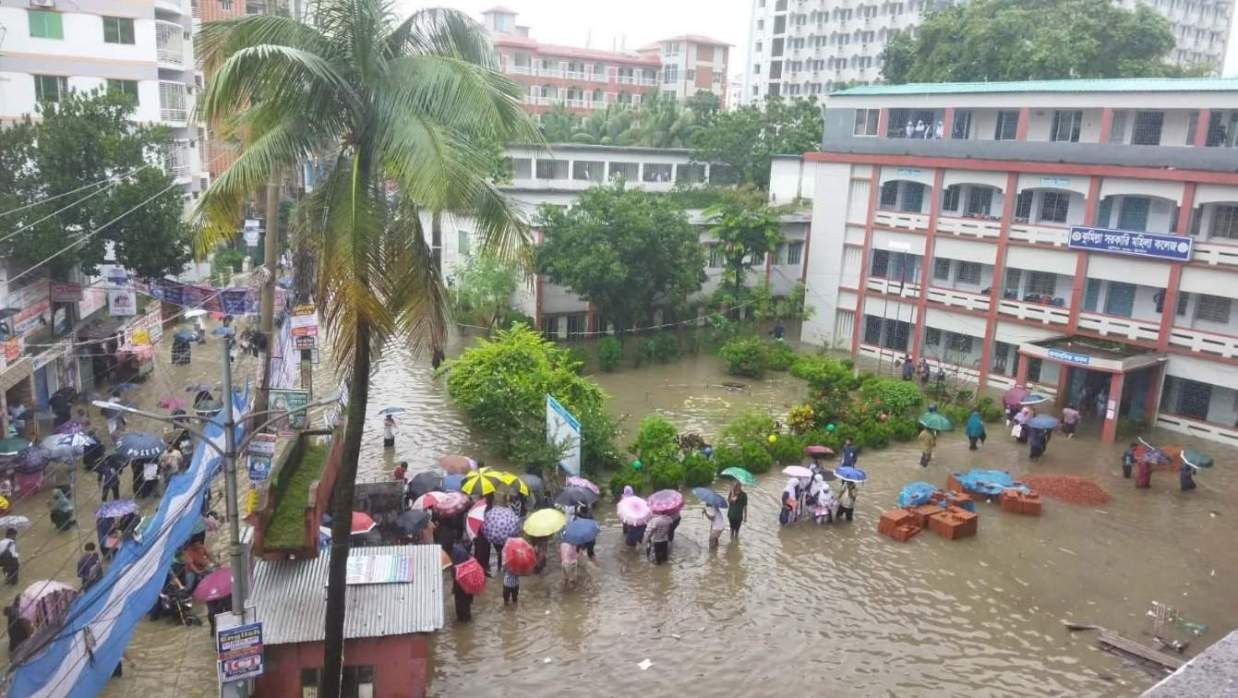
Amid relentless torrential downpours, widespread urban waterlogging, and escalating flood conditions, the sixth day of the 2026 Higher Secondary Certificate (HSC) and equivalent examinations was held across the country today, Monday (July 13). Thousands of examinees faced severe ordeals, navigating waist-deep water or relying on boats and vans to reach their respective venues. The distressing situation has triggered intense outrage among students, guardians, and prominent academics, who are strongly demanding the immediate postponement of the examinations.
While the exams under the flood-hit Chittagong Education Board—alongside the Madrasah and Technical boards in that region—remain suspended until July 16, the remaining eight general education boards proceeded with their schedules.
The situation turned particularly grim in Comilla and Noakhali districts. In Noakhali’s Hatiya upazila, multiple exam centers were heavily inundated, leaving hundreds of families marooned.
In Comilla, critical waterlogging was reported at major venues, including:
-
Comilla Government Women's College
-
Comilla Victoria College
-
Bhashashainik Ajit Guha College
Videos circulating widely on social media platforms depicted HSC candidates dressed in uniforms wading through waist-deep water or boarding wooden boats and rickshaw vans to enter the Comilla Government Women's College center, sparking a massive public outcry online.
Administrative Responses: Board Shifts Responsibility to Local Administration
Speaking to The Daily Campus, Professor Khondoker Mohammad Sadekur Rahman, Chairman of the Bangladesh Madrasah Education Board, clarified that central boards do not unilaterally cancel examinations.
"The respective district and local administrations review the ground realities of the centers and surrounding areas to submit a feasibility report to us. If they declare that the environment is unfit for holding exams, we consult with the Ministry of Education to announce a postponement. We look at whether students can safely access the centers. If local administrations do not formally recommend a suspension, our policy is to sustain the scheduled timeline to avoid putting immense psychological pressure on the candidates who have prepared for months."
Addressing the Comilla crisis, the Chairman noted that the sudden accumulation of knee-deep water followed overnight rain. He added that the board is awaiting reports from local administrations before deciding on the upcoming exam dates. Furthermore, he noted that the Ministry of Education is actively working to permanently shift the public exam calendar out of the monsoon season starting in 2027—planning the SSC exams for January and the HSC for June.
Meanwhile, Md. Kabir Uddin Ahmed, Controller of Examinations at the Comilla Board, admitted the severe waterlogging at the Government Women's College center and stated that the board is considering changing vulnerable venues permanently for future sessions.
Discrepancy in Local Reports
Despite the visible crisis, it was revealed that local administrative authorities failed to send timely risk assessment reports to the education boards.
Fatema Tuz Johra, Upazila Nirbahi Officer (UNO) of Comilla Sadar, told The Daily Campus, "The authority to postpone exams or change centers rests entirely with the education board. We had no written reports classifying these centers as high-risk until yesterday, as the severe waterlogging was triggered by continuous rainfall starting at 4:00 AM today. We are now formally updating the board through the district administration."
Professor Syed Akteruzzaman, President of the Inter-Education Board Coordination Committee and Chairman of the Dhaka Education Board, stated that they are keeping a close watch on the situation and are in constant communication with District Commissioners (DCs) to assess if broader interventions are required.
Educators and Guardians Vent Frustration
Academics have raised structural questions regarding the fairness of holding national evaluations under such polarized environmental conditions. Professor Mohammad Mojibur Rahman of Dhaka University’s Institute of Education and Research (IER) criticized the ministry’s rigidness.
"Forcing students to wade through waist-deep water to write a critical public exam is completely unjust. It completely shatters the principle of ensuring an equitable testing environment for all candidates. Conducting exams in some regions while postponing them in others using the same question sets could lead to standardization discrepancies. Since weather forecasts were available days in advance, a lack of coordination between the ministry, the boards, and local bodies is apparent."
Parents also shared harrowing experiences, with one mother noting her son had to write today's exam while suffering from a high fever contracted after being drenched in the rain during Saturday's ICT exam.
Meteorological Outlook
According to the Bangladesh Meteorological Department (BMD), the capital recorded of rainfall in the last 24 hours, following a seasonal record of the previous day. Chittagong recorded during the same period.
BMD Assistant Meteorologist Dr. Md. Bazlur Rashid indicated that while the intensity of rainfall in Dhaka might subside starting Tuesday, heavy to very heavy downpours will likely persist in several other parts of the country throughout the rest of the week due to an active monsoon and western low-pressure troughs.
 Follow The Daily Campus on Google News