Bangladesh Proposes Ending Dual Skills Assessment for Saudi-Bound Workers
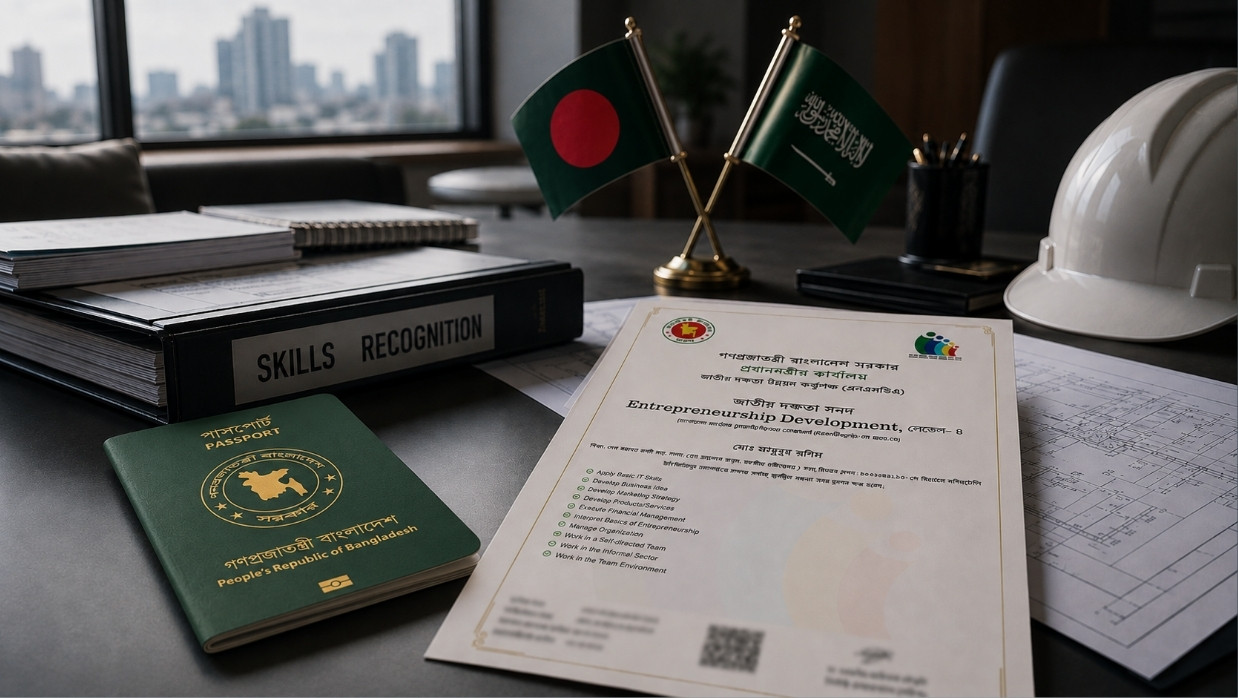
Dhaka has proposed that Riyadh recognise Bangladesh's National Skills Certificate (NSC) for 59 professions, allowing certified workers to bypass a second, costly skills verification test before taking up employment in Saudi Arabia.
In an exclusive interview with The Daily Campus, Dr. Nazneen Kawser Chowdhury, Executive Chairman (Secretary) of the National Skills Development Authority (NSDA), said Bangladesh has formally requested Saudi Arabia to accept the NSC directly, eliminating the need for an additional verification process before workers travel for overseas jobs.
Dr. Chowdhury raised the proposal during a keynote address at a human resources exposition in Saudi Arabia last November, where she held a side meeting with the chairman of the Saudi National Committee of Workers Committees (SNCWC). The NSDA is the regulatory body overseeing skills training and certification in Bangladesh.
During that meeting, it emerged that of the 65 professions required by Saudi Arabia, the NSDA has already developed curricula for 59, with training currently underway for those occupations, Dr. Chowdhury said in an interview with The Daily Campus.
Workers travelling to Saudi Arabia currently face a separate assessment under the Skill Verification Program (SVP), run in coordination with the Saudi organisation Takamol, even if they already hold an NSC certificate from Bangladesh. Dr. Chowdhury said this amounts to a duplicate process for workers who are already certified.
For these 59 professions, those who already hold an NSC certificate should not need to go through a duplicate assessment under SVP, the Skill Verification Program. The NSC certificate itself should be directly accepted, while only those without an NSC would go through SVP.
The Saudi side has shown interest in the proposal, Dr. Chowdhury said, adding that four rounds of dialogue have been held with Takamol so far.
SVP assessments are currently being carried out at 110 training institutions registered under the Bureau of Manpower, Employment and Training (BMET). Takamol considers this insufficient given the scale of demand and wants more training institutions brought into the programme, according to Dr. Chowdhury. She said Takamol's requirement is to complete around three thousand assessments a day, which would require additional manpower to manage.
Progress on the Saudi side has been slower than expected because of the Ramadan and Hajj seasons, Dr. Chowdhury said. A Saudi delegation is expected to visit the Centre of Excellence and a number of Skills Training Providers (STPs) after Eid, and a final decision on the proposal will be based on that visit.
"I'm hopeful that if this connection is realized, it will produce a positive outcome for access to the Saudi market," Dr. Chowdhury told The Daily Campus.
The proposal forms part of a broader push by the NSDA to expand Bangladesh's presence in skilled labour markets abroad. In the same interview, Dr. Chowdhury said the authority has also developed curricula for six skilled professions based on demand from five countries, including Saudi Arabia, Singapore, South Korea, Japan and the United States.
Bangladesh's expatriate labour market remains heavily concentrated in the Middle East, with a large share of workers going abroad as low-skilled or unskilled labour. Under an NSDA-led performance survey conducted through a Google Form, 73 percent of NSC certificate holders were found to be currently employed or self-employed, with 8 percent of that group working internationally across 72 countries.
If finalized, the direct acceptance of NSC certificates by Saudi Arabia would mark a shift from the current dual-assessment model, potentially reducing costs and delays for Bangladeshi workers seeking employment in the kingdom under the SVP framework administered with Takamol.
 Follow The Daily Campus on Google News