Trainees in Six Sectors Still Await Promised Jobs Despite Completing Training
In six major industrial sectors, Bangladesh's government-run skills-to-jobs pipeline is not producing any outcome at all, not because trainees complete courses and then fail to find work, but because the sector bodies responsible for starting the process, known as Industry Skill Councils or ISCs, have stopped functioning, according to Dr Nazneen Kawshar Chowdhury, Secretary and Executive Chairman of the National Skills Development Authority (NSDA).
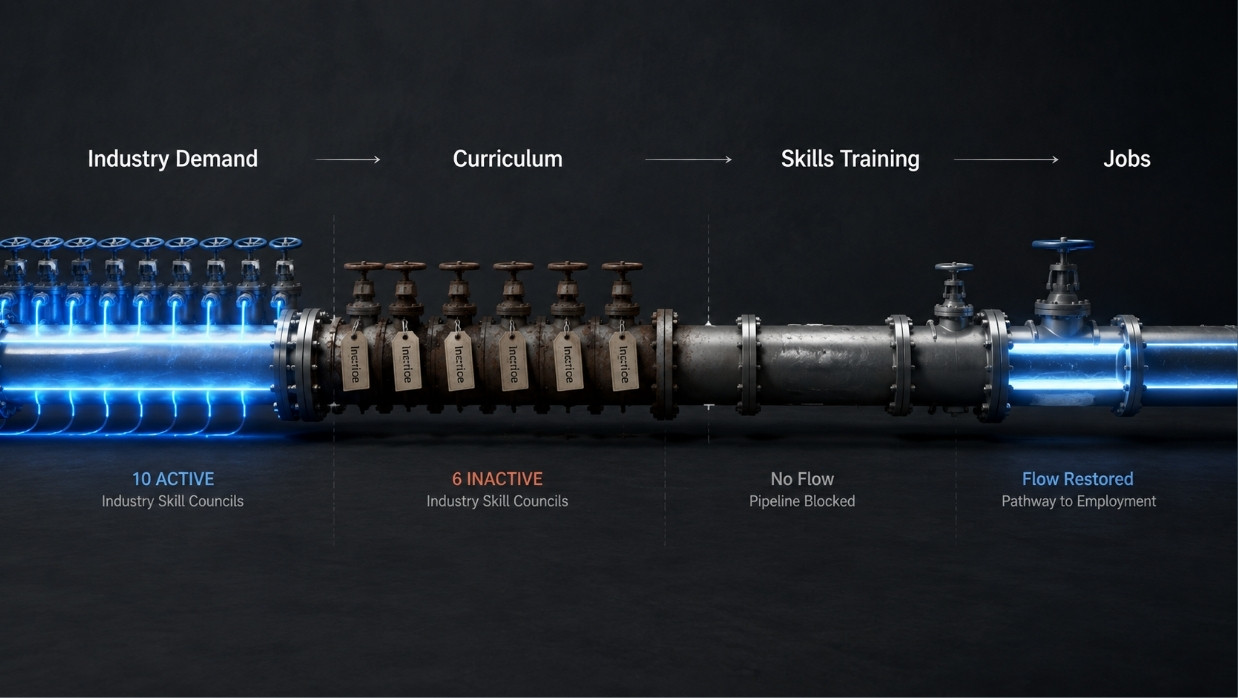
Under the system Chowdhury described, an ISC identifies the actual manpower demand within its industry and submits a requisition to the NSDA based on the types of jobs the sector expects to be able to offer. The NSDA then develops a curriculum to match that demand and hands it to selected Skills Training Providers, or STPs, which train interested participants. Once training is complete, it falls to the ISC to link the newly trained workers with employment opportunities in that sector.
Because six ISCs are currently inactive, they are not submitting any requisitions to the NSDA at all. As a result, no curriculum is developed and no course is commissioned for those sectors, and the job-linking role that ISCs are meant to play under employers' corporate social responsibility commitments does not take place either. Officials familiar with the matter said the breakdown occurs at the very start of the chain, before training curricula are even designed, rather than at the point where trained workers are seeking jobs.
There are currently 16 registered ISCs in the country. Of these, only 10 have functioning, reconstituted governing boards. The remaining six do not.
Explaining why so many councils became inactive, Chowdhury cited an example of demand-based curriculum development through official government channels, noting that many of the 16 ISCs remain non-functional. She said that after the political change of August 5, 2024, the chairmen of many ISCs could not be located, and several governing boards collapsed.
After taking charge, she said she notified all ISCs to urgently reconstitute their boards, arguing that effective leadership allows each sector to organise around its own demands and problems. She said only 10 of the 16 ISCs have had their boards reformed so far, and it is only after these 10 boards were reconstituted that the NSDA began receiving accurate information on real sector demand.
The 10 ISCs whose boards have been reconstituted, along with the dates of formation, are the ICT ISC, formed on August 30, 2025; the Agro-food ISC, formed on April 30, 2025; the Tourism and Hospitality Sector ISC, formed on April 19, 2026; the Construction ISC, formed on June 2, 2025; the Light Engineering ISC, formed on April 4, 2026; the Furniture Sector Industry Skill Council Limited, formed on February 1, 2025; the Ceramic ISC, formed on February 27, 2025; the Agriculture ISC, formed on September 29, 2025; the Plastics ISC, formed on January 8, 2026; and the Informal Sector ISC, formed on April 19, 2026. According to the document, separate performance data for each of these 10 sectors, based on activity indicators, has been submitted to the NSDA.
The six ISCs that remain inactive, and are therefore not submitting requisitions to the NSDA, are the RMG and Textile ISC, the Leather and Leather Goods ISC, the Creative Media ISC, the Jute Sector ISC, the Pharmaceuticals ISC, and the Logistics ISC. No specific reason is stated in the document for the RMG and Textile ISC's inactivity. For the Leather and Leather Goods, Creative Media, Jute Sector, and Pharmaceuticals ISCs, the document attributes the failure to reconstitute a new board to a lack of activity by the ISC itself. For the Logistics ISC, the document states that its registration process is pending with the Ministry of Commerce.
For the Leather and Leather Goods ISC, the document notes an alternative arrangement under Section 17, sub-section 2, clauses (b) and (c) of the Trade Organisations Act, 2022, which provides that if an organisation fails to hold elections in time after its governing board's term expires, the government will appoint an administrator to that organisation for a period of up to one year, as it deems appropriate.
Regarding the Logistics ISC, the document states that its registration remains under process at the Ministry of Commerce. It adds that, according to Bangladesh Bank, five members of the ISC's governing board are linked to loan default cases. A letter has been sent to the Logistics ISC asking it to remove these members and amend its memorandum and articles of association accordingly, and to inform the Ministry of Commerce once this is done. The document further notes that although the Jute Sector and Pharmaceuticals ISCs currently lack governing boards, data based on performance indicators for both sectors has still been submitted to the NSDA.
On the broader challenge of export diversification, Chowdhury said that Bangladesh's graduation from Least Developed Country (LDC) status requires diversification of both products and markets, which in turn requires modern technology and a skilled workforce capable of operating it. She said that the sectors with the greatest potential for diversification, including leather, jute, and furniture, are precisely the sectors from which demand for skilled manpower is lowest.
As an example, she said only seven corporate social responsibility (CSR) initiatives are currently active in the leather and leather goods sector, and that effectively no new work has come from this sector since 2019.
She said that unless the private sector fulfils its corporate social responsibility obligations, the demand side of the skills ecosystem cannot become active, and unless the demand side is active, the supply side cannot function effectively either. She said that simply blaming the government for a shortage of skilled manpower will not solve the problem, and that the private sector must properly fulfil its corporate responsibilities and actively participate in efforts to build a skilled workforce. She asked how the supply side could be expected to function if the demand side remains inactive.
In total, Bangladesh has 16 registered ISCs, of which 10 have reconstituted governing boards and six remain inactive: RMG and Textile, Leather and Leather Goods, Creative Media, Jute Sector, Pharmaceuticals, and Logistics. In the leather goods sector, only seven CSR initiatives remain active, with no new activity recorded since 2019.
 Follow The Daily Campus on Google News