The Bangladeshi Student's Journey
Every Year in School, a Worse Chance of a Qualified Teacher
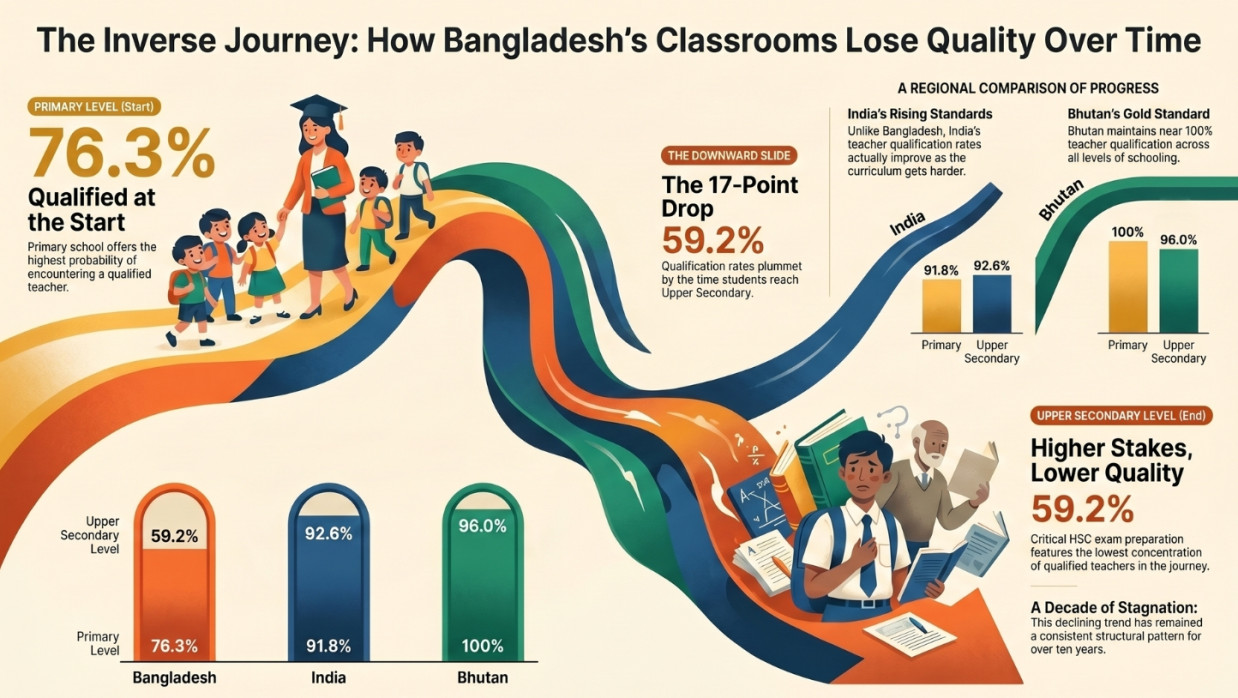
Imagine a child who starts Class One in a government primary school in 2024. She sits in a classroom where, statistically, just over three in four of the teachers around her are formally qualified to be there. It is not an ideal ratio, but it is the best she will ever experience in her schooling life. Because from here, for the Bangladeshi student, the proportion of qualified teachers only falls.
By the time she reaches lower secondary Classes Six through Eight the share of qualified teachers in her school has dropped to around 63 per cent. In secondary school, Classes Nine and Ten, it falls further to 60 per cent. And at the college level, as she prepares for the Higher Secondary Certificate examination that could determine her university prospects, fewer than six in ten of her teachers will meet the state's own minimum standard. The child who began her education in an imperfect environment ends it in an even weaker one.
An Education System That Works in Reverse
In a well-functioning education system, teacher qualification tends to rise with the complexity of the curriculum. Primary school teachers, who deal with foundational literacy and numeracy across multiple subjects, may sometimes have lighter credential requirements than those who must command advanced mathematics, science, or literature at the secondary level. Yet the expectation, broadly, is that advanced subject knowledge and pedagogical competence increase the further up the system one goes.
Bangladesh's system operates under a different logic, one where the highest-stakes classroom encounters are, paradoxically, the least likely to feature a fully qualified teacher. A student sitting her HSC board exams, whose results will shape her entire future, is more likely to have been taught by an under-qualified instructor than she was in Class One.
The recent data sharpens the concern. In the 2022–24 period, the qualification rate drops by a striking 17 percentage points between primary and upper secondary from 76.3 per cent to 59.2 per cent. This is not a statistical anomaly. It reflects a genuine structural pattern in which secondary-level positions often based in rural areas, harder to fill, and less professionally attractive draw from a shallower qualified pool.
What the Journey Looks Like Elsewhere
Set Bangladesh's trajectory alongside its neighbours, and the contrast is stark. In India, a student moves through an education system where teacher qualification rates are not only high at every level but actually improve as the stakes rise. The 2022–24 average climbs from 91.8 per cent in primary schools to 92.6 per cent at the upper secondary level. For an Indian student, advancing in school means encountering progressively better-credentialled teachers.
Nepal tells a similar story of stability, if not a rising trend. Qualification rates begin at a remarkable 96.7 per cent at the primary level and settle at 92.7 per cent in upper secondary a slight decrease, but one that keeps the Nepali student in a high-quality environment throughout their schooling. Even at the point of greatest decline, Nepal's worst figure is still better than Bangladesh's best.
Bhutan has effectively solved this problem altogether. Both primary and lower secondary schools operate at 100 per cent qualification, while upper secondary remains above 96 per cent. That a small Himalayan kingdom with far fewer institutional resources than Bangladesh can achieve this speaks less to Bhutan's exceptional wealth than to the political priority it has assigned to teacher standards.
Sri Lanka, it should be noted, does show a gentle downward trend as students advance qualification rates decline from 86.6 per cent in primary to 78 per cent in upper secondary. But even this declining trend operates some twenty percentage points above Bangladesh's upper secondary figure, and it does not carry the same severity of drop across the board.
TABLE 2: THE STUDENT'S JOURNEY — TEACHER QUALIFICATION ACROSS EDUCATION LEVELS

A Decade of the Same Story
One might hope that the recent data represents a temporary aberration perhaps the pandemic disrupted recruitment and training pipelines in ways that disproportionately affected secondary schools. The decade-long average, however, offers little comfort. Between 2015 and 2024, Bangladesh's primary qualification rate averaged 62.5 per cent while upper secondary averaged 60.3 per cent. The differential between primary and upper secondary has been a consistent feature of the system across governments and policy frameworks, not a recent development.
India's decade average, by contrast, improves from primary to upper secondary, moving from 83.2 per cent to 86.1 per cent. Nepal remains robustly above 86 per cent at every level. Both countries have been moving in the right direction upward, across the board. Bangladesh has largely been standing still.
What This Means for a Child
The compounding effect of this pattern matters enormously at the individual level. A student who passes through twelve years of schooling in Bangladesh accumulates years of instruction from teachers who, by the government's own standards, should not have been in those classrooms. The learning gaps introduced early are rarely recovered later and the later stages of schooling, where the deficit in qualified teachers is greatest, are also the stages where subject knowledge is most specialised and the consequences of poor teaching are hardest to reverse.
This reality sits in uncomfortable tension with Bangladesh's broader educational narrative. Enrolment rates are up. Gender parity has been largely achieved. The country takes pride in these gains, and rightly so. But access to a seat in a classroom is not the same as access to quality education, and the teacher standing at the front of the room is the single greatest determinant of what a student actually learns.
For the child who began Class One and is now preparing for her HSC the examination that bridges school and university, childhood and adulthood the journey has been one of diminishing odds. Not diminishing effort on her part, but diminishing quality in the system meant to support her. That is a debt Bangladesh owes its children, and one that the data says it has not yet begun to seriously repay.
 Follow The Daily Campus on Google News