Teachers Skip Textbook Exercises, Leaving Primary Students with Reading Deficits
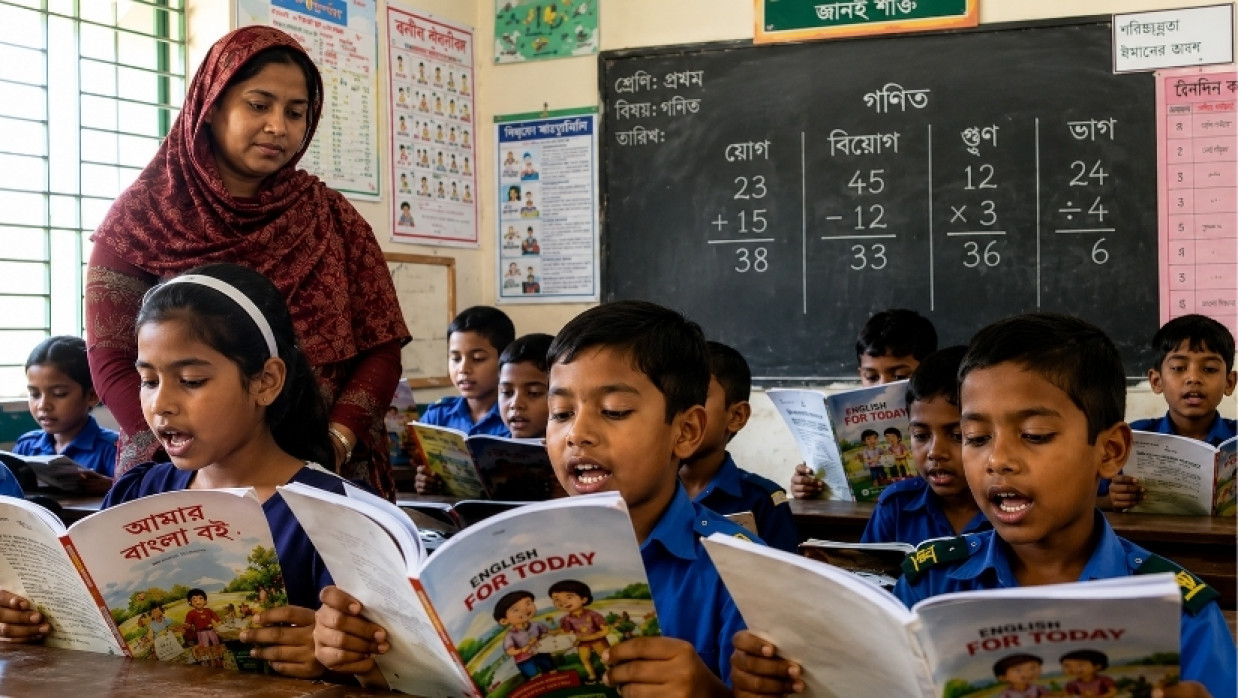
A mandatory government directive instructing primary school teachers to complete textbook exercises directly inside the classroom is being widely ignored across Bangladesh. A recent field evaluation conducted by the National Curriculum and Textbook Board (NCTB) across 36 primary textbooks from grades one to five has exposed systemic instructional failure, leaving a vast number of students struggling with basic spelling and reading comprehension.
The underlying educational gap took center stage during a recent workshop at a private university, where State Minister for Primary and Mass Education Bobby Hajjaj indicated that the government is evaluating structural shifts. The ministry is deeply reviewing options to completely separate standard textbooks from core student workbooks in the future, citing successful global implementation strategies that have yielded positive learning curves.
Field Inspection Reveals Absolute Classroom Neglect
An NCTB senior official attending the same event confirmed that a lack of active classroom exercise completion is a primary driver behind the reading deficit. Field inspections conducted by the agency across 43 government primary schools spanning 20 districts revealed that not a single student had utilized the practical 'Nije Kori, Dekhi Pari Kina' (Do It Yourself) evaluation segments.
The NCTB highlighted that if a child systematically engages in these interactive practical exercises throughout their five-year primary cycle, such severe literacy gaps should not exist, pointing directly to instructional negligence. To assist teachers, the NCTB designs and distributes specialized Teacher Guides annually. However, field reports indicate that teachers frequently neglect to read or utilize these blueprints altogether. To minimize financial waste, the agency halted printing physical copies of these guides for the 2025 and 2026 academic sessions, shifting availability exclusively online.
The crisis has also drawn serious legislative focus. Independent lawmaker Barrister Rumin Farhana (Brahmanbaria-2) raised the national reading deficiency issue in Parliament on June 18, triggering intense debates regarding teacher accountability and curriculum standards.
Administrative Crackdown: Salary Freezes and Immediate Literacy Targets
In response to the growing learning gaps, district primary education officers have launched a strict administrative crackdown. Official notices issued to headteachers and assistant teachers warn that failure to teach basic skills—including fluent reading in Bangla and English, alongside core arithmetic operations like addition, subtraction, multiplication, and division—will result in immediate salary suspensions.
The institutional framework sets explicit targets for the coming months:
-
The Daily Mandate: Teachers must ensure students read at least five pages of both Bangla and English textbooks out loud every day.
-
The Absolute Deadline: Primary and Mass Education Secretary Md. Sakhawat Hossain recently held a virtual briefing with all district officers, establishing July 2026 as the hard deadline to ensure every government primary student achieves fluent, independent reading skills.
-
The Workbook Integration: Officials emphasize that textbooks must double as practical workbooks within the classroom setting to ensure academic concepts are thoroughly retained.
Academic Experts Call for Authentic, Verifiable Data
While institutional stakeholders blame teachers, educational experts suggest a more nuanced view. Speaking to The Daily Campus, Professor Dr. Hafiz Ahmed of the Institute of Education and Research (IER) at Dhaka University urged caution regarding the phrasing of the research, stating that terms like "slow readers" are more accurate. He noted that reading speeds differ from student to student, with complex conjunct letters often acting as specific bottlenecks.
Professor Ahmed emphasized the need to analyze the underlying research methodology used by the NCTB, pointing out a potential misalignment between how teachers are trained and what the curriculum expects from students. He cited a parallel disconnect in higher education, where university admission testing formats differ significantly from the creative evaluation frameworks taught at the intermediate level. He concluded that while gaps exist, the government must commission authentic, highly verified research into classroom environments, teacher qualifications, and infrastructure before rolling out sweeping corrective policies.
Confirming the ministry's swift posture, newly appointed Additional Secretary (Schools) Md. Lal Hossain stated that official directives focusing on student reading standards have already been dispatched nationwide. The ministry is closely tracking field feedback and plans to convene strategic meetings to explicitly address why the text-based exercise modules are being systematically skipped in the classroom.
 Follow The Daily Campus on Google News