Fuel Crisis
Online Classes Planned in Schools, Working Parents Express Concern
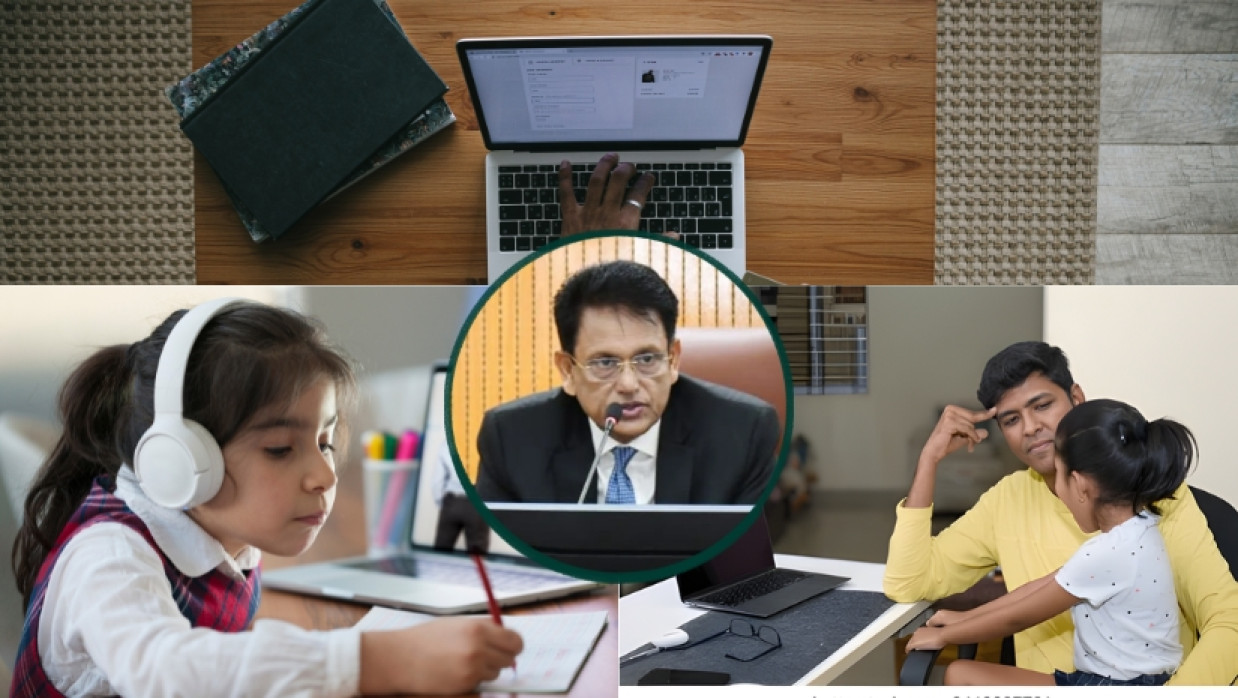
The Ministry of Education is considering a hybrid system of online and offline classes in educational institutions to save fuel amid the Iran war and various global crises. While one section has welcomed the move, another group — especially working parents — has raised serious concerns about the potential difficulties it may cause.
Many working and service-holder parents fear they will face significant trouble if their children have to attend online classes while they are at the office. There are also worries about young children becoming addicted to devices.
In this situation, some parents have requested the government to consider allowing home office facilities on days when online classes are scheduled.
According to ministry sources, a plan has been made to conduct classes on an alternate-day basis (odd-even system). A preliminary decision was taken in a meeting held at the ministry on Tuesday (31 March). A source close to the Education Ministry confirmed the matter to The Daily Campus, saying it is still a preliminary decision. The final decision may be taken at the Cabinet meeting on Thursday.
Working mother Iffat Soma questioned the decision and said, “Instead of three days of online classes, why not give three days of home office? I don’t understand how primary and secondary level children will attend online classes. And if both parents are in the office, who will supervise them? Does that mean we have to hand over mobile phones to them? Once they get a phone with internet access, will they actually attend classes? My child won’t. Whose brilliant idea is this hybrid system?”
Mohammad Waliullah, a private service holder and father of two, said, “Online classes may be manageable for older children, but how will younger ones in lower classes attend? There is also the risk of increased device addiction. Working parents will have to leave mobile phones with their children. Instead of this decision, they could have taken three days of classes and given more homework for the remaining days.”
After the news surfaced, several working parents said they will of course accept government decisions in emergency situations. However, they expressed doubts about how effective this initiative will be for children whose one or both parents are working. They questioned how attentive children will be to online classes when left alone at home, and raised concerns about safety and possible mischief.
One parent, Abu Hanif, commented, “Many students don’t pay attention even when sitting in front of the teacher in the classroom. Online, they will just play games. Online classes are only suitable for meritorious and hardworking students.”
However, Redwanul Islam took a different view: “Three days offline and two days online classes per week — in that case, the country’s fuel consumption will decrease and the nation will move forward on the path of development. Students will become smarter, and through smart education, the nation will progress.”
Sources said the proposed system may involve online classes on even dates and offline classes on odd dates. Practical and hands-on classes will be conducted only offline. Officials believe this hybrid method could be effective in ensuring student participation and promoting technology-based education, though further review will be done before implementation.
A web poll conducted by The Daily Campus asked: “Do you think the idea of 6 days of classes per week with a mix of online and offline is correct?” Out of 546 voters, 34% voted ‘Yes’, 64% voted ‘No’, and 2% did not express any opinion.
Several parents urged the government to consider the situation of working parents while taking such decisions. They suggested allowing home office facilities on online class days or finding some other convenient arrangement.
Abu Al Amin, another parent, said, “If schools remain open for 6 days but students don’t attend, teachers will suffer. It would be better to bring students back to institutions. With regular study, a lot can be taught even in 5 days.”
Azizul Islam Asif commented, “Will children in remote areas receive education under these rules? This kind of decision will bring no benefit. In the online class frenzy, thousands of children in rural areas have already become addicted to mobile games and their studies have been ruined. If this starts again, the rest will also be lost.”
A private service holder, requesting anonymity, said, “When we are not at home and are in the office, there is doubt whether our children will pay attention to online classes while staying alone at home. There is also concern about their safety. In that case, home office arrangements could be considered on those days. This way, they can also focus on classes, and we can manage our work.”
It is learned that the government has prepared at least eight plans for fuel and electricity conservation, including increasing the weekly holiday to three days and introducing online classes in educational institutions. The final decision on which plans will be implemented is expected to be taken at the Cabinet meeting on Thursday.
A senior official of the Cabinet Division said, “At least eight steps are under discussion for fuel conservation. These include adding an extra day to the weekly holiday or allowing officials to work from home two days a week. There are also proposals to start office work earlier or reduce total working hours. To reduce electricity consumption, at least half the classes in schools may be taken online.”
Earlier, Education and Primary & Mass Education Minister Dr. A N M Ehsanul Haque Milon said 55% of people want online classes due to the fuel crisis. He remarked, “I have already done a survey and found that 55% of people want classes to go online. However, if we go fully online, we will once again become anti-social.”
 Follow The Daily Campus on Google News