70% Leave Madrasa Stream After Dakhil
After passing the Dakhil examination from Chandraganj Karamatia Kamil Madrasa in Noakhali, Md. Abdur Rahman was supposed to enrol in Alim (higher secondary) level at the same institution. However, before admission, he chose to join a general college, driven by his dream of higher education and concerns about future job prospects.
He is not alone. Due to perceived discrimination against madrasa students in the mainstream job market, shortage of trained teachers, and uncertainty in employment opportunities, a large number of students are leaving madrasa education after Dakhil and shifting to general colleges or technical institutions. Many later pursue higher studies in universities or abroad.
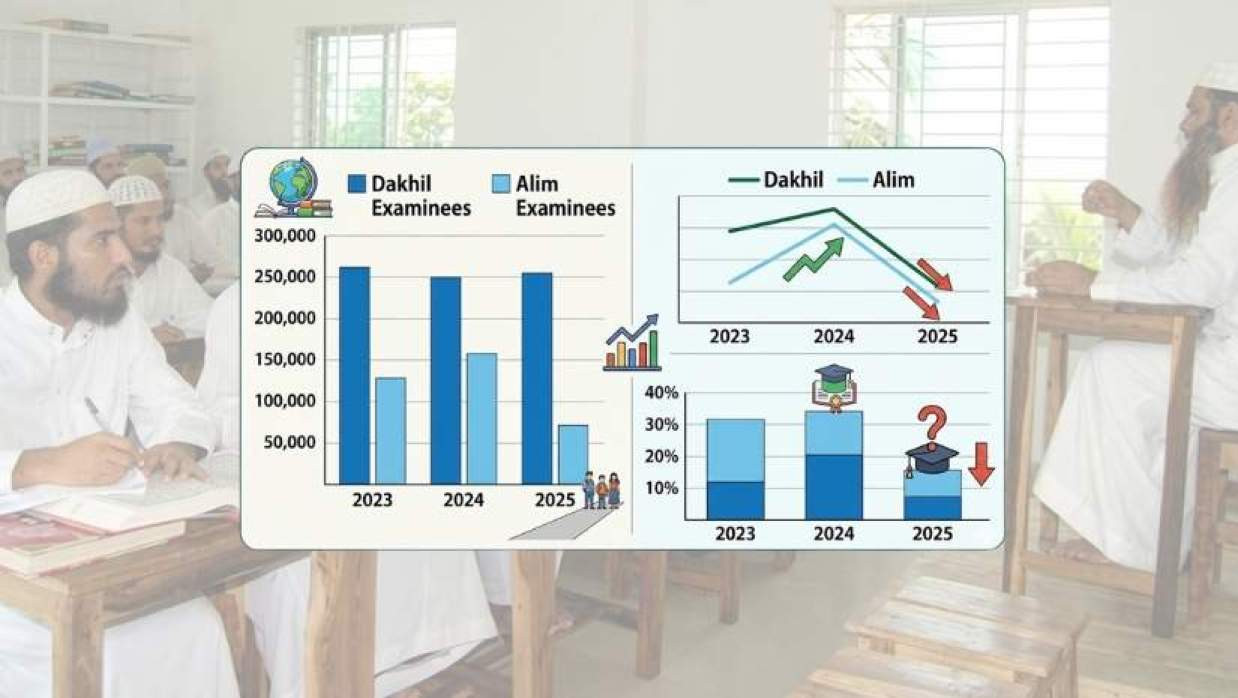
Statistics show that over the past three years, nearly 70% of Dakhil passers either drop out of the Alim level or transfer to other education boards. This trend has been compounded by a sharp decline in pass rates for both Dakhil and Alim examinations in 2025.
The primary reason cited by students is weakness in Arabic subjects. “Students do not want to continue in madrasas after Dakhil mainly because of difficulties with Arabic. It is hard to continue studying a subject they do not understand or enjoy,” said A N M Nizam Uddin, Principal of Raipur Alia Madrasa in Lakshmipur.
“Additionally, madrasa students often face neglect in the job market. The different social status attached to the two education systems also contributes to this. As a result, many students suffer from inferiority complex. There is also a dress code in madrasas that many are not comfortable with,” he added.
Many students who complete Alim later enrol in Islamic Studies at universities, but they often lack the deep proficiency in Arabic that madrasa education provides. “In madrasas, students study major books of Hadith and Tafsir hands-on, which is not possible in universities. General-line students who do not even know basic Arabic also join Islamic Studies departments,” the principal noted.
Declining Trend in Madrasa Enrolment at Alim Level
Analysis of Madrasa Board results over the past three years (2023–2025) shows that while the number of Dakhil examinees remains around 275,000, the number of Alim examinees is steadily decreasing each year.
In 2023, only 33.21% of Dakhil passers appeared for the Alim examination. This dropped to 30.41% in 2024 and further to 29.33% in 2025. In other words, out of every 100 Dakhil students, only about 29 continue to the Alim level. The remaining 71% either shift to general education boards for HSC or join technical education streams. Many also discontinue studies altogether due to employment pressures.
The 2025 results were particularly disappointing for the Madrasa Board, with the Dakhil pass rate falling by nearly 11.57% and the Alim pass rate dropping by 17.79% compared to 2024 (from 93% to 75%).
Experts attribute this decline to the madrasa system’s lag in modern curriculum and decreasing interest in purely religious education. Social perceptions and limited career opportunities for madrasa graduates also play a significant role. Only those who aspire to become religious scholars from childhood tend to complete the full madrasa curriculum, while many others switch to mainstream education midway.
 Follow The Daily Campus on Google News