Dhaka sits on the edge of world’s most dangerous megathrust fault: 2016 Nature study warns
Dhaka sits on the edge of world’s most dangerous megathrust fault: New Geological Research Warns
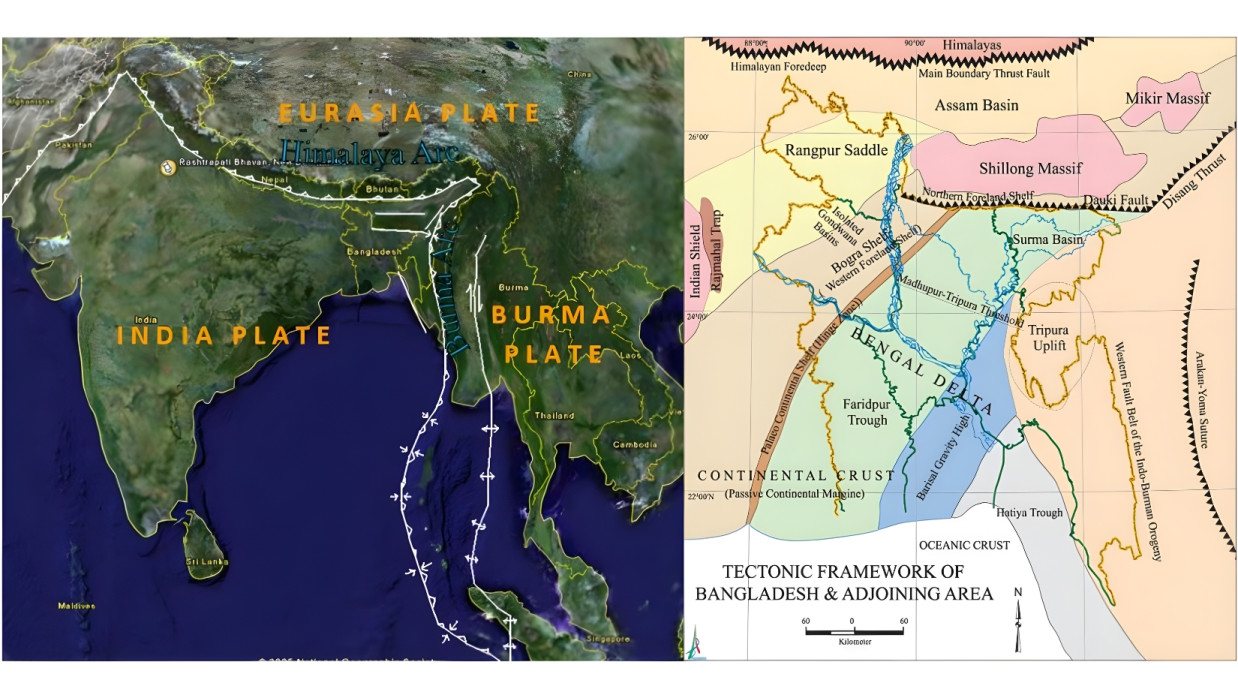
Researchers from universities in the United States, Bangladesh and Singapore, in a 2016 paper published in Nature Geoscience, calculated the velocity of the plate beneath Bangladesh. They found that the Bangladesh portion of the plate is moving northeast at 15 to 40 millimetres per year, sliding beneath the Burma Plate. Thick sediment from the Ganga and Brahmaputra rivers has accumulated over this part of the Indian Plate, and beneath the sediment lies an oceanic plate that is subducting under the continental Burma Plate.
Such active regions are called subduction zones. At the boundary where one plate dives beneath another, a megathrust fault is formed. The world’s largest earthquakes generally occur when these megathrust faults slip.
The boundary of this subduction zone between the Indian and Burma plates is the deformation front. Rocks to the west of this front are hardly deformed at all, but rocks to the east become deformed and start sinking into the Earth’s interior. This deformation front lies very close to Dhaka. In the figure at the bottom of the paper’s one-dimensional plot, the map shows the deformation front as a black dashed line, and it is clear that the line passes directly over Dhaka.
This does not mean that the epicentre of a future large earthquake will necessarily be in Dhaka itself. The one-dimensional diagram shows that the megathrust fault extends nearly 250 kilometres from the deformation front. The epicentre could be anywhere along this vast zone.
No major earthquake of magnitude 8–9 has occurred on our segment of this megathrust fault in the past 400 years.
That means pressure has been steadily accumulating here for 400 years; when this stored pressure is finally released, a very large earthquake will occur. Without any major earthquake, in the last four centuries we have converged nearly 5 metres with the Burma Plate. It is impossible to say when the stress accumulated over four centuries will be unleashed; it could happen now, or it could happen another 400 years later.
Therefore, the paper does not predict any earthquake, nor would such a prediction be scientific. But one thing has been stated very clearly: Dhaka stands at the edge of one of the world’s most terrifying megathrust faults. One day, an earthquake could occur on this terrifying fault that would be equivalent to Japan’s most devastating earthquakes.
Bangladesh sits on a “Ticking Time Bomb”, a catastrophic earthquake here is not a question of “if”, but “when”. There is no alternative to being prepared.
 Follow The Daily Campus on Google News