BUP Team Clinches 2nd Runner-Up at Global HSBC/HKU Business Case Challenge
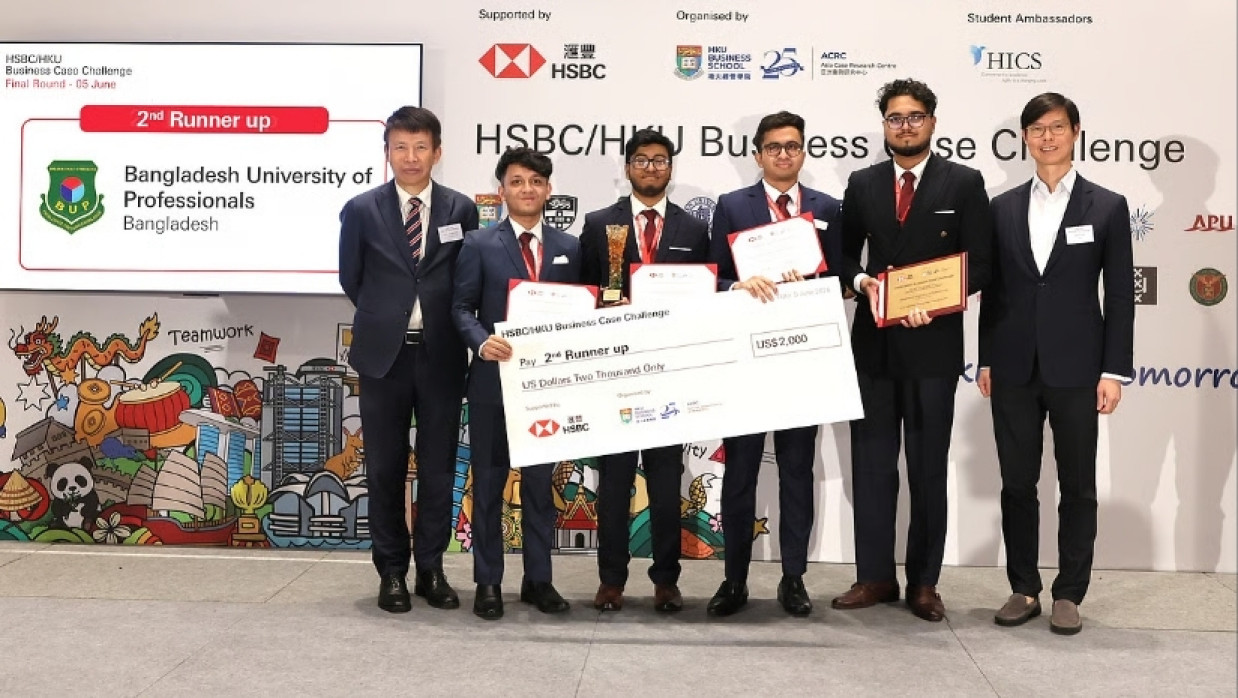
Bringing immense pride to the nation, a four-member delegation from the Bangladesh University of Professionals (BUP) secured third place globally at the prestigious HSBC/HKU Business Case Competition recently held in Hong Kong. Standing on the global podium as second runner-up, the team was also awarded a cash prize of USD 2,000 for their exceptional strategic acumen.
Representing Bangladesh under the moniker "Team Six Seven," the squad comprised Mohammad Faiyad, Sakhawat Selim, Navid Abrar, and Md. Ridwan Sakib, who are all final-year undergraduate students at BUP’s Department of Business Administration. Israt Jahan from HSBC accompanied the group as their official team mentor.
The Anatomy of a High-Pressure Challenge
Widely recognized as one of the world's premier business case competitions for undergraduate students, the HSBC/HKU challenge simulates real-world executive decision-making under intense pressure. The grueling format across all rounds mandated strict operational parameters where participants had exactly 3 hours to dissect a highly complex, 15 to 20-page real-world business case study.
Teams also faced a complete device blackout with a total prohibition of mobile phones, internet connectivity, laptops, or external digital aids, forcing them to formulate data-driven solutions and pitch the final strategy before an international panel of judges purely using their analytical skills.
A Viral Name with Serious Synergy
Despite the high-stakes nature of the competition, the close-knit group of friends deliberately chose a lighthearted name. Inspired by the "Six Seven" phrase that recently became a popular internet mimi among Generation Alpha, the team used the name to add a touch of levity to the intense proceedings. Behind the humorous name, however, lay a highly coordinated and structured operational framework.
For their workflow, Navid Abrar spearheaded the situation analysis and diagnosis, while Md. Ridwan Sakib orchestrated the core strategic planning. Sakhawat Selim managed the financial modeling and valuation, and Mohammad Faiyad supervised the final feasibility and implementation framework.
Battling Adversity on the Global Stage
The four-day global grand finale commenced on June 1 in Hong Kong, bringing together 24 champion teams representing 20 countries. The contenders were split into six highly competitive groups, progressing through four intensive elimination phases between June 2 and June 5, where the University of Sydney, Australia, ultimately clinched the championship title.
The journey for the Bangladeshi contingent was punctuated by significant personal and operational hurdles. During the critical second round, Navid Abrar suffered severe food poisoning. Despite mid-round vomiting and physical exhaustion, Abrar persevered through medication and sheer teamwork, ensuring the squad's performance remained uncompromised.
Furthermore, the team highlighted the resource gap they had to bridge during their preparation phase, noting that unlike foreign universities that provide institutional access to high-cost financial terminals, Team Six Seven had to rely on free public resources, such as analyzing open-source videos from Bloomberg on YouTube, to track complex macroeconomic and geopolitical trends.
The Urgent Need for University 'Case Clubs'
Reflecting on their silver-lining victory, the team emphasized the critical structural gaps in Bangladesh's business education ecosystem. Team leader Ridwan Sakib noted that while top-tier global institutions have dedicated, well-funded corporate "Case Clubs" that formally train students in advanced corporate problem-solving, local universities still lack such institutionalized bodies.
The achievement of Team Six Seven stands as a definitive blueprint for young Bangladeshi business minds, demonstrating that resource constraints are no barrier to competing against the finest global institutions on the world stage.
 Follow The Daily Campus on Google News