
DU’s Global Standing Keeps Eroding in QS Rankings
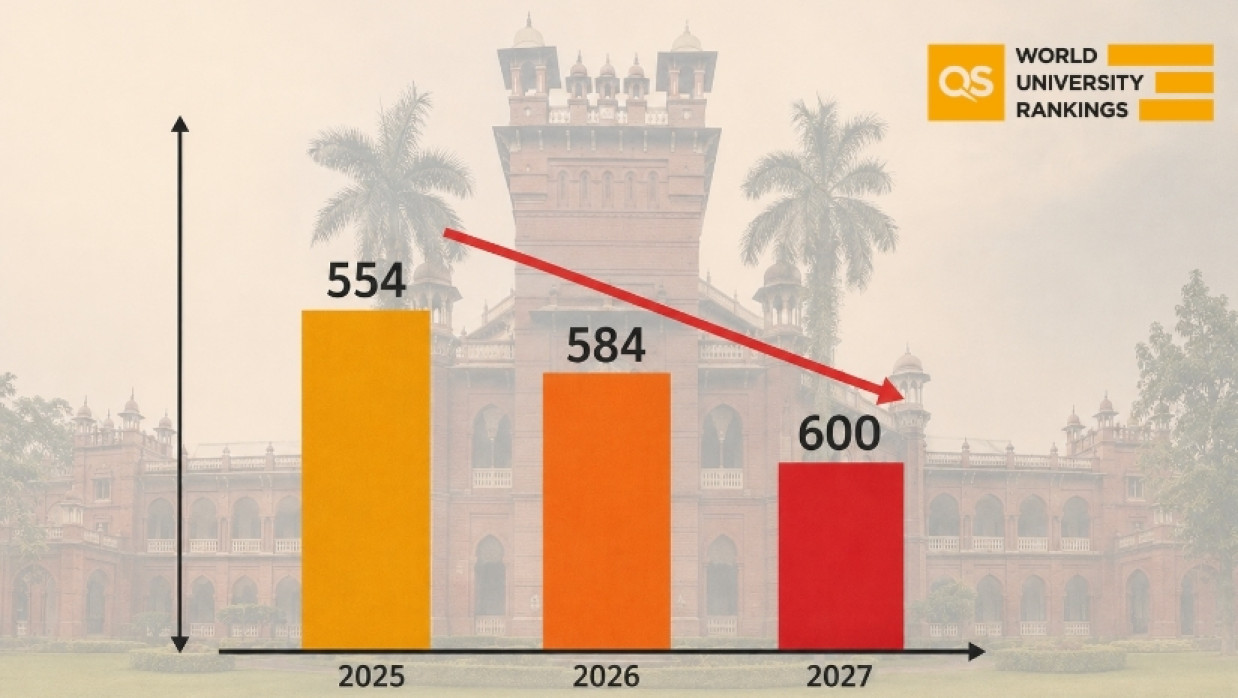
Although the University of Dhaka (DU) has retained its position as the top-ranked institution within Bangladesh, the country’s premier public university has suffered a consecutive drop in the newly released QS World University Rankings 2027.
The report, published on Thursday, June 18, by the UK-based higher education analytics firm Quacquarelli Symonds (QS), features a total of 13 higher education institutions from Bangladesh. This includes eight public, four private, and one international university among 1,504 ranked institutions worldwide.
A Three-Year Downward Trajectory
An analysis of the performance metrics over the past three evaluation cycles reveals that the University of Dhaka has consistently ceded ground on the global stage.
In the newly published 2027 rankings, DU is placed at the flat 600th position globally. This marks a clear drop of 16 spots from the previous 2026 edition, where the university stood at 584th.
The institution achieved its historic peak in the 2025 edition of the index, when it breached the top-600 threshold for the first time, securing the 554th position globally.
Prior to that breakthrough, the university was positioned in the 691 to 700 bracket during the 2024 assessment. While DU registered a significant upward jump between 2024 and 2025, it has been unable to sustain that momentum, experiencing back-to-back declines over the last two years.
National Standings and Methodological Factors
Despite its global slide, the University of Dhaka maintains its premier status domestically. Bangladesh University of Engineering and Technology (BUET) locked in the second spot nationally, ranking in the 711 to 720 bracket, while North South University (NSU) held its ground at third place nationally, positioning itself in the 901 to 950 range. These three institutions remain the only universities from Bangladesh to maintain a presence within the top 1,000 elite global bracket.
Higher education experts attribute these fluctuating performances to several key evaluation parameters used by QS. These include academic reputation, employer perception, citations per faculty, faculty-student ratios, and the level of internationalization, including the proportion of foreign students and faculty members.
The continued decline of the country's flagship university underscores an urgent need for structural academic reforms, increased research funding, and improved global collaboration frameworks to regain lost ground in international assessments.
 Follow The Daily Campus on Google News