ADB-SIPG Training at NSU Strengthens Capacity in Public Policy Monitoring and Evaluation
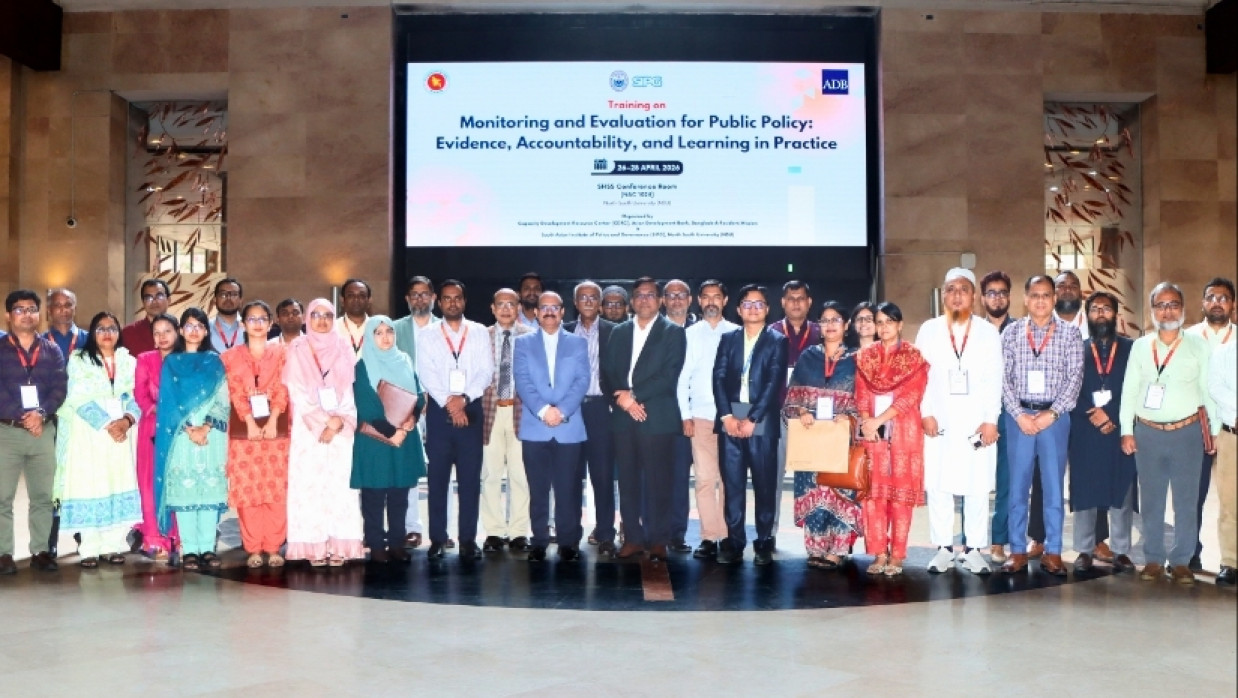
The South Asian Institute of Policy and Governance (SIPG) at North South University (NSU), in collaboration with the Asian Development Bank (ADB), successfully concluded a three-day intensive training program today. Titled “Monitoring and Evaluation for Public Policy: Evidence, Accountability, and Learning in Practice,” the workshop was held from April 26 to 28, 2026, at the NSU campus.
The program brought together senior government officials and policy practitioners from various ministries and public institutions. The primary objective was to strengthen their expertise in monitoring and evaluation (M&E), fostering evidence-based decision-making and higher accountability in the implementation of public policies.
Throughout the three-day initiative, participants moved beyond traditional compliance-based reporting to focus on learning-oriented M&E approaches. The curriculum included interactive sessions and hands-on exercises covering results frameworks, administrative data utilization, evaluation methods, and adaptive management. The sessions were specifically designed to address institutional constraints and the unique policy challenges faced within the context of Bangladesh.
The closing ceremony took place on April 28 at the NSU Moot Court Room, where certificates were presented to the participants. The event was moderated by Dr. Rizwan Khair, Chair of the Department of Political Science and Sociology at NSU.
Professor Sk. Tawfique M. Haque, Director of SIPG, emphasized the necessity of shifting toward adaptive governance. S.M. Ebadur Rahman, Lead Social Sector Officer at the ADB Bangladesh Resident Mission, highlighted the importance of institutional partnerships in improving public sector performance.
The Vice-Chancellor of North South University, Professor Abdul Hannan Chowdhury, attended as the Chief Guest. In his address, he underscored that such capacity-building initiatives are vital for enhancing governance and the quality of public service delivery in the country.
The program concluded with praise from academics and development practitioners, who described the initiative as a timely step toward strengthening the nation’s policy implementation capacity. This collaboration further reflects SIPG’s ongoing commitment to professional training and policy-relevant research in the South Asian region.
 Follow The Daily Campus on Google News