On This Day in 2024
67 Killed Nationwide on Day 2 of 'Complete Shutdown'; Curfew Imposed, Military Deployed
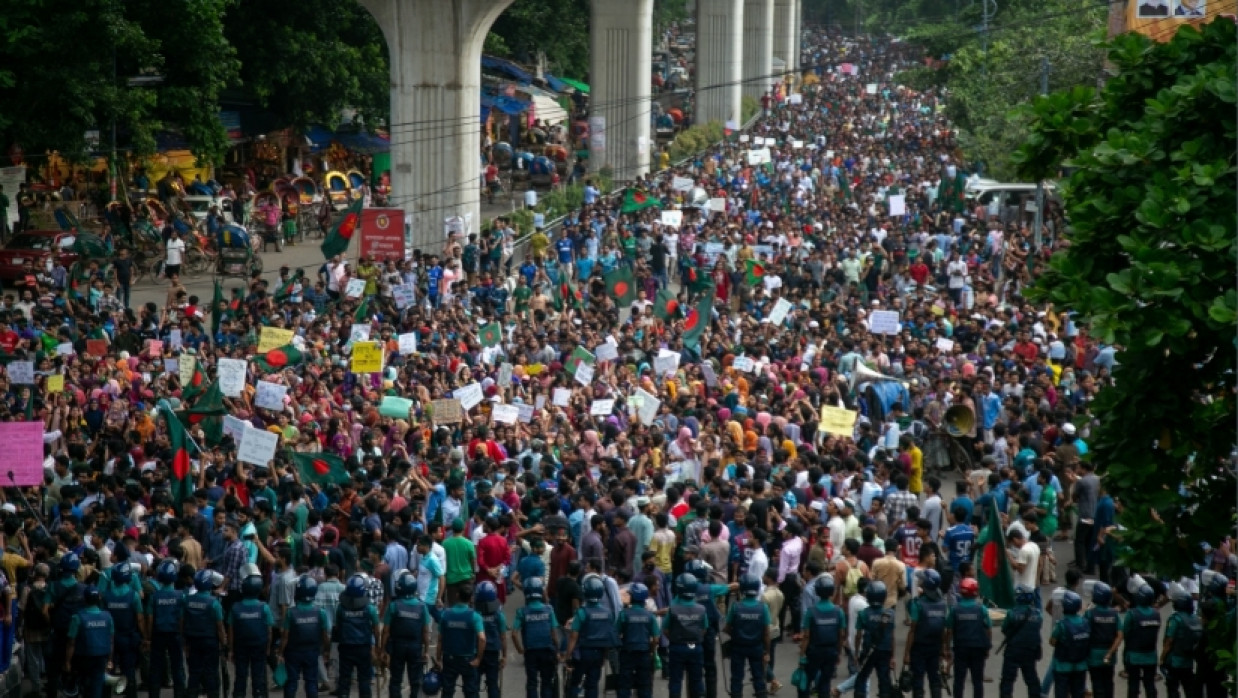
July 19, 2024, marked the second consecutive day of the student-led "Complete Shutdown" enforcing reforms to the civil service quota system. The day witnessed unparalleled escalation across the capital and multiple districts, characterized by fierce clashes, gunfire, targeted assaults, vandalism, and arson. As casualties mounted rapidly and law enforcement lost control of critical zones, the then-government declared a nationwide curfew at midnight and deployed the military to restore order.
Statistical tracking from the day indicates that at least 67 individuals lost their lives nationwide amidst the violence. The capital bore the brunt of the casualties, recording at least 62 deaths. Outside Dhaka, two fatalities were logged in Rangpur, alongside one each in Savar, Sylhet, and Narsingdi. However, conflicting media accounts from the following day reported up to 12 fatalities outside the capital, including five in Rangpur and individual deaths across Gazipur, Bogura, Mymensingh, Sylhet, and Madaripur.
Ground Realities and Urban Clashes
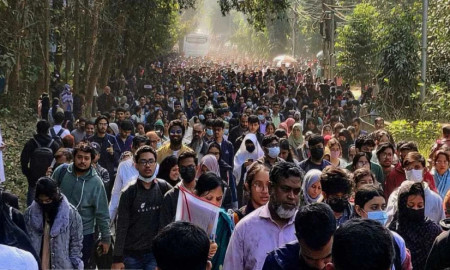
Throughout the day, protesting students—joined by activists from the BNP and various political organizations—engaged in pitched battles against law enforcement personnel and cadres from the ruling Awami League and its affiliate fronts. Security forces opened fire on demonstrators, triggering a massive influx of bullet-riddled casualties that overwhelmed the operational capacity of major public and private hospitals.
Protesters barricaded the arterial route near the Bangladesh Television (BTV) headquarters early in the morning, holding the perimeter stretching to the Rampura Bridge as violent standoffs involving the Police, BGB, and RAB persisted deep into the night. Clashes erupted across Dhanmondi, Mohammadpur, Badda, Uttara, Mohakhali, Paltan, Press Club, Bijoynagar, Old Dhaka, Sutrapur, and Laxmibazar, while the Gulshan-Badda Link Road and Natun Bazar areas similarly turned into battlegrounds.
Following Friday prayers, private university students occupied Pragati Sarani, where eyewitness reports detailed coordinated assaults by Awami League, Chhatra League, and Jubo League cadres wielding sticks and sharp weapons across Kuril and Kalachandpur. In Kuril, RAB helicopters were observed deploying tear gas canisters, sound grenades, and discharging live ammunition—an allegation the agency subsequently denied, claiming the aerial units were strictly utilized for surveillance and rescue operations. Meanwhile, in Uttara, a demonstration led by former Gazipur City Mayor Jahangir Alam was repelled by students following an exchange of gunfire.
Sabotage and Infrastructure Shutdowns
Key state infrastructure and public utilities faced systemic attacks and arson throughout the afternoon. The state television station was set on fire, forcing an immediate suspension of all terrestrial broadcasting. The Rampura police station and various outposts were overrun, while five police boxes spanning from Mirpur-10 to Purebi were dismantled.
Furthermore, the head office of the Bangladesh Road Transport Authority (BRTA) in Banani, its Metro-1 branch in Mirpur, and the Directorate General of Health Services (DGHS) old building in Mohakhali were subjected to extensive arson. Following extensive damage inflicted upon the Kazipara station, the Dhaka Metro Rail operations were suspended indefinitely, while long-distance bus services, commuter rail networks, and several international flights were completely grounded.
Prison Break and Regional Unrest
Outside Dhaka, the unrest manifested in major localized revolts. In an unprecedented breach, the Narsingdi District Jail was stormed by an armed crowd, where jail officials and guards were taken hostage, allowing inmates to break out and escape after looting weapons from the prison armory.
Simultaneously, the Dhaka Metropolitan Police enforced an immediate ban on motorcycle movement across the capital citing security emergencies. Concurrently, a total nationwide internet blackout was executed by regulatory authorities for over 24 hours, paralyzing online banking, telecommunications, and digital news verification.
Political Deadlock and the 9-Point Demand
Prior to the midnight curfew, high-level security meetings were convened at Ganabhaban involving the Prime Minister, the Home Minister, the IGP, the DG BGB, and the DMP Commissioner. Shortly thereafter, Nahid Islam, one of the primary coordinators of the Anti-Discrimination Student Movement, was detained by plainclothes security personnel.
In response to the government's backchannel offers for dialogue, the coordinators formally rejected any negotiations, labeling the proposal a "farce." At approximately 9:30 PM, coordinator Abdul Kader announced a comprehensive 9-Point Demand framework that demanded a public apology from then-Prime Minister Sheikh Hasina accepting responsibility for student fatalities, the immediate resignation of Home Minister Asaduzzaman Khan and Road Transport Minister Obaidul Quader, and the summary dismissal of law enforcement officials involved in the operational orders to open fire.
The framework also sought the immediate resignation of the Vice-Chancellors and Proctors of Dhaka University, Jahangirnagar University, and Rajshahi University, alongside the filing of direct murder charges against police personnel and Awami League affiliates responsible for the deaths. Furthermore, the coordinators demanded state-funded financial compensation for the families of all victims, a permanent ban on partisan student politics across all campuses with the reinstatement of functional student unions, the immediate reopening of all educational institutions and residential halls, and an absolute legal guarantee against any future academic or administrative harassment of participating students.
While then-Law Minister Anisul Huq announced the formation of a judicial inquiry committee and pledged to fast-track a full-bench Supreme Court hearing on the quota issue, the student leadership maintained their absolute non-cooperation stance. Concurrently, citizens and civil society members demonstrated solidarity, as parents and professionals organized a human chain at Shahbagh under the banner of "Guardians Next to Children" to protest the state crackdowns.
 Follow The Daily Campus on Google News