Politics vs Pedagogy: Why Tarique Rahman’s academic journey remained "incomplete"
The academic background of Tarique Rahman, chairman of the Bangladesh Nationalist Party (BNP), has long been a subject of public discourse. Much of the criticism directed at the political leader centers on his inability to complete his formal higher education. For the son of late President Ziaur Rahman and three-time Prime Minister Begum Khaleda Zia, the question of why he could not finish his university degree has frequently surfaced in political rhetoric, talk shows, and social media debates.
The record does not cooperate with that reading.
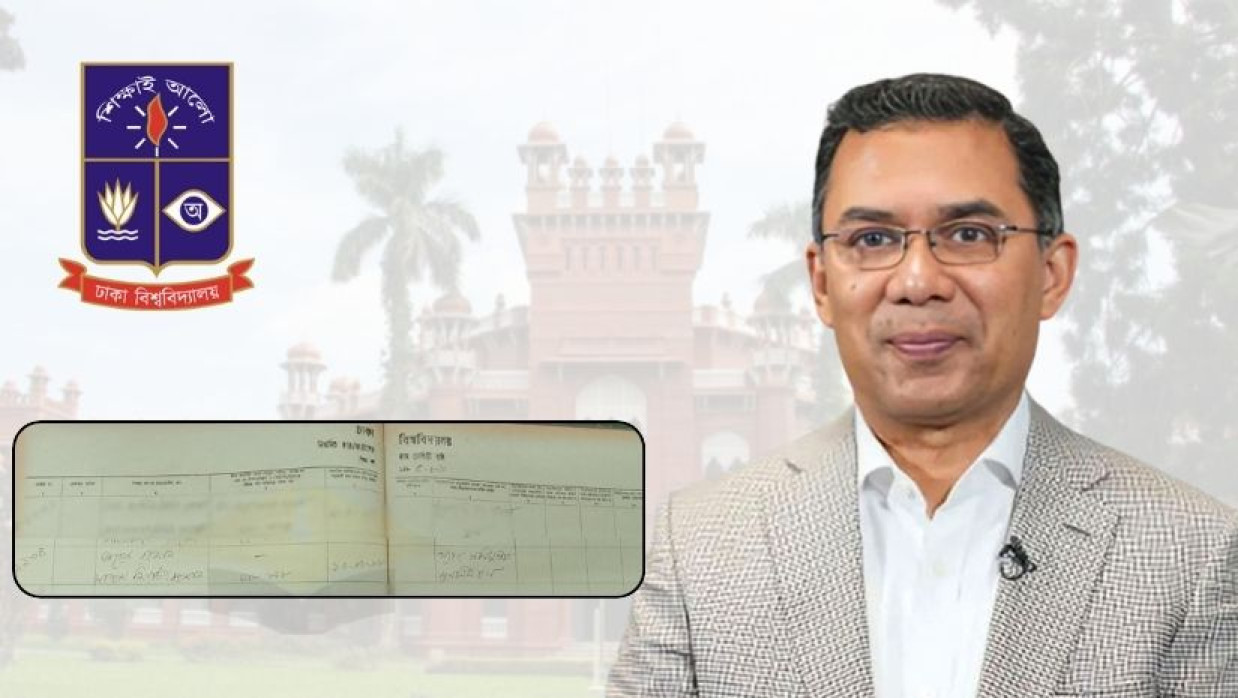
Rahman enrolled in the Department of Law at Dhaka University for the 1985-86 academic session, later transferring to International Relations. He held a formally allotted seat at Sir Salimullah Muslim Hall, documented in the hall's regular student registry. None of that is disputed. What interrupted his studies was not laziness or indifference. It was a campus that had effectively ceased to function as a place of learning.
.jpg)
General Hussain Muhammad Ershad ran Bangladesh as an autocracy through the 1980s, and Dhaka University absorbed the consequences more than perhaps any institution in the country. Mamunur Rashid, an office assistant at Kabi Jasimuddin Hall during that period, told The Daily Campus that regular classes had become a fiction. The campus was a battleground. Gunfire was not metaphorical. Examinations originally scheduled for 1977 routinely did not take place until 1981. Session jams of three and four years were the norm, not the exception.
For most students, this was a shared misfortune. For Rahman it carried an additional dimension. He was the son of late President Ziaur Rahman, which made him a specific target of the Ershad administration's efforts to neutralize the political opposition.
He had been detained alongside his mother, Begum Khaleda Zia, and his younger brother during the Liberation War of 1971, when he was three years old. By 1986 he was appearing at the National Press Club to denounce state security agencies attempting to suppress democratic opposition, after which the military government subjected both him and Khaleda Zia to repeated house arrests.
Professor Mohammad Ainul Islam of DU's Political Science Department put it plainly: navigating a formal degree track was functionally impossible for anyone from a high-profile political family during the turbulence spanning the early 1970s through the 1980s. Professor Nurul Amin Bepari, a former chairman of the same department and a direct teacher of Rahman's, recalled the mid-1980s as an era of total breakdown. Weapons were pervasive on campus.
Attending public lectures posed genuine physical risk for someone of Rahman's visibility. Dr. Himadri Shekhar Chakraborty, now acting controller of examinations at DU and a contemporary of Rahman's, confirmed that constant hall-centric violence victimized ordinary students across the board.
Rahman formally joined the BNP in 1988 through the Gabtoli Upazila unit. By then, the combination of regime-engineered campus collapse and mounting political responsibility had ended his academic chapter. The question worth asking is whether any of this reflects on his fitness for political leadership.
The historical evidence suggests it does not, in either direction. Abraham Lincoln read law on his own and never attended college. George Washington held no degree. The credential became a proxy for competence only when someone needed a proxy. Bangladesh's political culture has long preferred biography as a battlefield, parsing family trees and transcripts in lieu of debating policy.
Rahman's critics are entitled to oppose him on any number of grounds. The BNP's record in government, its organizational choices, its positions on governance and democratic norms, all are legitimate subjects of scrutiny. An unfinished degree from a university that Ershad's regime had rendered inoperable is not.
The political pressure applied to his family was documented. The session jams were documented. The house arrests were documented. The campus gunfire was documented by the people who worked there. Treating the outcome of all that as evidence of personal failure requires ignoring the conditions that produced it.
Bangladesh would benefit from holding its political figures accountable for what they have done in office rather than what they could not finish in a dormitory forty years ago.
 Follow The Daily Campus on Google News