Dr Muhammad Shahidullah: From Master Linguist to Pioneer of the Language Movement
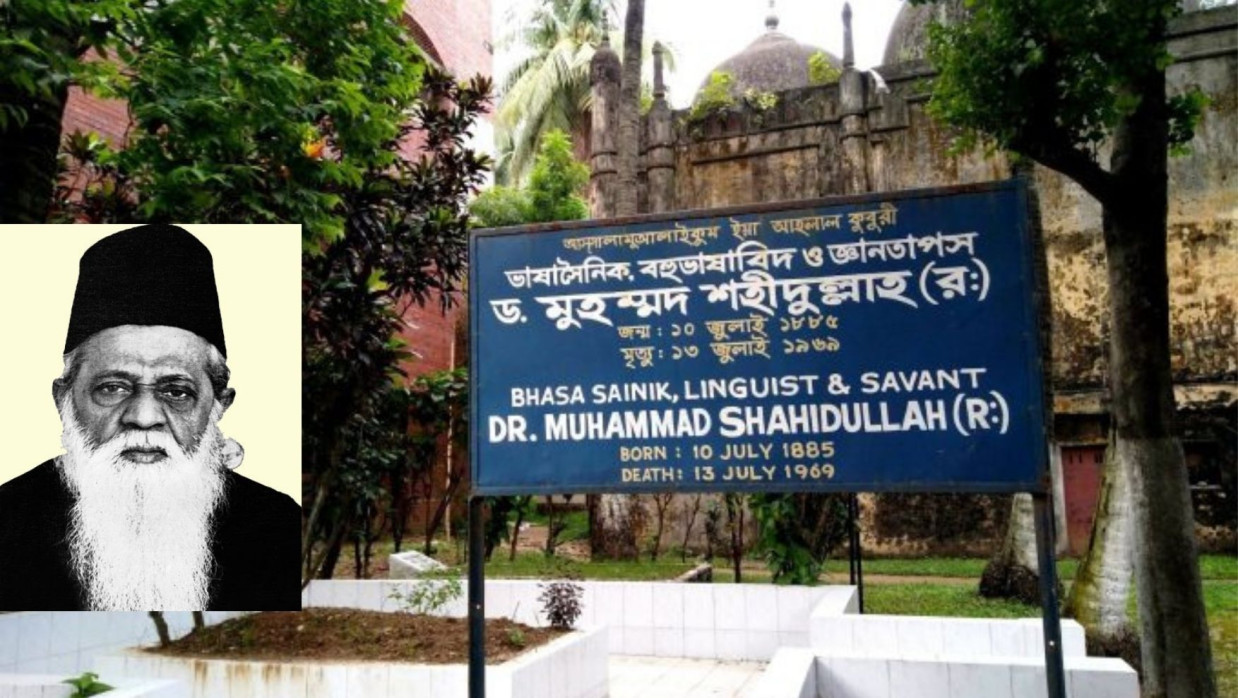
Dr Muhammad Shahidullah is one of Bangladesh’s most extraordinary scholars. Although born in the Twenty-Four Parganas district of West Bengal, India, almost his entire professional and scholarly life was spent in Dhaka, the capital of Bangladesh. His grave is located in the courtyard adjacent to the historic Musa Khan Mosque near Curzon Hall at Dhaka University. It is worth mentioning that he regularly offered Jumu’ah prayers at this mosque and served as its imam for many years.
Born into a Bengali Muslim family, he earned his B.A. (Honours) in Sanskrit, a “foreign” language, from the University of Calcutta in 1910, an exceptional achievement in the social context of that era.
When a section of conservative Hindu Sanskrit scholars refused to teach him at the M.A. level in Sanskrit, he turned his attention to comparative philology and completed his M.A. in that subject from Calcutta University in 1912. Notably, he was the first Bengali to obtain this degree.
Later, he pursued advanced research on the language and phonology of Charyapada, the oldest literary work in the subcontinent, at the renowned Sorbonne University in Paris and the University of Freiburg in Germany. He earned a D.Litt. in linguistics and a Diploma in phonetics. As an Indian Muslim, his D.Litt. in linguistics was the first of its kind, and his Diploma in phonetics was the first in Asia.
This rigorous scholarly journey deepened his lifelong commitment to the Bengali language, literature and phonetics, resulting in his invaluable collection of works.
Born on 10 July 1885 in Peyara village of Twenty-Four Parganas, this great thinker passed away on 13 July 1969 at his residence “Peyara Bhaban” in Dhaka. He was buried beside the Musa Khan Mosque near Curzon Hall.
Dr Muhammad Shahidullah is widely recognised as a linguist and eminent educationist. Yet his role as an uncompromising and visionary language warrior during the Bengali Language Movement is often overlooked. In the history of that movement, no one was more learned, courageous and far-sighted than him – not then, and arguably not even today.
After the creation of Pakistan in 1947, when the state language controversy arose, Dr Shahidullah took an unwavering stand in favour of Bengali. He strongly opposed the attempt to impose Urdu as the sole state language while ignoring the fact that Bengali was the mother tongue of the majority of Pakistan’s population. At the same time, he clearly stated that Pakistan was not exclusively a Muslim country; the mother-tongue rights of non-Muslims living in the country deserved equal respect.
Quoting verses from the Holy Qur’an, he argued that Islam stands for the dignity of the mother tongue, not for any particular language. In his words: “Urdu can never usurp the rightful place of Bengali by force; the rightful place belongs to Bengali.” Yet he never denied the importance of Urdu. Acknowledging its role as a link language between provinces, he advocated for both Urdu and Bengali to be granted equal status as state languages.
His clear, balanced and principled position was not the product of emotional or political rhetoric, but the outcome of a lifetime of research, comparison and analysis. As early as 1920, while at Visva-Bharati in Santiniketan, he had discussed the rational claims of Urdu, Bengali and Hindi in the context of a “common language for India.” In the course of history, his early proposal found fulfilment when Urdu, Bengali and Hindi became the state languages of three independent nations.
Dr Muhammad Shahidullah proved that language is not something to be imposed by religious authority or numerical majority; it is a fundamental right of self-identity. In him converged the identities of linguist, educationist and language warrior – making him an inseparable pillar of Bengali language and Bengali national identity.
It is worth noting that his 140th birth anniversary will be observed in July 2026.
 Follow The Daily Campus on Google News