
Interview Part II
Prioritizing Quality, Research, and Regulatory Strength in Higher Education
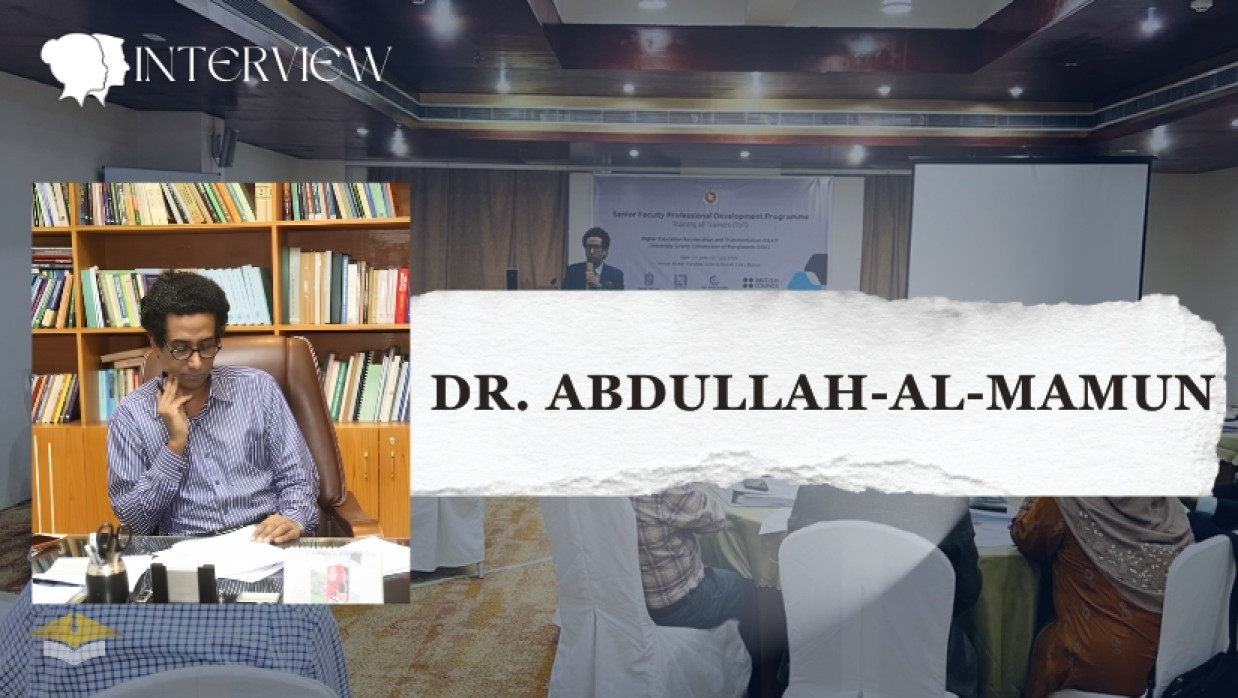
Professor Dr. Abdullah-Al-Mamun. On May 23, the government appointed this professor and former chairman of the Department of Japanese Studies at Dhaka University as a full-time member of the University Grants Commission of Bangladesh (UGC). He will serve in this position for the next four years. Dr. Mamun has also made significant contributions to education and research at the international level. He obtained his PhD in International Economic Development from the Department of Economics, Finance, and Accounting at the University of Huddersfield, United Kingdom.
His primary fields of research include Japanese Studies, development planning, international development cooperation, development project management, aid effectiveness, development sociology, and political sociology. He also possesses an outstanding record in research and publication.
The number of books, book chapters, and research articles published by Dr. Mamun exceeds 50. His research has been published in various internationally recognized journals. In addition, his books and book chapters have been published by renowned international publishing houses such as Springer, Routledge, Palgrave Macmillan, and Emerald. He spoke to The Daily Campus regarding the government's plans for the overall improvement of the country's education quality, his thoughts on higher education, and various aspects of the education system. The second and final part of the two-part interview is published today—
The Daily Campus: Domestic universities are missing from the top 500 list in international rankings. What is the way forward to overcome this situation?
Professor Dr. Abdullah-Al-Mamun: No university in Bangladesh has yet been able to consistently secure a place among the top 500 in international rankings. This is certainly not a pleasant matter for us. However, it must also be remembered that international rankings are primarily determined based on various indicators such as education, research, internationalization, teacher-student ratio, research citations, and the university's reputation among employers. We have opportunities for improvement in these areas.
In my opinion, to overcome this situation, the highest priority must be given to research. A strong research culture operates behind the success of the world's top universities. In our universities as well, we must increase quality research, publications in international journals, and the global impact of our research. Increasing investment in research and developing research infrastructure are crucial in this regard.
At the same time, the teacher-student ratio must be improved, modern laboratories and academic facilities must be increased, and international cooperation must be expanded. It is also necessary to create a favorable environment to attract foreign teachers and students. This is because internationalization is now an important indicator in determining a university's quality.
Curriculums must also be made more up-to-date and research-oriented. Universities should be developed not just as degree-awarding institutions, but as centers of knowledge creation and innovation. If effective cooperation can be built among industries, research institutions, and universities, positive changes will occur in both research quality and employment.
The UGC can play an important role in this regard through policy support, quality assurance, research financing, and increasing international cooperation. Currently, efforts are underway to bring qualitative changes to higher education through various initiatives, including the ‘Higher Education Acceleration and Transformation (HEAT)’ project. If these initiatives are successfully implemented, Bangladesh's universities will be able to attain a better position in international rankings in the days ahead.
I believe that if we focus on the quality of education, research, innovation, and building an academic environment of international standards instead of targeting rankings as the end goal, progress in rankings will follow naturally.
Recently, a national seminar organized by the UGC titled "Transformation of Higher Education in Bangladesh: Roadmap for Sustainable Excellence" highlighted a multidimensional plan for the transformation of higher education and improvement in rankings. These plans will be implemented with high importance.
The Daily Campus: Apart from a few top-tier private universities, there is considerable criticism regarding the quality of education in most of them. What could be the UGC's plan to elevate their quality?
Professor Dr. Abdullah-Al-Mamun: Currently, among the 116 private universities in the country, academic activities are functional in 107. Out of these, 55 universities are conducting their academic operations on their own permanent campuses, while 61 universities are still operating on temporary campuses.
Private universities are making a significant contribution to the expansion of higher education in the country. Currently, a large portion of students enrolled in higher education are studying in these institutions. However, it is also true that apart from a few leading universities, questions exist regarding the educational quality, research activities, number of faculty members, and infrastructure of many institutions.
In my view, rather than approving new universities now, it is more necessary to emphasize the quality improvement of existing universities. First of all, a comprehensive evaluation needs to be conducted regarding the academic capacity, teacher-student ratio, research activities, infrastructure, and employment status of the country's private universities. Based on this, development plans can be adopted by identifying where each university is lagging behind.
One of the prime responsibilities of the UGC will be to further strengthen the quality assurance system. Universities must be brought under regular academic and administrative evaluation. Fundamental conditions such as permanent campuses, an adequate number of full-time teachers, a research environment, modern laboratories, and libraries must be strictly ensured.
At the same time, the curriculum must be made more aligned with the demands of the labor market. In many cases, it is observed that even though students earn degrees, they fail to acquire the necessary skills for the workplace. Therefore, emphasis must be placed on industry-academia collaboration, internships, practical learning, and skill-based training.
The culture of research also needs to be strengthened. Currently, research activities in many private universities are limited. This situation can be improved by increasing research grants, collaborative research, and international cooperation.
I think the goal of the UGC should not just be to enforce rules and regulations, but to play a supportive role in enhancing the capacity of universities. Significant improvement in the quality of education at private universities can be achieved if importance is given to three aspects: accountability, quality assurance, and continuous development, allowing them to play a more effective role in developing the country's human resources.
The Daily Campus: New public and private universities are being established across the country. Yet, universities are failing to ensure proper education and research. To what extent do you consider granting approvals in this manner to be logical?
Professor Dr. Abdullah-Al-Mamun: The establishment of new universities is necessary to increase access to higher education, reduce regional disparities, and develop human resources. However, the fundamental objective of establishing a university must be to provide quality education, conduct research, and create skilled human resources. Merely increasing the number of institutions cannot be the sole indicator of higher education development.
The reality is that although the number of universities in the country has increased rapidly, the quality of education, research activities, infrastructure, and the number of skilled teachers have not increased at the same rate in many cases. Some universities still face a shortage of adequate teachers, laboratories, libraries, accommodation, and academic facilities. As a result, ensuring quality education and research has become a challenge. The current government's plan to increase the education budget will play a role in solving these problems.
In my opinion, there should be a need-based and capacity-based plan when approving new universities. It is necessary to deeply evaluate whether a university is needed in a particular region, what the structural and financial capacity of the proposed institution is, and whether it will be possible to ensure adequate faculty recruitment and a proper research environment. Simply increasing the number of universities without ensuring quality will not bring long-term benefits to higher education.
In this regard, the government can take the opinion of the UGC before establishing new universities. After a university is set up, the UGC's job will be to ensure quality assurance, regular monitoring, and accountability of the universities. Along with establishing new institutions, equal importance must be given to the educational quality, research capacity, and infrastructural development of existing universities. We are now trying to ensure transparency and accountability in various areas, including recruitment at public universities.
The Daily Campus: Public university teachers show less interest in research. Is that due to their personal reluctance, or is it a lack of opportunities and facilities? What does your experience say?
Professor Dr. Abdullah-Al-Mamun: I do not want to view this matter solely as a reluctance on the part of the teachers. The reality is that there are multiple structural challenges in the field of research. Many universities still experience a shortage of adequate laboratories, modern equipment, research assistants, access to international databases, and necessary administrative support. Particularly for research in science, engineering, and technology, the kind of infrastructure required is not equally available across all universities.
However, it is also true that research is fundamentally a matter of mindset and academic culture. Despite having the necessary facilities, a lack of expected interest in research is observed in some cases. On the flip side, many teachers are earning praise by conducting international-standard research even within limited facilities. Consequently, this matter cannot be explained by a single reason alone.
My experience tells me that the pressure of teaching, examinations, administrative tasks, and responsibilities in various committees is very high on the teachers in our universities. As a result, it becomes difficult to find sufficient time for research. At the same time, there are also some limitations in institutionally evaluating and incentivizing research outcomes.
I believe that to make research more attractive and fruitful, we must increase infrastructure, financing, and research support on one hand, and on the other hand, effectively link the qualitative standards of research with recruitment, promotion, and academic recognition. More weight needs to be given to publications in international-standard journals, research impact, and innovative contributions.
The most important aspect is to build a strong research culture within the university. If a teacher is active in research, students will also become interested in it. Only a research-oriented university can create new knowledge, encourage innovation, and make an effective contribution to the country's development. Therefore, I believe this is not just a question of facilities, but rather an integrated matter of opportunities, incentives, and a research-friendly culture.
It is worth noting that in the 2025-26 fiscal year, the total allocation increased to 219 crore BDT, which includes 194 crore BDT for universities and 25 crore BDT for the UGC. Under the ICSETEP project, 20 Industry-University Collaborative Research projects are currently under implementation to encourage research and innovation in the IT sector, with a total allocation of 38 crore 21 lakh BDT. On the other hand, under the HEAT project, 180 sub-projects are currently under implementation, for which a total of 641 crore BDT has been allocated.
Overall, a new door of potential has opened in the country's higher education and research sector through the government's continuous investment, assistance from international development partners, and the coordinated initiatives of the UGC. If these initiatives are successfully implemented, the universities of Bangladesh will be able to play a more effective role in building a knowledge-based society, an innovation-driven economy, and a Smart Bangladesh.
The Daily Campus: Is it possible to control nearly 170 universities with such a small workforce at the UGC? Does this disrupt the normal pace of work, or does it not cause any problems?
Professor Dr. Abdullah-Al-Mamun: The reality is that monitoring the activities of nearly 170 universities in the country with the UGC's existing workforce and infrastructure is a massive challenge. The higher education sector has expanded rapidly over the last two decades, but the organizational capacity of the UGC has not increased proportionally. As a result, the workload has naturally increased heavily.
I will not say that work is stopping or that the UGC is failing to perform its duties. However, managing such a large sector with a limited workforce creates extra pressure on the officials. In many cases, the same official has to perform multiple responsibilities. Along with regular bureaucratic tasks, they have to manage university inspections, policy-making, project implementation, research activities, meetings, and various urgent matters.
Under these circumstances, many officials work beyond designated office hours. Sometimes, responsibilities have to be carried out even on weekly holidays. Since joining, I have observed that the officers and staff of the UGC are discharging their duties with utmost dedication and sincerity. It is because of their efforts that the continuity of work is being maintained.
However, it is also true that to meet the growing demands of the higher education sector in the long run, the workforce, technological capability, and infrastructure of the UGC need to be strengthened further. An adequate workforce is indispensable for quality assurance, research monitoring, international cooperation, and close observation of university activities.
In my opinion, given the current realities of higher education, the organizational restructuring and capacity enhancement of the UGC are demands of the time. Without a strong and efficient regulatory body, it will be difficult to ensure the qualitative development and good governance of higher education. Therefore, considering future needs, the matter of increasing the institutional capacity of the UGC should be considered with high importance. To this end, the proposed ‘Higher Education Commission’ law needs to be implemented swiftly.
 Follow The Daily Campus on Google News