Interview Part I
Ensuring Research and Skill-Based Higher Education is Our Priority
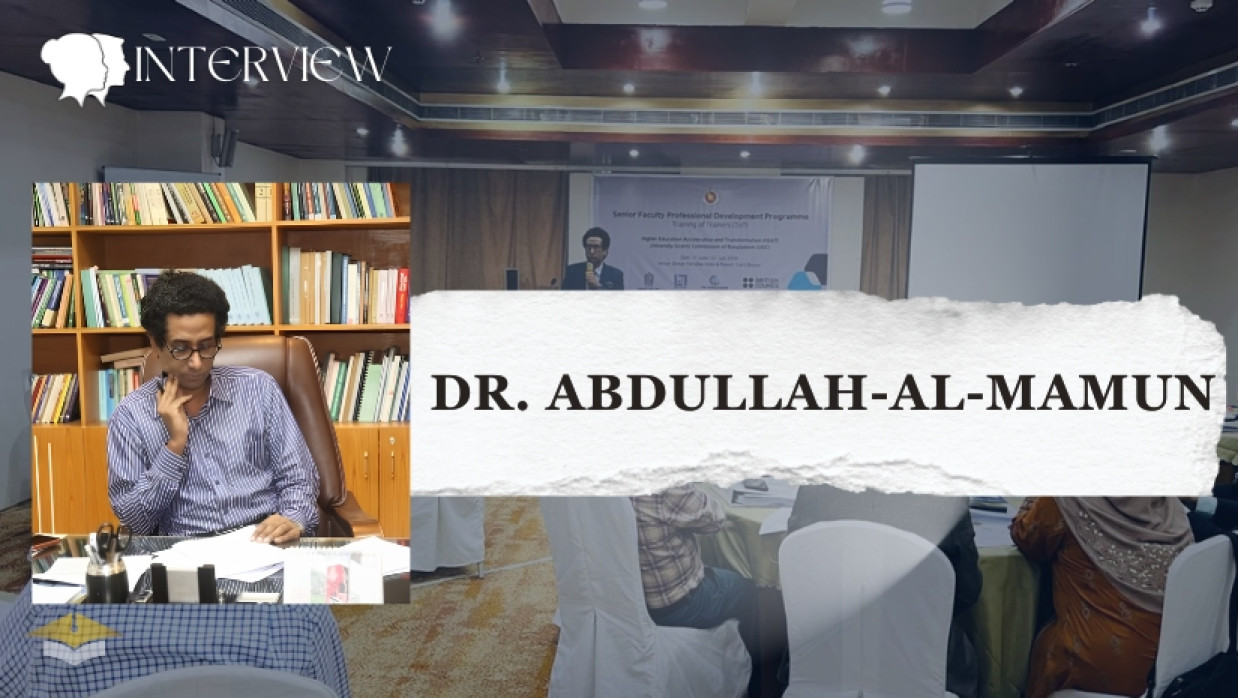
Professor Dr. Abdullah-Al-Mamun, the newly appointed full-time member of the University Grants Commission (UGC) of Bangladesh, stated that improving the overall quality of higher education, enhancing research capacity, and introducing career-oriented curricula are the top priorities of the current education administration. On May 23, the government appointed him as a full-time member of the UGC for the next four years.
This professor and former chairman of the Department of Japanese Studies at Dhaka University is also a renowned researcher internationally. He obtained his PhD in International Economic Development from the Department of Economics, Finance, and Accounting at the University of Huddersfield, UK. His published books, book chapters, and research articles number more than 50, and his work has been published in internationally recognized journals as well as by prestigious international publishing houses such as Springer, Routledge, Palgrave Macmillan, and Emerald.
On the occasion of completing nearly one month of his joining the UGC, he spoke with The Daily Campus about the reform of the country's higher education system, the budget, and future plans. The first part of the two-part special interview is published today—
New Responsibilities and Work Experience at the UGC
The Daily Campus: It has been about a month since you were appointed as a full-time member of the UGC. Which department have you been given charge of, and what is your experience working at the UGC so far?
Professor Dr. Abdullah-Al-Mamun: On May 23, the Secondary and Higher Education Division of the Ministry of Education appointed me as a member of the UGC. I received this responsibility for the next four years in accordance with the Bangladesh University Grants Commission Order, 1973. Around a month has passed since then.
During this time, I have had the opportunity to participate in various meetings of the Commission, official activities, and policy discussions. I have also participated as a representative of the UGC in events organized at various universities across the country. As a result, within a short period, I have had the opportunity to observe various issues in the field of higher education from up close.
Currently, I am in charge of the Public University Management Division and the Public Relations and Right to Information Division of the UGC. Along with this, I have also been given the responsibility of the subcommittee related to Teachers' Training, Graduate Employability, and Skill Development under the UGC's Higher Education Acceleration and Transformation (HEAT) project. I consider these responsibilities related to improving the quality of higher education and developing the skills of teachers and students to be extremely important.
The work environment at the UGC is highly positive and professional. Under the leadership of Chairman Professor Dr. Mamun Ahmed, the members and officials of the Commission are working in a coordinated manner. I have long experience in teaching, research, and various administrative responsibilities at Dhaka University.
I am getting the opportunity to utilize that experience at the UGC. I believe that the UGC has an important role to play in implementing the government's commitment to higher education, ensuring good governance in universities, and improving the quality of education. To achieve this, the cooperation of all stakeholders associated with the universities is required.
National Higher Education Policy and Budget Allocation
The Daily Campus: What should the government's higher education policy look like? What will be the role of the UGC in that regard?
Professor Dr. Abdullah-Al-Mamun: The government's policy priorities include increasing investment in the research sector in higher education, expanding women's participation and empowerment, expanding technology-driven education, and improving the qualitative standards of education.
At the same time, an undergraduate curriculum that is modern and outcome-based, skill development, entrepreneurship initiatives, and an international-standard research environment must be ensured in universities. Education should not be considered an expense; rather, it needs to be viewed as one of the state's most important investments in human resource development.
The UGC will formulate a coordinated roadmap in light of the government's higher education-related policies and the UGC's strategic plan. The UGC will play an effective role as a policy-making, coordinating, and supervisory institution in implementing the government's higher education policy.
The UGC will work in areas such as ensuring the quality of education in universities, providing support for research and innovation, introducing a skill-based curriculum, increasing international cooperation, and establishing good governance. At the same time, the UGC will attach importance to coordinating the activities of public and private universities, strengthening the quality assurance system, and expanding funding opportunities for research.
Currently, considering the demands of artificial intelligence, digital technology, and the Fourth Industrial Revolution in higher education, a necessity has emerged to acquire new skills. Therefore, the UGC will provide the necessary policy support and guidance to make universities suitable for the future job market. Developing effective partnerships among universities, industries, research institutions, and relevant stakeholders to implement the government's higher education plan will also be one of the top priorities of the UGC.
In addition, initiatives will be taken to increase apprenticeships, internships, and industry-academia cooperation to make the country's higher education system more practical and career-oriented. To this end, this activity will be launched by establishing relationships between universities located in divisional cities and local industries and business enterprises. This will allow students to gain hands-on education and make it easier for them to enter professional life.
The future of Bangladesh depends on the improvement of education, the quality development of human resources, and skills in science and technology. The government is emphasizing building a skilled workforce. It has set a target to gradually make the education budget 5% of the GDP. In this very budget, the current government has increased the budget for the education sector by 56%. The government is giving importance to teaching a third language to students.
It is developing smart cities to create income sources for students alongside their studies. For the first time, money has been allocated in the budget for the creative economy. I believe that the government's goodwill has been reflected in this budget. Allocation in the education sector has been raised to 2% of the Gross Domestic Product (GDP), allocating a total of 1,36,606 crore BDT. I believe this budget will act as a catalyst to bring about radical changes in the country's higher education system.
Education Reform Commission and the Future Blueprint
The Daily Campus: The formation of an Education Reform Commission was mentioned in BNP's election manifesto for the overall improvement of the quality of education. What should the government's plan regarding the Education Reform Commission, education policy, or education law look like?
Professor Dr. Abdullah-Al-Mamun: Education is the most important vehicle for building a nation's future. Therefore, a long-term rather than a short-term perspective is required when reforming education, formulating an education policy, or enacting an education law. The core foundation of the BNP government's higher education philosophy is research, skill development, technology-driven education, women's empowerment, and linking higher education more effectively with employment and national development.
I believe the task of the Education Reform Commission will be to evaluate the country's entire education system in the context of new realities and formulate a realistic outline considering the demands of the coming decades. At present, the nature of knowledge, technology, and the job market is changing rapidly.
As a result, our education system must also adapt to that change. For this purpose, it is necessary to include local and foreign educationists, researchers, technologists, industry representatives, and experienced individuals from the education administration in the commission. At the same time, the opinions of students, teachers, and relevant stakeholders should also be considered with importance.
Regarding education policy, I am in favor of giving special emphasis to three aspects. Firstly, improving the qualitative standards of education; secondly, expanding research and innovation; and thirdly, skill-based and employment-oriented education. Universities must produce graduates who are not only capable of competing in the job market but can also contribute to the country's development through creating new knowledge, innovation, and entrepreneurial initiatives.
A coordinated and future-oriented perspective is also required in enacting education laws. Issues regarding university autonomy, accountability, quality assurance, research funding, and protecting the interests of students should be clearly reflected in the law. At the same time, new realities such as artificial intelligence, digital education, online learning, and international cooperation must also be taken into consideration.
It is my belief that through continuous reforms, adequate investment, and effective policy support in the education sector, Bangladesh will be able to build an educational system that is of international standard, research-driven, skill-based, and capable of facing future challenges.
Career-Oriented Plans to Eradicate Unemployment at National University
The Daily Campus: Plans for the development of National University were included in BNP's election manifesto. Research shows that a large portion of National University graduates remain unemployed. What would be your advice on creating employment opportunities for them?
Professor Dr. Abdullah-Al-Mamun: The issue of employment for National University graduates is now not just an issue for the education sector, but an important issue for national development as well. Although a massive number of students graduate with a bachelor's degree from National University every year, many of them are unable to enter the job market with the necessary skills. As a result, a gap has been created between degrees and employment.
In my opinion, to solve this problem, the curriculum must first be linked more closely with the demands of the labor market. In current times, subject-based knowledge alone is not enough; communication skills, proficiency in the English language, information technology knowledge, problem-solving capabilities, and teamwork skills are equally important. These skills need to become a part of the curriculum.
At the same time, an effective connection must be built between the industry sector and educational institutions. If opportunities for internships, apprenticeships, and work-based learning can be increased in colleges affiliated with National University, students will gain ideas about real work environments and stay ahead when entering the job market.
I believe it is also necessary to move away from the notion that every student must get a conventional job. Universities must also attach importance to producing entrepreneurs. If self-employment, innovation, and a start-up culture can be developed among students, new fields of employment will be created.
It is also crucial to improve the quality of education, teacher training, practical education, and career counseling in colleges affiliated with National University. At the same time, regular research must be conducted regarding how many graduates are needed in which subjects and what kind of skill demands exist in the labor market to plan admissions and the curriculum accordingly.
It is my belief that National University, as the country's largest higher education network, will not remain merely a degree-awarding institution. Rather, it will transform into a prime cradle for science, training, skill development, and building good citizens. Initiatives will be taken to expand vocational and technical education, launch career centers and job placement activities, strengthen industry-academia collaboration, increase apprenticeship and internship opportunities, establish language centers, expand third-language education, implement the 'Learning with Happiness' program, and introduce the 'One Student One Tree' initiative at National University. Efforts will be made to send the youth demographic abroad for white-collar jobs by enhancing their soft skills. The purpose of these initiatives is to build a qualified, responsible, and self-reliant young generation.
Additionally, to promote sports in educational institutions, the BNP government has promised to make sports education mandatory in the curriculum. Along with making sports compulsory at the school and college levels, they have announced the launch of 'Talent Hunt' programs at various levels, including universities. These plans are present in the party's sports framework to keep youth away from drug and gadget addiction. To implement the government's promise, the UGC is taking practical steps to promote sports in universities and encourage taking it up as a profession.
Quality and Research Environment in Public Universities
The Daily Campus: Questions are often raised regarding the quality of education in the country's public universities. It is said that research is almost non-existent. How can the UGC play a role in improving research and the quality of education?
Professor Dr. Abdullah-Al-Mamun: I believe that the biggest challenge facing the country's higher education right now is improving the quality of education and research capacity. Over the past 17 years under a decaying and fascistic governance system, the number of public universities and students in the country increased. However, compared to that growth, it failed to reach the expected levels in terms of research, innovation, and generating international-standard knowledge.
I do not want to frame it as a complete absence of research. A lot of good research is happening in the country. However, compared to our capacity and potential, both the volume and the impact of the research are low. One of the main reasons for this is long-term limited investment in research, lack of necessary infrastructure, and a lack of institutional encouragement for research.
The primary responsibility of the UGC will be to create an environment supportive of research and education in universities. Initiatives must be taken to increase allocations in the research sector, ensure transparency in distributing research grants, increase inter-university and international research cooperation, and link research findings with national development. Along with this, a more effective system needs to be developed to evaluate the quality of research.
The UGC has an important role to play in improving the quality of education as well. Work must be done to develop students' skills by modernizing the curriculum, strengthening quality assurance activities, increasing teacher training, expanding digital education, and enhancing industry-academia cooperation. Importance must also be given to ensuring that graduates coming out of universities can adapt to the demands of the job market and the future technology-driven economy.
Currently, the UGC's 'Higher Education Acceleration and Transformation (HEAT)' and 'ICSETEP' projects can play an important role in transforming higher education. Through these initiatives, it will be possible to further strengthen research capacity, teacher training, skill development, and university-industry cooperation.
It is my belief that simply increasing the research budget will not be enough; the effective utilization of those funds, accountability, and the qualitative standard of research must be ensured. If the new generation can be inspired toward research, scientific mindedness, and innovative thinking, the country's higher education and research will definitely reach a new height.
 Follow The Daily Campus on Google News