Super Specialized Hospital to Operate on Apollo-Evercare Model; Ownership Dispute Nearing Resolution
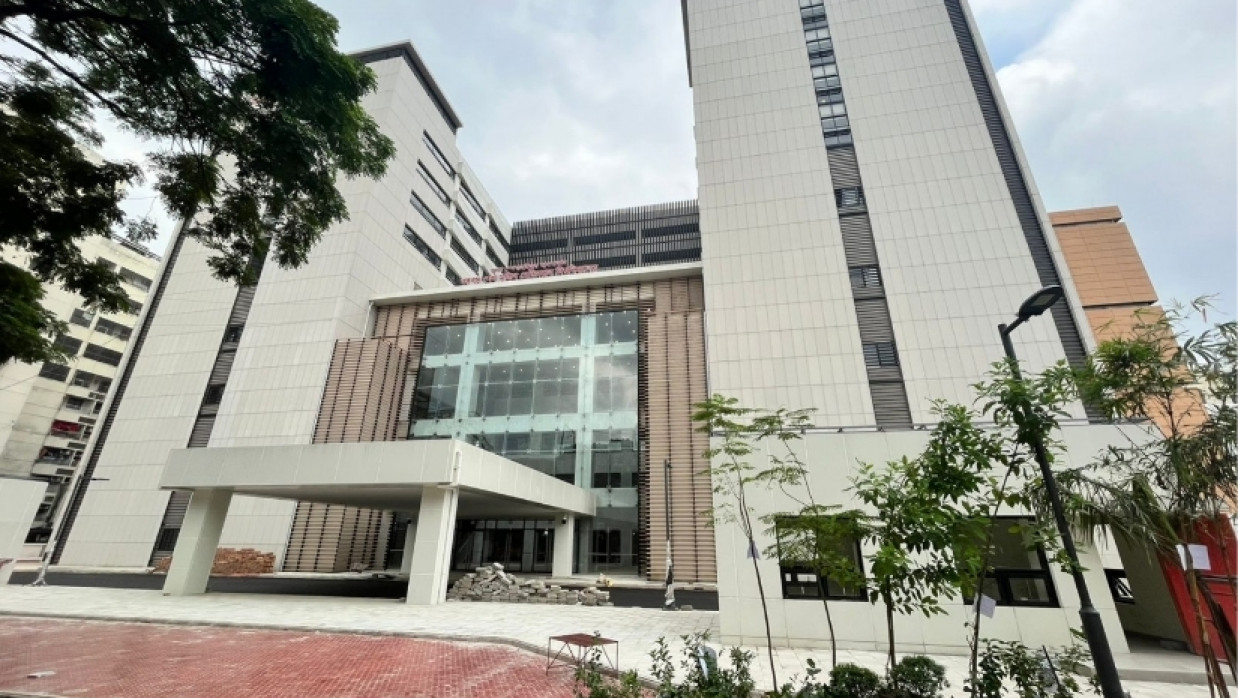
A structural initiative has been launched to amend the existing institutional framework of the Super Specialized Hospital under Bangladesh Medical University (BMU) in Shahbagh, Dhaka, to resolve its ownership and operational deadlocks and bring it into full functionality. The draft regulations have already received formal approval from the Cabinet and are currently awaiting presentation in the National Parliament. The university administration expects the amendment bill to be raised in parliament as early as next week.
According to stakeholders, the construction of this state-of-the-art healthcare institution was predominantly funded by South Korea. Out of the 1,500 crore BDT total cost for the hospital building, 1,000 crore BDT was invested by South Korea, while the Government of Bangladesh contributed 330 crore BDT, and BMU provided the remaining 170 crore BDT.
The facility was constructed by the Korean firm Hyundai Development Company (HDC). Beyond construction, Korea's Samsung C&T Corporation supplied the specialized medical equipment, while Korea’s Sunjin Engineering & Architects handled the architectural design and structural supervision.
Although the hospital project commenced in 2018 and was originally slated for completion by June 2023, the then head of government formally inaugurated the facility on September 14, 2022, before the physical construction had concluded. Since then, Bangladesh Medical University has maintained physical control over its ownership and administrative operations.
Root Causes of the Institutional Conflict and Infrastructure Decay
Multiple hospital officials told The Daily Campus that complexities regarding the ownership and management of this advanced healthcare facility emerged right from its inception. BMU has been reluctant to relinquish its authority over the institution, given that it was built on 3.8 acres (approximately 12 bighas) of land belonging to the university. Conversely, various government quarters have demanded that it be declared a fully state-run public hospital, while the Korean partners have sought a structural stake in its ownership and administrative management.
Sources indicated that the protracted ownership dispute centers primarily around project assets, building management, operational rights, and the future distribution of revenues—including the highly contested authority over the recruitment of faculty and staff, procurement of medical equipment, and administrative dominance.
Due to this continuous deadlock, the Super Specialized Hospital could not be made fully operational even nearly four years after its high-profile inauguration. Consequently, high-value, sophisticated medical machinery remains packed, facing a severe risk of degradation before ever being uncovered.
Speaking on the condition of anonymity, a Deputy Director of the Super Specialized Hospital told The Daily Campus that the state-of-the-art facility is suffering from severe neglect, with expensive medical apparatus decaying inside their original packaging. The official added that the vast array of modern machinery cannot even be fully inspected in a single day and that the immense national asset is deteriorating due to a lack of maintenance and a deficit of dedicated support staff.
Furthermore, despite BMU exercising authority over the facility, the hospital has suffered administratively. Officials noted that even for minor equipment or logistical requirements, a prolonged chain of official correspondence must be initiated.
The hospital management holds no independent purchasing power; because it is an extension of the university, every single procurement requires administrative clearance from "across the wall," which is bogged down by severe bureaucratic red tape. Officials warned that even if the hospital becomes fully operational, it will struggle to maintain its momentum under such stifling bureaucratic constraints.
Transitioning to the 'Apollo-Evercare' Corporate Structure
Hospital and university sources revealed that the BMU administration has initiated fresh steps to resolve these operational bottlenecks and launch full-scale medical services. To this end, during a BMU Syndicate meeting held on May 11, a seven-member specialized committee was formed, appointing BMU Pro-Vice-Chancellor (Administration) Professor Dr. Abul Kalam Azad as the Convener and the hospital's Director, Professor Dr. Saif Ullah Munshi, as the Member-Secretary.
The other members of the committee include Pro-Vice-Chancellor (Academic) Professor Dr. Nazrul Islam, Pro-Vice-Chancellor (Research & Development) Professor Dr. Mojibur Rahman Howlader, Treasurer Professor Dr. Nahrin Akhter, Registrar Professor Dr. Mostafa Kamal, and Proctor Professor Dr. Sheikh Farhad.
Subsequently, an official order issued on May 16 defined the committee's scope of work, directing it to review the operational mandates of permanently appointed staff and submit a comprehensive structural report. Sources familiar with the development stated that based on the committee's findings, a formal proposal was forwarded to the Ministry of Health and Family Welfare, which was later presented to and passed by the Cabinet.
However, the committee's recommendations have given rise to intense rumors within the hospital corridors. While the hospital and BMU high authorities refuse to disclose granular details before the policies are finalized, a section of the workforce suspects that the committee's report might recommend handing over operations to a private corporate entity. Others have speculated about the potential appointment of a foreign Chief Executive Officer (CEO).
When approached for comments, multiple visits to the office of the University Vice-Chancellor, Professor Dr. F.M. Siddiqui, proved unsuccessful, and he did not respond to phone calls. University Registrar Professor Dr. Md. Mostafa Kamal declined to speak on the matter, as did the Super Specialized Hospital Director and committee Member-Secretary, Professor Dr. Saif Ullah Munshi.
However, a senior official speaking on the condition of anonymity assured The Daily Campus that the proposed regulations do not hand over the facility to a private corporation; rather, core authority will remain firmly with the university. The official clarified that BMU will retain 90% ownership of the hospital, while the remaining 10% will be held by the government. Nevertheless, a major shift will be introduced in its management system, allowing it to be run like a private corporate hospital.
Dismissing rumors of full privatization, the official remarked that if transferring ownership to a private entity were that simple, the previous administration's Vice-Chancellor, Professor Sharfuddin—who holds substantial credentials regarding this institution—would have executed it during his tenure. He emphasized that no policy detrimental to national interests would be approved.
When contacted, BMU Pro-Vice-Chancellor (Administration) Professor Dr. Abul Kalam Azad stated that the administration has specific structural motivations that cannot be achieved under the current regulatory framework. Consequently, certain amendments to the university's statutory rules are mandatory. He noted that once the Prime Minister or the Health Minister returns to the country, the amendment bill will be raised in the current parliamentary session, most likely within the coming week. He added that since the Cabinet has already passed the draft, the administration can move forward once the National Parliament grants its final approval.
Professor Dr. Abul Kalam Azad concluded by stating that once their proposal is enacted, the Super Specialized Hospital will operate dynamically along the lines of elite private facilities like Square, Apollo-Evercare, or United Hospital, completely departing from the traditional management style of BMU's existing hospital. However, he stressed that instead of a private company, the facility will run under a joint partnership between the government and BMU, though he declined to elaborate further on the exact operational modalities.
 Follow The Daily Campus on Google News