
Apple finally folded the iPhone. Should You care?
For years, buying an iPhone in Bangladesh has been a fairly predictable exercise. You decide how much you can spend, pick your storage, debate whether the Pro is worth the extra money, and then spend another few minutes explaining to yourself why the camera upgrade was absolutely necessary.
This year, Apple has complicated that decision. The iPhone still looks like an iPhone. The new iPhone 18 Pro and 18 Pro Max are polished upgrades with a faster chip, better battery claims and a more sophisticated camera system.
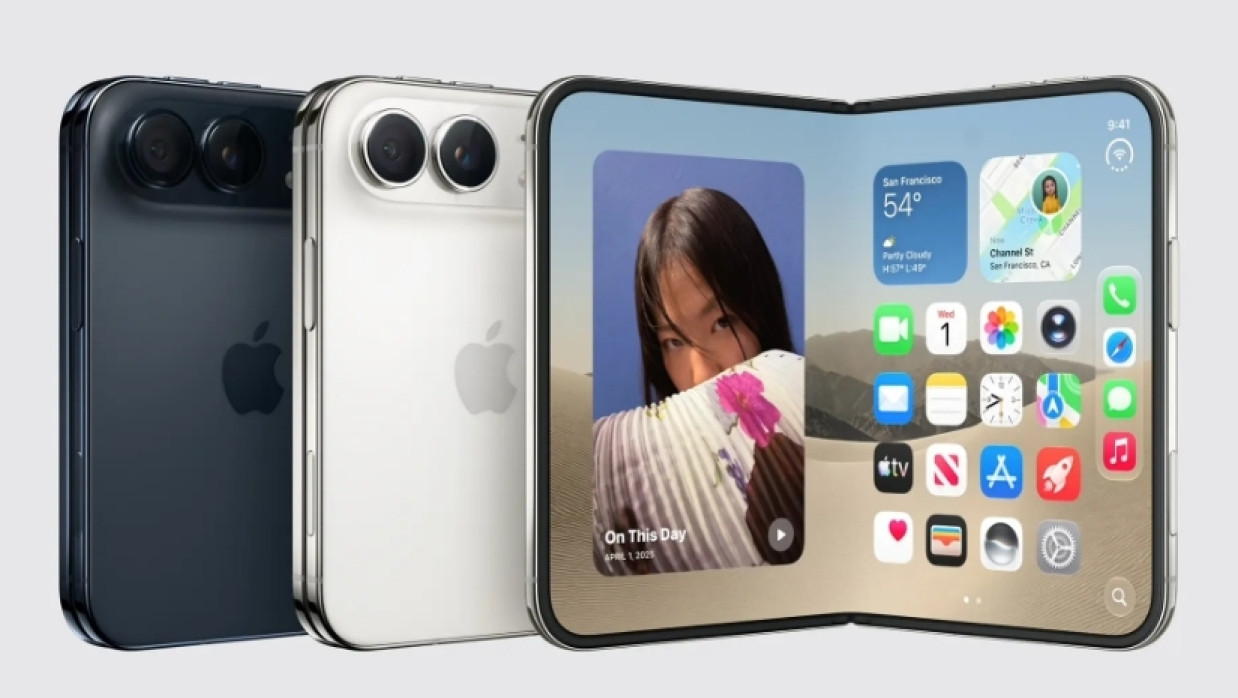
But sitting above them is something Apple has never made before. An iPhone that folds.
The iPhone Duo, unveiled at Apple's annual September event, is the company's first genuinely new iPhone form factor since the original arrived in 2007.
And for a country where premium smartphones are already aspirational purchases, the Duo raises an interesting question: is this the beginning of the moment when foldables finally stop looking like an expensive experiment?
Apple enters a market others built
Samsung has been making foldables for years. Chinese manufacturers such as Oppo and others have pushed the technology in different directions.
Apple, meanwhile, watched.
That wait is now over.
The iPhone Duo is a book-style foldable. Closed, it has a 5.4-inch high-refresh-rate display. Open it and the device becomes a 7.6-inch screen, turning a phone that fits in your pocket into something closer to a tiny tablet.
That is the basic pitch, and it is a good one.
You cannot realistically carry an iPad mini everywhere just because you might want a larger screen. But a device that folds in half can give you both.
Closed, it is an iPhone.
Open, it is almost an iPad mini.
That distinction becomes particularly interesting in Bangladesh, where one expensive device often has to do the job of several. A phone is a camera, entertainment screen, work device, reading device and increasingly a mobile office.
A bigger screen that disappears into your pocket has obvious appeal.
The problem is the price.
The Duo starts at $1,999.
For most Bangladeshi buyers, that is not a casual smartphone purchase. Even before local market pricing, taxes, retailer margins and unofficial-market premiums enter the conversation, the starting price puts the Duo firmly in luxury territory.
So the question is not whether Bangladesh can afford foldables.
It is whether enough people will decide they are worth the premium.
The 18 Pro is the sensible iPhone
While the Duo grabbed the attention, Apple's conventional flagship received a substantial collection of upgrades.
The iPhone 18 Pro and 18 Pro Max retain the familiar overall design and dimensions. The biggest changes are under the surface.
Apple's new A20 Pro chip is built on a 2-nanometre process and offers 50% more memory bandwidth. Apple is also making major battery-life claims, saying the 18 Pro can match the battery life of last year's 17 Pro Max, while the 18 Pro Max delivers the longest battery life ever offered on an iPhone.
Those claims will need real-world testing.
The camera, however, gets an unusually interesting hardware change.
The main camera now has a variable aperture, allowing users to manually move between four aperture settings rather than leaving the lens permanently wide open.
Samsung actually tried something similar years ago with the Galaxy S9. But Apple's version offers four selectable stops, and the larger sensor could potentially make the effect more meaningful.
There is also a smaller Dynamic Island, thanks to Apple moving the infrared Face ID camera underneath the display. Most people probably will not notice the difference most of the time, but the additional screen space allows up to three Live Activities.
And then there are the colours.
Burgundy. Glacier. Silver.
And finally, a fully matte black Pro iPhone.
For some buyers, that last one may be the most important specification of all.
Then there is the Duo
The first thing that strikes you about the Duo is not necessarily the screen.
It is how much attention Apple has paid to the little things.
The outer display and inner display transition into each other through an animation that feels remarkably immediate. Open the phone and the interface moves naturally onto the larger screen. Close it and the experience returns to the cover display.
That sounds trivial.
It isn't.
Foldables have always had a slightly experimental feeling. There are hinges, two displays, different aspect ratios, software that needs to understand whether the phone is open or closed and, somewhere in the middle of all that, a crease.
Apple's approach seems to be to make the technology disappear as much as possible.
The internal 7.6-inch display has uniform bezels and an under-display selfie camera. Its nano-texture finish significantly reduces reflections, which also makes the crease harder to see.
The crease is still there.
You can feel it.
But during ordinary use, it apparently becomes something you have to deliberately look for.
That may be one of the most important improvements Apple has made.
Samsung has the head start. Apple has the polish.
The obvious rival is Samsung's Galaxy Z Fold 8.
Functionally, the two devices are remarkably similar. Both are compact, book-style foldables with large internal displays, flagship processors, dual rear cameras and fingerprint readers integrated into the power button.
Samsung has the advantage of experience.
Apple has something else: an enormous ecosystem of people already comfortable with the iPhone.
And the early impression of the Duo is that Apple is leaning heavily into refinement.
The hinge can hold the phone partially open. The speakers are positioned so that opening the phone creates a stereo setup across both halves. The phone supports MagSafe and uses Apple's A20 Pro chip.
It is also IP68-rated for water and dust resistance, which is particularly reassuring on a device with a complicated folding mechanism.
There are dozens of tiny touches like these.
None of them will make a phone faster.
Together, they can make a phone feel better.
And that is where Apple may have its biggest opportunity.
But this is not a perfect foldable
The Duo also inherits some of the problems that have followed foldables for years.
The cover display is visually asymmetrical, with a rounded edge on one side and a squared edge on the other.
The software appears heavily designed around right-handed use, with important interface elements positioned on the right side.
The dock is limited to four items.
And the under-display selfie camera, while aesthetically elegant, comes with a familiar compromise: image quality.
There is also no dedicated zoom camera, no silicon-carbon battery and no ultra-fast charging.
So if the question is whether Apple has built the ultimate specification-heavy foldable, the answer appears to be no.
But Apple may not need to.
Why this could matter in Bangladesh
Bangladesh is already familiar with the foldable conversation, even if foldables remain far from mainstream.
The country's premium smartphone market is dominated by conventional devices, while flagship phones are often judged not only by specifications but by resale value, durability, camera performance and how long they can realistically remain useful.
That makes the Duo an interesting test.
A foldable has more moving parts and a more complicated display than a conventional iPhone. For a buyer spending the equivalent of a small fortune on a phone, durability matters.
Apple's IP68 rating helps.
So does the company's ecosystem.
For an existing iPhone user, switching to a Samsung Fold means switching not just hardware but potentially habits, accessories, services and software. The Duo removes one of those barriers.
You do not have to leave the iPhone world to get a foldable.
You just have to pay for one.
And that could be Apple's strongest selling point.
The $2,000 question
At $1,999, the Duo is undeniably expensive.
Yet the price is not as shocking as it might have been.
Samsung's Galaxy Z Fold 8 starts at $1,799, while premium foldables from Chinese manufacturers can also reach extraordinary prices.
Apple has therefore entered an expensive category with an expensive product rather than attempting to make foldables suddenly cheap.
That means the Duo probably will not turn every Bangladeshi iPhone user into a foldable buyer.
It does not need to.
Apple's first job is to make the idea feel normal.
Remember how strange large smartphones once looked? Or how wireless earbuds initially seemed like an unnecessary luxury?
Technology changes when people stop asking whether something is possible and start asking whether they want it.
Apple has now answered the first question.
Yes, the iPhone can fold.
The next question belongs to consumers.
Do we actually want one?
For Bangladesh, the answer will probably come down to something far less glamorous than the hinge, the A20 Pro chip or the nano-texture display.
It will come down to price.
But if Apple can make the Duo feel as ordinary, reliable and effortless as an iPhone, the company may have done something Samsung and others have been trying to do for years.
It may have made the foldable phone feel less like a new category and more like the next iPhone.
And that is a much bigger change than simply adding another screen.
 Follow The Daily Campus on Google News