Samanta Sarmeen Resigns from NCP, Cites Four Reasons
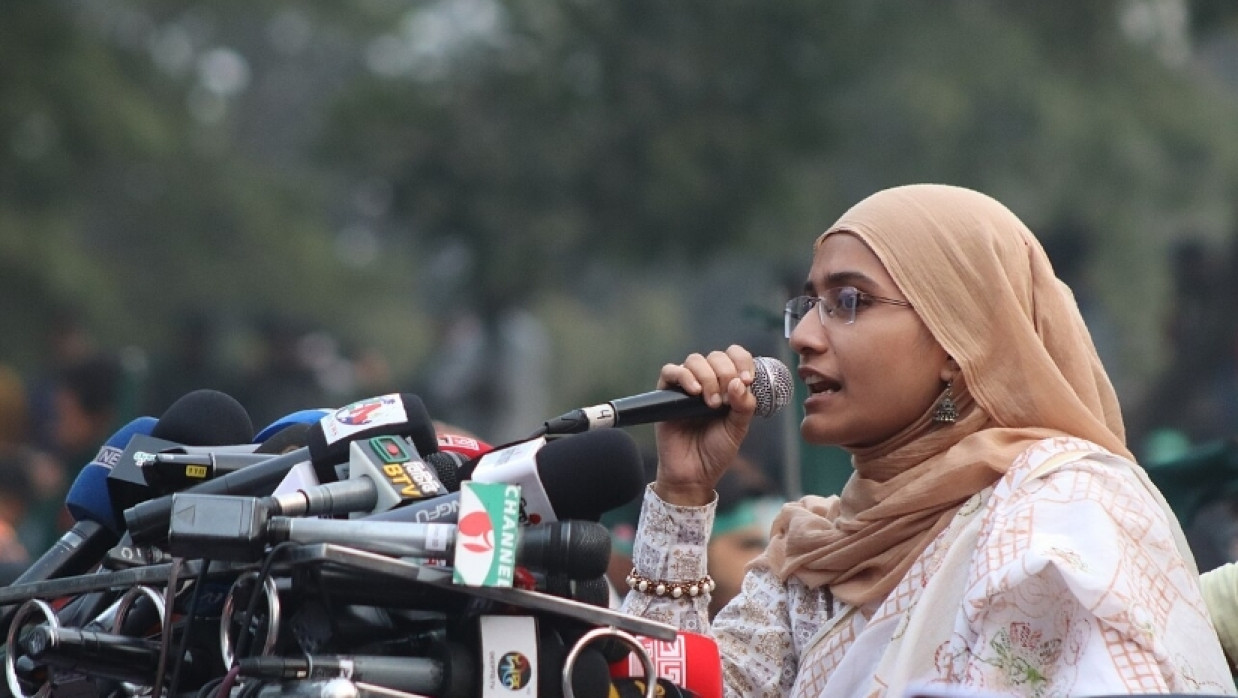
National Citizen Party (NCP) Joint Convener Samanta Sarmeen has resigned from the party, citing disagreements over its alliance with Jamaat-e-Islami, its electoral strategy, women's political rights and its internal restructuring without a council.
Samanta announced her resignation in a lengthy Facebook post on Thursday evening, November 5. She had been serving as the party's Senior Joint Convener but was placed in the position of Joint Convener in the new committee announced by the NCP on October 23.
A prominent figure in the July uprising, Samanta had become relatively inactive after the NCP formed an electoral alliance with Jamaat-e-Islami ahead of the February 12 national election. Although speculation had circulated about her departure, she had not previously left the party.
In her post, Samanta said she had taken a different position on the NCP's alliance strategy nearly a year ago, arguing that Jamaat-e-Islami was not a suitable ally either in principle or strategy and that the NCP would pay a heavy price for forming an alliance with the party.
She said that over the past 11 months, she had submitted written complaints and proposals and participated in debates and discussions at different levels of the organisation, seeking to influence the NCP's past actions and future political direction.
“I chose ideological struggle within the NCP because I believed it was my political responsibility to protect the party from taking the wrong path. There was no other democratic way to bring the party back from the wrong path except to challenge its adopted policies through reasonable arguments in recognised forums,” she wrote.
She said she was ending that struggle after nearly a year because she no longer believed the NCP could remain committed to the values on which it was founded.
Samanta said she could have waited for a more suitable time to resign, when her departure might have been interpreted as a response to a particular party decision or action. However, she considered such a wait meaningless.
“The NCP may sometimes take different political positions, including a decision to leave its alliance with Jamaat, but I still do not believe it can develop its own identity, ideas and programmes outside the old political model,” she wrote.
She added that political parties built around the old system would never help establish a new state order and would instead stand in its way.
She said it was now necessary to make public the disagreements and discussions she had had with the party.
Four reasons behind her resignation
1. Whether Jamaat can be an ally in reform
Samanta said reform was central to the NCP's political vision as a party representing the aspirations of people across the country. She argued that at least three areas required reform to prevent the existing power structure from obstructing the transition to a democratic state: constitutional reform to remove authoritarian and fascist foundations, legal reform to make state laws and regulations serve public welfare, and political and party reforms to change the traditional structures of political parties and the colonial nature of politics in the country.
She alleged that Bangladesh Jamaat-e-Islami did not consider any of these three areas part of its own political agenda or state project. According to her, Jamaat did not genuinely embrace reform politics, and its stated support for reform was merely a pretence intended to appropriate the aspirations of the 2024 uprising.
She argued that democratic reform must be rooted in liberal democratic social values. Jamaat, she alleged, was not only opposed to a democratic state system but also sought to use the benefits of democracy to establish a fascist state. She further claimed that the party considered even genocide justifiable when necessary to implement its political project.
Samanta said Jamaat's political and ideological foundations remained unchanged, pointing to its position on the party's role in 1971 and its failure to apologise to the nation.
She argued that when the NCP treated Jamaat as an ally in the reform process, ordinary Bangladeshis who were naturally liberal and democratic, and who represented the genuine force for reform, were compelled to turn away from reform politics.
The NCP's unclear political position, she said, had resulted in the party losing its distinct identity within Jamaat's political influence and taking reactive and supportive positions on various issues. She said she had repeatedly warned the party about these problems and tried to bring it back on course.
2. The 2026 national election
Samanta argued that the 2026 national election had the potential to become a political election capable of bringing fundamental political change, rather than merely replacing those in power. She cited the elections of 1946, 1954, 1970 and 1990 as examples of elections that had brought broader political transformations.
She said old political parties had sought to strip the election of the political character of the uprising and turn it into an exercise in transferring power. According to her, the NCP had an opportunity to form an alliance with those seeking to politically challenge the old system, despite the failures of the Consensus Commission, Election Commission and interim government's reform initiatives, or to contest independently while pushing for a political election.
Had it taken that path, she said, the NCP could have achieved a better result than it eventually did, because the outcome of a political election was not determined by the organisational strength of political parties. She accused the NCP of ignoring this historical lesson by contesting the election as a junior partner of a larger political party, thereby undermining its own political identity and the prospect of a new post-uprising political order.
Samanta said she had proposed five ways for the party leadership to build greater political influence than it ultimately achieved without joining an electoral arrangement such as the 11-party alliance. However, the party did not pursue those options.
She argued that prioritising electoral victory over political success had also weakened the NCP's credibility in raising objections to the election results under an unreformed system.
On the issue of security, she referred to Shaheed Osman Hadi, who had campaigned independently in a complex and high-risk constituency in Dhaka against a strong opponent, hoping to secure at least 500 votes.
She alleged that Hadi's death had been used as a justification for adopting the undemocratic and outdated electoral strategy of forming an alliance with a larger party, describing the reasoning as entirely irrational and motivated by ulterior purposes.
3. Women's ownership and rights in the uprising
Samanta said women had played a decisive role in the 2024 mass uprising, serving as important catalysts, frontline fighters and protectors of the movement. She argued that women's political aspirations, demands for a fair share of power and resistance to discrimination and oppression had been central to their participation.
Women did not merely take part in the uprising, she wrote; they built resistance. Their presence, courage and activism at barricades helped give the movement a broader and more inclusive character.
However, she alleged that conservative political forces and parties from the old political order had begun pushing women out of the space created by the victory. Social restrictions that had failed to prevent women's participation during the movement were subsequently used against them, she said, marginalising their political aspirations and demands for a fair share of power.
Samanta said the NCP had an opportunity to establish a different political example outside the traditional parties by building a new political culture based on equality between women and men. This, she argued, required more than simply including women in the party. Their positions in numbers, leadership, decision-making and organisational authority also needed to be ensured.
Instead, she alleged, the NCP's role had aligned with conservative political tendencies hostile to women, undermining the anti-discrimination and inclusive character of the 2024 uprising.
She said the party had failed to embrace the possibilities the uprising created for women's advancement in Bangladesh's future politics. Like traditional parties, the NCP had marginalised women, failed to give adequate importance to their protests and made decisions based on male majorities.
Women account for approximately 51% of the country's population, she noted. Ignoring women's voices, she argued, meant not only disregarding the views of female party members but also excluding the political aspirations and experiences of more than half the population from decision-making.
Samanta said positive discrimination, or special opportunities and representation for historically disadvantaged women, was necessary in a society such as Bangladesh. However, she argued that even such measures might not be sufficient because existing power structures in the state, society and institutions actively suppress women.
Ensuring equal opportunities alone was therefore not enough, she said. Women needed greater representation, more power and meaningful participation in decision-making. Even then, she added, it might not be possible to eliminate the full extent of entrenched inequality.
She also alleged that Jamaat and far-right forces had played a role in pushing women out of politics, while the NCP had followed and supported their conservative positions in various areas. The problem, she argued, was therefore not limited to isolated decisions but had become embedded in the party's organisational structure and decision-making process.
Samanta further argued that women's role in a movement could, in certain circumstances, be one that men themselves could not perform. When men protect other men, she said, the impact is one thing; when women become protectors of men, their role can more deeply challenge conventional gender-based power relations and social expectations.
Women had stood at the front of barricades and protected the movement during the 2024 uprising, she said. Yet after victory, their dignity, political rights and decision-making authority had been overlooked.
She raised a fundamental question about whether placing women at the front of marches during the movement had recognised their leadership and political capabilities or used their presence as a protective shield in the face of danger.
“If women's courage and sacrifice are accepted when they are needed for a movement, but their power and fair share are denied after victory, where is the genuine recognition of their participation?” she wrote.
She said a party claiming the legacy of an uprising against discrimination, oppression and repression could not reproduce discriminatory power relations within its own structure. Women had not merely participated in the 2024 uprising; they had helped shape its character.
A political force that relied on women's courage and resistance to achieve victory but denied them equal dignity and power afterwards could not genuinely claim to stand against discrimination, she added.
4. NCP restructuring without a council
Samanta said people in post-uprising Bangladesh had expected a political party with an organisational structure different from those of traditional parties. Such a difference, she argued, needed to be reflected not only in leadership, political statements and public conduct but also in financial transparency and democratic practices within the party.
She listed several features of traditional political parties, including personality-centred leadership, concentration of power, dynastic politics, nepotism in distributing positions, the influence of money and muscle power, financial opacity, disregard for grassroots opinions, suppression of dissent and a lack of accountability among leaders.
These practices, she said, limited ordinary party members' participation in decision-making and narrowed opportunities for leadership change and the emergence of alternative leadership. She also pointed to the tendency among traditional parties to delay or avoid holding councils.
Samanta described holding party councils at scheduled intervals as one of the most important mechanisms for ensuring internal democracy. Failure to hold councils on time, she said, raised questions about leadership legitimacy, accountability and representation while increasing the risk of organisational decisions becoming concentrated in the hands of a small group.
She alleged that restructuring the NCP's convening committee instead of holding a council had damaged the party's internal democratic environment and replicated a pattern seen in traditional political parties. She also accused the party of adopting old methods of suppressing dissent.
The major reshuffle before the election of party leadership, she said, demonstrated the leadership's indifference towards internal democracy and neutrality. It would also undermine the NCP's political credibility and public trust when advocating for a democratic and impartial national electoral system.
She questioned how a party that could not ensure democratic leadership selection within its own organisation could credibly demand democracy and neutrality at the state level.
Samanta said she had repeatedly called on the party to reconsider these issues but the NCP had shown no willingness to change course. She therefore announced her resignation, adding that there were further explanations and reasons she could present but that she did not have the time at that moment.
Samanta calls for unity-based politics
After announcing her resignation, Samanta outlined her political direction under the heading, “Bangladesh needs the politics of unity instead of the politics of division”.
She said Bangladesh had been pushed into various forms of division, whereas the country's greatest need after the uprising had been a political vision capable of bringing people together despite differences in opinion, belief and identity.
She said the NCP could have created that possibility and that people had expected the party, led by young people, to move beyond conventional political divisions and establish a new form of politics. However, she argued, narrow political calculations and decisions had gradually eroded that prospect.
The loss of political potential by a party or a few leaders, she said, did not mean the death of the political aspirations behind it or that people's needs had disappeared.
Samanta called for a political force whose primary goal would be to unite people rather than divide them. Such unity, she said, should not be based on a particular ideology, religious identity or single political belief, but on a shared commitment to building a democratic state.
She argued that the interests of Bangladesh and its people, rather than narrow personal interests, must remain at the centre of the political thinking of those leading such an initiative.
Taking the side of the United States while opposing India, or aligning with China's interests while opposing the United States, could not form the basis of an independent and self-respecting political position for Bangladesh, she said.
Bangladesh's foreign policy, she argued, must be determined by the country's interests, sovereignty and public welfare, rather than allegiance or hostility towards another state. If an agreement with India undermined Bangladesh's interests, political leaders should speak out against it. The same standard, she said, must apply to agreements with the United States, China or any other country.
“Uncompromising opposition towards one country and silence towards another is not pro-Bangladesh politics; it is a double standard,” she wrote. Genuine pro-Bangladesh politics, she added, meant applying the same principles regardless of whether a country was considered a friend or an adversary.
She also called for women's political and social participation to be made an integral part of the political structure, rather than limiting it to formal representation. Women's independent participation, leadership, decision-making authority and equal citizenship rights must be ensured, she said.
The political force she envisaged would also need to take clear positions on developing and protecting national capital, expanding domestic production and employment, reducing economic inequality, and safeguarding public interests in the management of national resources and policymaking.
Protecting national interests, she argued, meant not only opposing foreign influence but also challenging domestic power structures and vested interests that restricted people's rights and economic opportunities.
Samanta said people had united behind young leaders in the expectation that they would not reproduce old power structures but would instead create a new political culture, democratic institutions and a politics based on national interests.
She said democracy, sovereignty, women's equal participation, economic justice and national interests continued to await a new political initiative.
She argued that the challenge facing young people was not simply to form another political party but to build a political unity in which differences of opinion would remain without division becoming the driving force of politics. Ideological differences should not overwhelm the shared goal of establishing democracy, and international relations should not place any foreign power's interests above those of Bangladesh, she added.
Any effort by young people to organise around these goals, she said, should not reproduce an old party but represent a new attempt to build Bangladesh's democratic future.
“I am committed to working as part of this effort. I invite everyone who wishes to exchange views with me in detail on these issues to get in touch. I want to move forward with the project of building a democratic Bangladesh together with you,” she wrote.
 Follow The Daily Campus on Google News