Bloody clashes mark Interim's last Friday before National Election
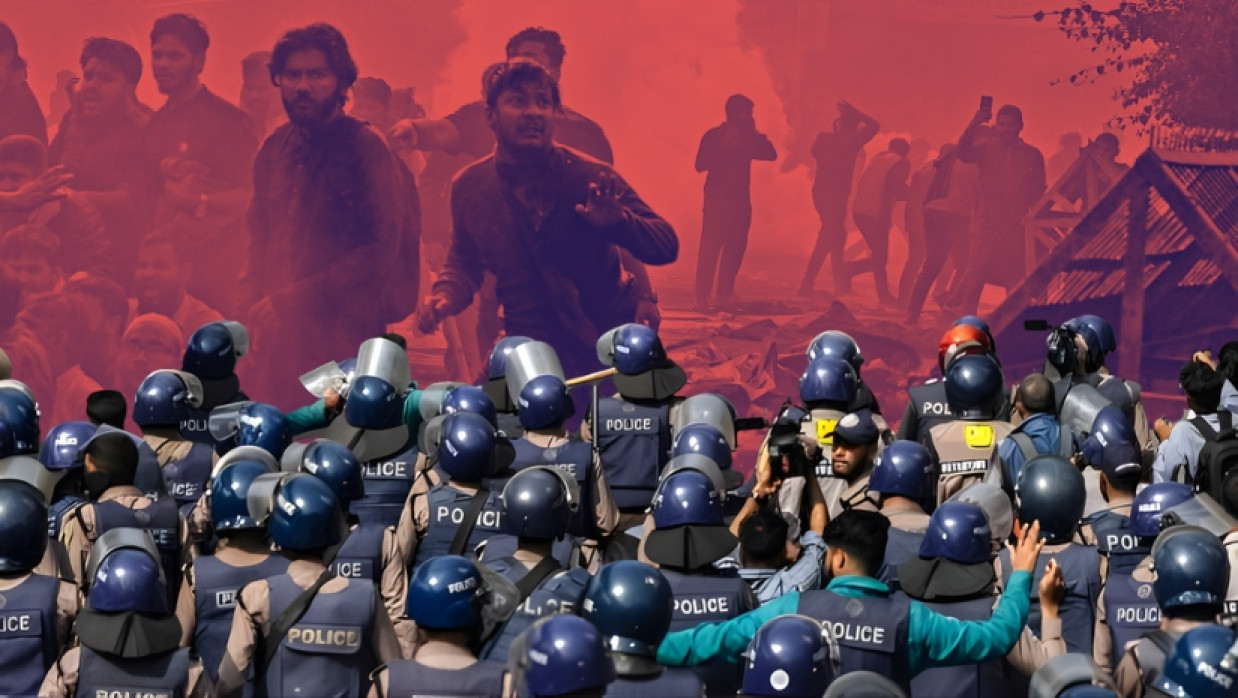
The final Friday of the interim administration led by Muhammad Yunus was marked by widespread violence, leaving at least 60 to 76 people injured and several journalists assaulted. On February 6, 2026—just six days before the general election—clashes erupted in Dhaka as activists from the Inqilab Moncho platform demanded justice for the murder of Sharif Osman Hadi. The unrest, which began in the capital, quickly spread to major university campuses across Bangladesh, reflecting a significant escalation in pre-poll tensions.
The violence in Dhaka unfolded in two distinct stages, centered around the high-security zone of the State Guest House Jamuna and the Shahbagh intersection.
Phase I: The March toward Jamuna
The confrontation began in the afternoon when leaders and activists of Inqilab Moncho, accompanied by the wife of the late Sharif Osman Hadi, attempted to march from the Raju Memorial Sculpture at Dhaka University toward the Chief Adviser's residence at Jamuna.
- The Breach: Protesters attempted to break through established police barricades at the Hotel InterContinental intersection.
- Police Response: To disperse the crowd, law enforcement deployed water cannons, sound grenades, tear gas, and baton charges.
- Casualties: Inqilab Moncho claimed that more than 50 activists were injured in this initial phase. The platform specifically alleged that member secretary Abdullah Al Jaber sustained "bullet injuries" and that female activists Fatima Tasnim Juma and Shanta were physically assaulted by officers.
Phase II: The Shahbagh Siege
Following the afternoon dispersal, activists regrouped and blocked the Shahbagh intersection later that evening.
- The Trigger: At approximately 7:30 PM, as a police unit moved from BIRDEM Hospital toward the InterContinental intersection, protesters began chanting "Bhua, Bhua"—a slogan challenging the legitimacy of the current police force.
- The Escalation: A second round of violence broke out when police attempted to clear the road. Protesters reportedly threw bricks and stones, leading to a counter-charge involving 20 sound grenades and further tear gas deployment.
- High-Profile Injury: Mohiuddin Roni, an independent candidate for the Dhaka-18 constituency, was among approximately 20 individuals injured during this phase and was subsequently rushed to the hospital.
Medical Status and Casualty Reports
Data from the Dhaka Medical College Hospital (DMCH) provided a comprehensive look at the human cost of the clashes, while also addressing conflicting narratives regarding the nature of the injuries.
|
Metric |
Detail |
|
Total Treated |
60 (Hospital Director) to 76 (Emergency Dept. Logs) |
|
Common Injuries |
Blunt force trauma (baton hits), cuts, lacerations, and breathing issues from tear gas |
|
Hospital Admission |
Only one patient (Mohiuddin Roni) was admitted for long-term observation |
|
Medical Findings |
DMCH Director Brig. Gen. Md Asaduzzaman confirmed no cases of gunshot or pellet wounds |
Hospital Operations and Challenges: Brigadier General Asaduzzaman reported that 200 doctors and a full nursing staff were on duty to handle the influx. He noted that the emergency department was expanded to treat 25 patients simultaneously. However, medical staff faced significant challenges with crowd control, as 10 to 15 people often accompanied a single patient, hindering the hospital’s ability to work efficiently.
Specific Medical Condition of Mohiuddin Roni: Dr. Mostaque Ahmed, resident surgeon of the Emergency Department, confirmed that Roni sustained baton-inflicted injuries and an "inhalation injury" from tear gas. While full-body scans revealed no internal organ damage, Roni was kept under observation for respiratory distress and pain management; his condition was listed as stable.
Systematic Attacks on the Press
The events of February 6 were further marred by reports of police aggression toward media professionals. At least six journalists identified themselves as being assaulted while documenting the confrontation.
- Attacked Personnel: Multimedia reporters included Abu Bakar Siddique (RTNN), Rayhan (Kaler Kantho), Abu Saleh Musa (Jugantor), Zakirul Islam (MyTV), Sabbir Ahmed (Bornojoy News), and Masum (Jamuna TV).
- Testimony of Aggression: Abu Bakar of RTNN alleged that police dragged passengers off buses and beat pedestrians who were filming the clashes. When he protested these actions, he was reportedly dragged away and beaten by several officers.
- Media Response: On Saturday, February 7, the Multimedia Reporters' Association and local journalists held a protest at the National Museum. Speakers alleged that the attack was planned and occurred in the presence of DC Masud, demanding judicial accountability for the officers involved.
Regional Uprising and Nationwide Protests
The "Bloody Friday" events acted as a catalyst for student-led demonstrations at several major universities outside the capital.
- Chittagong University (CU): Students gathered at Gate No. 2, demanding the immediate release of detained activists and justice for Sharif Osman Hadi. CU Inqilab Moncho convener Rafsan Rakib issued a warning, stating that continued delays in the murder trial would lead to a movement to "separate Chattogram from Bangladesh."
- Islamic University (IU), Kushtia: Students led by Anti-Discrimination Student Movement coordinator SM Sweet and IU Chhatra Shibir Secretary Rashedul Islam Rafi blocked the Kushtia-Khulna highway for several hours. Protesters criticized the interim government for using "repressive tactics" reminiscent of previous regimes.
- Jashore University of Science and Technology (JUST): A protest march began at 7:00 PM, moving through student residential halls and key campus roads. The demonstrators warned that force would not silence their demands for accountability.
Government Response and Judicial Outlook
In an official statement issued on the evening of February 6, the interim government clarified its position:
- Denial of Force: The government explicitly rejected claims of "excessive use of force," stating that law enforcement did not fire any shots or use lethal weapons.
- UN Investigation:To address the lack of public trust in the domestic judicial process, the Chief Adviser's Press Wing announced that the government is reviewing legal aspects and will formally send a letter to the United Nations on Sunday, February 8, 2026, to request a UN-led investigation into the Sharif Osman Hadi case.
- Call for Restraint: With the February 12 polls approaching, the administration urged all citizens and political entities to maintain "patience, restraint, and responsibility" to ensure a peaceful election milestone.
 Follow The Daily Campus on Google News