
DAP 2022-35
Dhaka Needs 627 More Quality Schools with Large Playgrounds
Dhaka’s rapid population expansion has far outstripped the growth of quality primary and secondary schools, leaving many families with few viable local options. Zarif Kabir, who lives in Basundhara Residential Area, finds that the nearest reputable schools are often high-fee English-medium institutions, forcing families to weigh long commutes or substantial tuition costs against limited alternatives. The pattern illustrates a persistent gap in the city’s education infrastructure and equitable urban development.
The Detailed Area Plan (DAP) 2022-35, prepared by the Rajdhani Unnayan Kartripakkha (RAJUK) to guide Dhaka’s long-term development, estimates the city requires 627 additional high-quality schools, each equipped with large playgrounds. The plan cites institutions such as Motijheel Ideal School, RAJUK School, and Viqarunnisa Noon School as examples of schools that combine strong academic performance with adequate facilities.
The DAP defines a “good school” with clear, specific standards. Beyond high examination results, it requires spacious playgrounds, modern safety features, sufficient numbers of teachers, classrooms, washrooms, science laboratories, libraries, staircases, corridors, offices, and appropriate space per student. All these criteria are explicitly detailed to ensure a supportive and functional learning environment.
Quality schools remain concentrated in older neighborhoods such as Bangla Bazar, Dhanmondi, Azimpur, Motijheel, and Mirpur. Many are long-established facilities, while newer schools in emerging areas frequently fall short of these benchmarks. As a result, significant portions of Dhaka’s population lack access to good local education and must settle for substandard institutions.
RAJUK officials emphasize that academic outcomes alone do not define a good school. Facilities must include proper playgrounds, address common educational and environmental challenges, and guarantee student safety, a healthy atmosphere, and hygienic amenities.
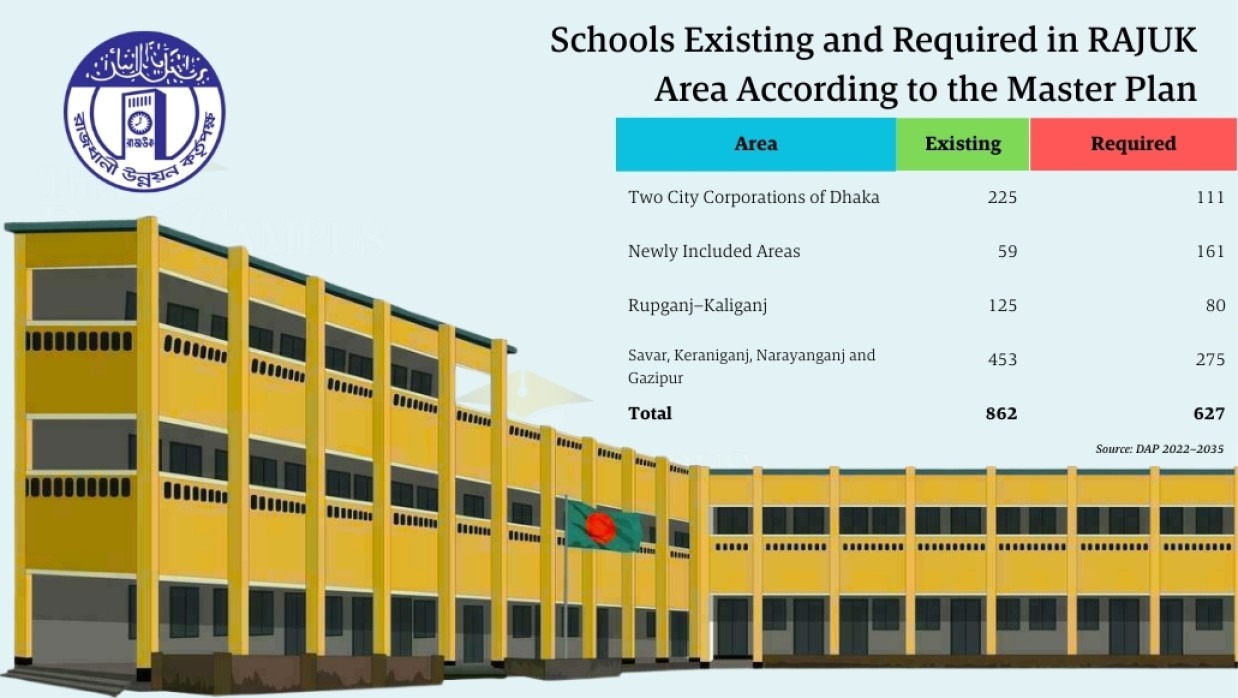
The DAP reports that Dhaka currently has 862 schools meeting basic quality thresholds (based on strong results and the presence of large playgrounds): 225 within the two city corporations, 59 in the newly incorporated 35 wards, 125 in Rupganj-Kaliganj, and 453 in Savar, Keraniganj, Narayanganj, and Gazipur.
The plan calls for upgrading existing primary schools to extend to Class 10 and mandates that both government and private institutions adhere to DAP guidelines when seeking approval for new schools.
For the first time, the DAP introduces school zoning. No additional quality schools will be permitted in areas where demand is already satisfied, redirecting development to underserved zones such as Jurain or Keraniganj. The Primary Education Directorate is already in discussions to build 10 schools in locations like Zilimil and Purbachal in alignment with DAP recommendations. While progress is slower than ideal, implementation has begun.
Existing schools are recommended for retrofitting to meet DAP standards. In total, the plan identifies the need for 627 new schools: 111 in the two city corporations, 161 in the newly included 35 wards, 80 in Rupganj-Kaliganj, and 275 in Savar, Keraniganj, Narayanganj, and Gazipur. Different design models are proposed depending on population density and location.
In central Dhaka, schools should occupy at least 18,000 square feet, accommodate 1,500 students per shift (3,000 total), feature six branches per class (25 students per branch), include 60 classrooms through Class 10, allocate 20 square feet per student (500-square-foot classrooms), provide a 1,800-square-foot science laboratory, a 750-square-foot library, 4,000 square feet for toilets and corridors, and at least one acre for playgrounds.
Mahfuja Aktar, Town Planner (Plan Preparation Section) at RAJUK, explained the concept of school zoning in the DAP. The plan divides RAJUK’s jurisdiction into small blocks and calculates the number of schools needed in each, comparing current availability with projected demand through 2035. The core goal of zoning is to ensure children attend schools within their own neighborhoods.
When asked whether sufficient land exists for schools with playgrounds, Aktar noted that specific plots have not yet been designated. Most land is privately owned freehold property, requiring formal acquisition processes rather than immediate assignment.
On the issue of footpaths around schools being occupied by hawkers, the DAP does not recommend complete removal. Instead, it proposes designating limited, regulated spaces for informal vendors, requiring them to pay a formal fee to the city corporation and register. This approach balances the needs of the informal sector while preventing uncontrolled occupation.
Regarding traffic congestion near major institutions such as Viqarunnisa Noon and Ideal School, where private car drop-offs create heavy pressure during peak hours, Aktar pointed to zoning as the primary solution: if students attend local schools, the need for extensive private-vehicle parking diminishes. As an alternative, RAJUK requires new school plans to include provisions for school buses, with parking prioritized for buses rather than individual cars.
Aktar added that on March 4, the Minister for Housing and Public Works, Zakaria Taher MP, visited RAJUK and expressed interest in reviewing the plan’s details, with discussions ongoing for further refinements.
Experts note that realizing these 627 schools would address multiple interconnected problems in Dhaka. Traffic congestion, footpath encroachment, and air pollution are partly driven by long school commutes. Parents endure significant hardship traveling across the city. Families sometimes relocate neighborhoods solely for access to better schools. The DAP presents a comprehensive vision, yet public discussion often focuses narrowly on building height regulations. Few address the absence of schools, hospitals, or adequate fire-fighting infrastructure. Proper execution would improve education access, reduce traffic, lower pollution, save time and money for citizens, and enhance overall urban livability.
 Follow The Daily Campus on Google News