Smart on Smartphones, Weak on PC: A Growing Crisis Among Graduates
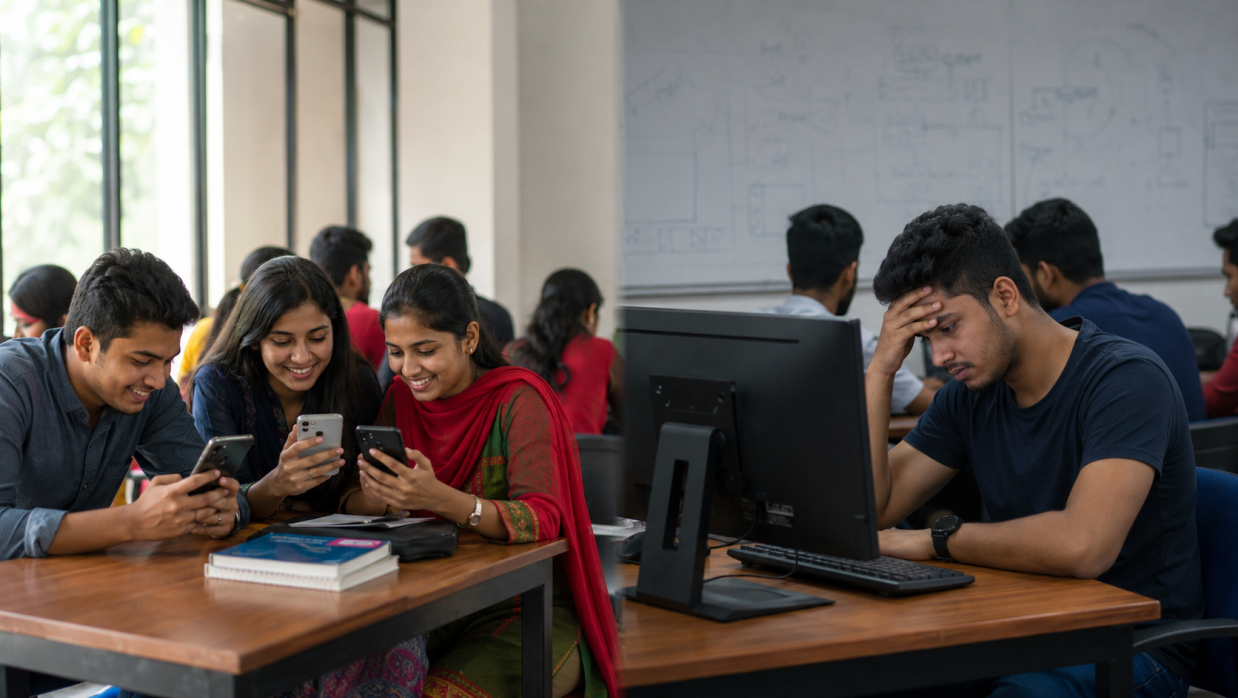
Fresh university graduates entering Bangladesh's competitive corporate landscape are facing a significant barrier to employment due to a severe deficiency in foundational technical and communication skills. While the current generation demonstrates high proficiency in navigating mobile applications and social media platforms, a substantial portion struggles to perform basic, desktop-centric professional tasks, creating a widening mismatch between employers' expectations and graduates' competencies.
According to the Labor Force Survey 2025 published by the Bangladesh Bureau of Statistics (BBS), approximately 10 million people in the country are underemployed relative to their educational qualifications.
The data indicates that 13.5 percent of the total unemployed population hold undergraduate degrees, while 7.13 percent have completed their Higher Secondary Certificate (HSC), meaning that one out of every five unemployed individuals possesses a higher education certificate. Most critically, roughly 29 percent of youth unemployed aged between 15 and 29 years are university graduates, which effectively translates to one in every three fresh graduates being unemployed.
The Desktop Detachment and Academic Outpacing
The issue has become pronounced during employment interviews, where academic achievements are often overshadowed by a lack of operational computer skills. Job seekers who are highly confident in answering theoretical questions are increasingly being disqualified during practical testing phases. For instance, a graduate from a top public university recently lost his fourth consecutive job opportunity when he was asked to perform a simple task in Microsoft Excel and type a table in Microsoft Word, finding himself paralyzed by the complexities of a physical computer keyboard and office software setup.
The shift toward smartphone reliance accelerated significantly in the post-COVID-19 environment, leading the younger generation to treat mobile phones as their primary learning and communication tool. However, because corporate environments remain fundamentally desktop and laptop-dependent, this smartphone dependency is presenting unexpected roadblocks.
Academic experts emphasize that while the global job market is evolving rapidly, university curricula across the country remain heavily outdated. Professor Dr. Imranul Haque, Chairman of the Department of Marketing at Jagannath University, noted that several departments are still following two-decade-old curricula, entirely failing to integrate modern digital competencies, data management, presentation skills, problem-solving abilities, and basic technological adaptability.
Corporate Friction and Lack of Structural Readiness
Recruitment managers and career experts state that corporate bodies are increasingly demanding prior experience or specialized skills because fresh graduates emerge from universities without basic corporate readiness. Common shortcomings include an inability to speak fluently in English during interviews, poor business communication, and a lack of familiarity with data analysis, drafting professional emails, utilizing Artificial Intelligence (AI) tools, and working collaboratively in team settings.
Imon Shahriar, former president of the Jagannath University Career Club, attributed part of the crisis to perfunctory teaching methods and the absence of a modern academic environment, pointing out that some graduates cannot even power on a computer desk unit properly upon entering the workforce.
From a policy perspective, Professor Dr. Mojibul Haque Azad Khan, Chairman of the Department of Psychology at Rajshahi University, observed that this is a collective failure of the state education framework, pointing to a lack of long-term national planning regarding what type of workforce the country intends to build.
The Evolving AI Paradigm and Expert Advice
The ongoing transformation of the job market requires graduates to look beyond conventional degrees. Reflecting on global trends, Ryan Roslansky, CEO of LinkedIn, recently highlighted that the future of work will no longer rely solely on prestigious institutional credentials, but on individuals who are highly adaptable, forward-thinking, and comfortable working alongside advanced AI tools.
"If we say we will not learn AI, only academic certificates will do, then it will not be right. Again, if we think AI will bring my job, that is also wrong. In the future, the way AI will take away people's jobs; similarly, a new job market will be created. As a result, those of us who are lagging behind, learning less, will have to face danger. If we cannot master the skills with time, then we will fall into the list of those whose jobs will be gone."
— Md. Abdul Quayyum, Head of Communications at UNDP Bangladesh
Addressing the employment deficit, A.K.M. Fahim Mashroor, CEO of the country's largest online job board, Bdjobs.com, noted that the state has allocated significant funding to skill development over the last 15 to 20 years. He pointed out that the core issue is not a lack of financial capital, but rather weak institutional implementation and the inability of local training centers to deliver international-standard training programs.
Career strategists emphasize that a resume alone cannot secure employment; rather, long-term career success requires fresh graduates to proactively address their personal skill deficiencies and master core corporate competencies such as advanced proficiency in Microsoft Excel, professional communication skills in both Bengali and English, analytical and critical thinking, project management foundations, strategic personal branding, and strong leadership qualities.
 Follow The Daily Campus on Google News