Higher Education or Hidden Unemployment?
The Truth Behind Bangladeshis Pursuing Master’s Degrees
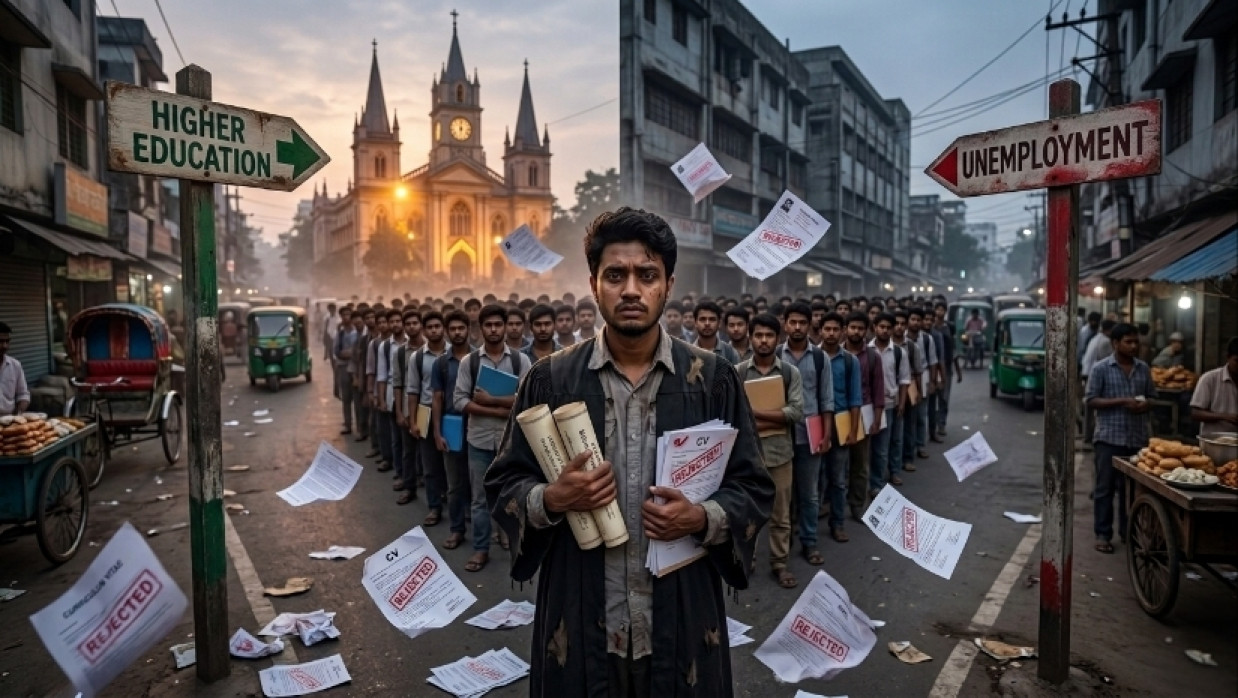
Bangladesh has climbed to the top of South Asia in one measure of higher education achievement. According to the UNESCO World Education Statistics 2025, the country records the highest share of adults with a master's degree or above among all South Asian nations. Yet the same country also carries one of the region's highest unemployment rates. The question many are now asking is not whether this achievement is real, but whether it tells the story we think it does.
What the UNESCO Numbers Say
The UNESCO report, which analyzes data from 2015 to 2025, places Bangladesh at a regional average of 3.70 percent of adults aged 25 and above holding advanced degrees. That figure leads South Asia, with the Maldives at 3.10 percent and India at 3.05 percent following behind.
Pakistan stands at 2.68 percent, while Bhutan and Nepal record 1.80 percent and 1.70 percent respectively. Sri Lanka, despite its high general literacy rates, records the lowest in this category at 0.77 percent.
Bangladesh's trajectory within this decade was not without movement. The country started at 3.3 percent in 2015, rose to a peak of 4.3 percent by 2019, and after a data gap in 2020, settled at 3.7 percent in 2022 and 3.6 percent in 2023. The trend suggests consistent growth in postgraduate attainment rather than a statistical anomaly.
South Asia at a Glance: Postgraduate Attainment (2015-2025 Average)
|
Country |
Adults with Master's or Higher (Avg) |
|
Bangladesh |
3.70% (Regional Leader) |
|
Maldives |
3.10% |
|
India |
3.05% |
|
Pakistan |
2.68% |
|
Bhutan |
1.80% |
|
Nepal |
1.70% |
|
Sri Lanka |
0.77% |
A Degree Economy Built on Social Expectation
The numbers raise an immediate question: if so many Bangladeshis are earning master's degrees, why does graduate unemployment remain stubbornly high? Education experts say the answer lies not in the degree itself, but in why students are pursuing it.
Dr. Mohammod Moninoor Roshid, Professor at the Institute of Education and Research (IER) at the University of Dhaka, points to a convergence of cultural, economic, and structural pressures.
From a socio-cultural perspective, when a student finishes an honours degree but does not continue to a master's, they feel incomplete. Society also sees them as incomplete.
Dr. Mohammod Moninoor Roshid, IER, University of Dhaka
This perception, according to Dr. Roshid, is not accidental. It has been constructed over decades through education policy, institutional design, and labour market practices that collectively treat a bachelor's degree as an unfinished product.
"Most employers expect both honours and master's in the relevant discipline," he says. "Since this has become normalised, students continue directly into a master's after completing honours." In many developed countries, a bachelor's degree functions as the terminal degree for entering the workforce. In Bangladesh, across public universities, the National University, and private institutions, continuing from honours to a master's is treated as the default path.
When Status Drives Credentials
Professor Mohammad Mojibur Rahman, also of IER at the University of Dhaka, traces the problem to a deeper historical current in Bangladeshi society.
Historically, our society had a rigid class system based on birth. Then the British arrived, and people saw that someone from a lower background could become an SDO, a lawyer, or a barrister through education. So education became a tool for changing social class and status. And we still haven't come out of that mentality.
Prof. Mohammad Mojibur Rahman, IER, University of Dhaka
In an office, there are liftmen, peons, clerks, officers, and bosses. What determines respect is not capability or contribution but title and position. A higher degree signals a higher title before employment even begins. This logic, Professor Rahman argues, drives the mass rush toward postgraduate degrees regardless of whether the economy can absorb the graduates.
"We should only produce as many graduates as the economy can employ," he says. "Every year universities produce graduates in subjects like philosophy and history. But after completing honours and master's degrees, what will these students actually do?"
A Structural Gap in Planning
Both experts agree that the deeper problem is not ambition but policy failure. Bangladesh has expanded university access significantly, with new institutions opening in districts and upazilas across the country. But this expansion has not been matched with a coherent plan linking graduate output to labour market needs.
Professor Rahman is direct in his diagnosis: "Our education system is being run on a flawed policy framework. In fact, it would be more accurate to say that we don't really have a clear philosophy of education at all."
Without that philosophy, the curriculum has no anchor. Institutions multiply. Programmes expand. Degrees are conferred at scale. But the question of what a graduate should be equipped to do, and whether an employer exists for that skill set, goes largely unasked.
Dr. Roshid adds another layer to this. Since nearly all of a student's peers are pursuing master's degrees, opting out carries a social cost. Not continuing has not become part of the culture. The system sustains itself through peer behaviour as much as through formal requirements.
The Delayed Unemployment Argument
Education researchers have long debated whether mass postgraduate enrolment in high-unemployment economies represents genuine human capital development or a structural delay of labour market entry. Bangladesh appears to demonstrate both tendencies simultaneously.
For a portion of master's students, the degree represents real specialisation and career advancement. For another portion, it is a socially acceptable way to remain in the education system while avoiding the anxiety of an unforgiving job market. The UNESCO data cannot distinguish between these two groups, but experts suggest both are present in significant numbers.
"We often see students pursuing master's degrees just to keep their 'honours fit,' not because they genuinely want to study further," Professor Rahman observes. "These practices are deeply rooted in our society."
What the Data Cannot Say
Bangladesh's top ranking in South Asia for postgraduate attainment is a real achievement in terms of educational access. Millions of students who might not have had pathways to higher degrees a generation ago now hold them. That matters for individual mobility, for women's participation in higher education, and for the aspirational trajectory of families across income levels.
But the data also cannot measure the quality of those degrees, the relevance of those qualifications to employment, or the welfare of graduates who hold them and cannot find work. Until those dimensions are measured and addressed through coherent policy, the UNESCO ranking will remain a figure that demands interpretation before it can serve as cause for celebration.
Both Dr. Roshid and Professor Rahman are cautious about calling this a crisis, but neither hesitates to call it a symptom. The symptom: a society that has learned to value the credential over the competency, and a state that has expanded institutions without building the systems to make them meaningful.
 Follow The Daily Campus on Google News