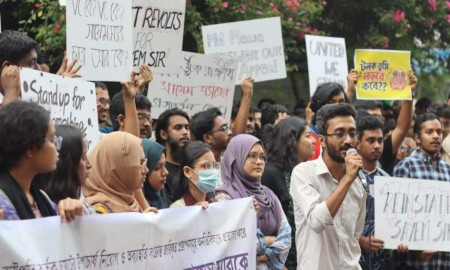
International Women’s Day Today: ‘Protect Women’s and Girls’ Rights’
Today, 8 March, is International Women’s Day. Under the theme “Step Today for Tomorrow’s Justice, Protect Women’s and Girls’ Rights,” Bangladesh joined the global community in celebrating the occasion with various programmes organized by government and non-government institutions, organizations, and agencies.
The day featured discussion sessions, rallies, award ceremonies, and recognition events. The Ministry of Women and Children Affairs, along with several NGOs and banks, organized special programmes, including the “Indomitable Women Award” ceremony, discussions, and processions. One of the highlights was the posthumous recognition of former Prime Minister Khaleda Zia as an “Indomitable Woman” for her contributions to democracy and women’s advancement. Her granddaughter, Barrister Jaima Rahman, accepted the award on her behalf.
The “Indomitable Women Award” recognized women who made outstanding contributions in various fields. Five women were specially honoured from across the eight divisions: Bobita Khatun (Khulna), Shomola Begum (Chattogram), Nurbanu Kabir (Rangpur), Nurun Nahar Akter (Mymensingh), and Afroza Yasmin (Dhaka).
This year’s award categories included:
- Women achieving economic success
- Women succeeding in education and employment
- Exemplary mothers
- Women who overcame violence and triumphed in life struggles
- Women making exceptional contributions to social development
Recipients were also announced division-wise, with names from Dhaka, Rajshahi, Chattogram, Sylhet, Khulna, Rangpur, Barishal, and Mymensingh divisions.
The Department of Women Affairs has requested local administrations in districts and upazilas to implement coordinated activities in line with the theme. Various government and non-government institutions have also undertaken separate programmes.
President Mohammed Shahabuddin and Prime Minister Tarique Rahman issued separate messages on the occasion, extending greetings and congratulations to women worldwide.
The National Press Club, as in previous years, organized a discussion session, award presentation, and lamp-lighting ceremony. The event began at 11:00 a.m. in the Press Club auditorium, with Foreign Minister Shama Obaid as chief guest. Journalist Momtaz Banu received a special honour this year.
The Dhaka Reporters Unity also planned programmes, starting with a rally at 10:00 a.m. Due to the holy month of Ramadan, the remaining events will be held after Eid-ul-Fitr.
How International Women’s Day Began
The observance of 8 March as International Women’s Day dates back more than a century, rooted in the labour movement. The idea emerged from women workers’ struggles for shorter working hours, better wages, and voting rights. In 1908, around 15,000 women marched in New York City demanding these rights. The following year, the Socialist Party of America declared the first National Women’s Day.
Clara Zetkin, a communist and women’s rights activist, proposed making it an international day at an International Conference of Working Women in Copenhagen in 1910. Delegates from 17 countries unanimously adopted the proposal. In 1911, Austria, Denmark, Germany, and Switzerland celebrated the first International Women’s Day. In 2011, the centenary was observed, and in 2024, the 113th International Women’s Day was marked.
Why 8 March?
Clara Zetkin did not initially specify a date. Until the 1917 Russian Revolution, no fixed date was formally set. In that year, Russian women struck for “Bread and Peace” against the Tsar. Four days later, the Tsar abdicated, and the provisional government granted women voting rights. Under the Julian calendar used in Russia at the time, the strike began on 23 February, which corresponds to 8 March in the Gregorian calendar. Subsequently, 8 March was adopted as International Women’s Day.
Why Purple as the Symbolic Colour?
According to the official International Women’s Day website, the day’s symbolic colours are purple, green, and white. Purple represents justice and dignity, green symbolizes hope, and white stands for purity. These colours were chosen in 1908 by the Women’s Social and Political Union in the United Kingdom.
International Men’s Day Also Exists
Similar to Women’s Day, International Men’s Day is observed annually on 19 November. It began in 1990, though it is not officially recognized by the United Nations. More than 80 countries, including the United Kingdom, now celebrate the day.
Global Observance
In many countries, International Women’s Day is a public holiday. In Russia and several other nations, flower sales nearly double in the days leading up to 8 March. In some regions of China, women receive a half-day holiday by government decision. In Italy, women are traditionally given flowers, a custom that began in Rome after World War II.
In the United States, March is designated as Women’s History Month, with the President issuing a proclamation each year recognizing American women’s achievements.
Why Women’s Day Is Still Needed
Despite progress, women worldwide continue to fight for rights and equality. In countries like Afghanistan, Iran, Ukraine, and the United States, women face severe challenges due to war, violence, and policy changes. In Afghanistan, the Taliban government has restricted women’s higher education and employment and imposed rules requiring a male guardian for going out. In Iran, the 2022 death of Mahsa Amini in custody sparked nationwide protests, with women burning hijabs in defiance.
A UN report notes that the Russia-Ukraine war, which began on 24 February 2022, has increased global food insecurity, malnutrition, poverty, and gender-based violence, with women bearing the heaviest burden. Debates over abortion rights also persist in the United States and Mexico.
Women’s rights advocates stress that International Women’s Day remains essential to address these barriers and ensure a safe, equitable future for women and girls everywhere.
 Follow The Daily Campus on Google News