HEAT Project Has Two Years Left, but Progress Stands at Just 5%: Education Minister
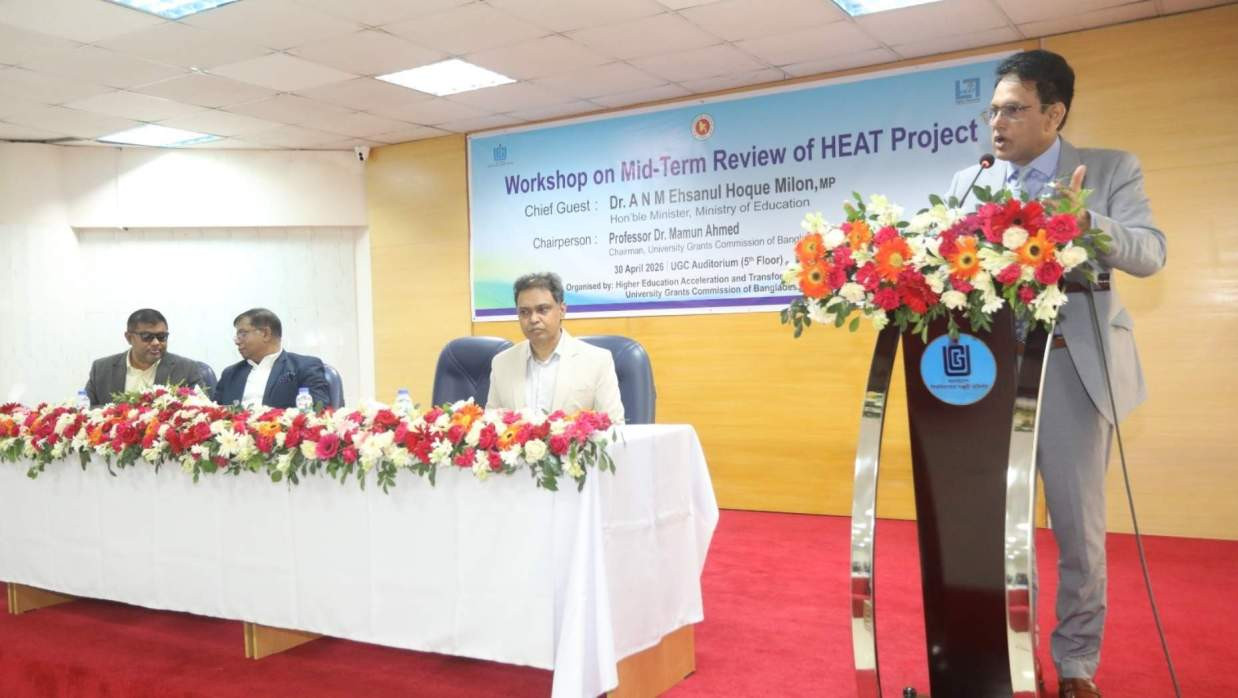
Education Minister Dr. A. N. M. Ehsanul Haq Milan has issued a directive to fast-track the implementation of the Higher Education Acceleration and Transformation (HEAT) project. Speaking as the chief guest at a mid-term review workshop held today (April 30) at the UGC building, the Minister expressed concern over the project's current status, noting that while only two years remain of the initial timeline, progress stands at a mere 5 percent.
The workshop was presided over by University Grants Commission (UGC) Chairman Professor Dr. Mamun Ahmed. Special guests included Additional Secretary of the Ministry of Education Dr. Sardar Md. Keramat Ali and World Bank Senior Education Specialist and Task Team Leader T. M. Asaduzzaman. The welcome address was delivered by Project Director Professor Dr. Asaduzzaman.
In his address, the Education Minister emphasized the critical importance of the project for the development of the country's higher education sector. He noted that certain components of the project have become irrelevant in the current context and directed the relevant authorities to revise the Development Project Proforma (DPP) to align with the government's current priorities.
He also stressed the need for cost-effectiveness, echoing the Prime Minister's directive to ensure the rational use of development funds. The Minister stated that the project must be completed by 2028 and assured that the ministry would provide all necessary support to achieve this goal.
UGC Chairman Professor Mamun Ahmed reassured the participants that despite a late start, the project aims to meet its targets through dedicated efforts. He clarified that the focus would be on achieving tangible goals rather than just exhausting the budget.
Professor Ahmed highlighted that the HEAT project is designed to address the prevailing crisis in higher education by fostering international research collaborations. A key priority will be increasing the connection between universities and industrial or commercial sectors. Furthermore, the project intends to create opportunities for public and private research institutions to collaborate more effectively, bridging the gap between academic output and practical application.
 Follow The Daily Campus on Google News