Dhaka, the 'City of Universities': Does Any Other City Match Its Higher Education Density?
Dhaka, the capital of Bangladesh, is a densely populated and extremely busy city. Traffic jams, clusters of rickshaws, and the constant movement of people define its everyday scene. Besides being known as a “city of traffic jams” or a densely populated urban centre, it is also called the “City of Mosques” due to the record number of mosques.
However, this city can be given another fitting name — the ‘City of Universities’. Considering the geographical size of a small country like Bangladesh, the capital Dhaka has a record number of universities. For this reason, calling Dhaka the ‘City of Universities’ would not be wrong at all.
When the number of universities located in the capitals of the world’s 10 largest countries by area is analysed, no other city matches Dhaka. Bangladesh, with an area of 147,610 square kilometres, has a total of 171 public and private universities. More than half of them — 59 universities — are located in Dhaka, which spans only 306.4 square kilometres.
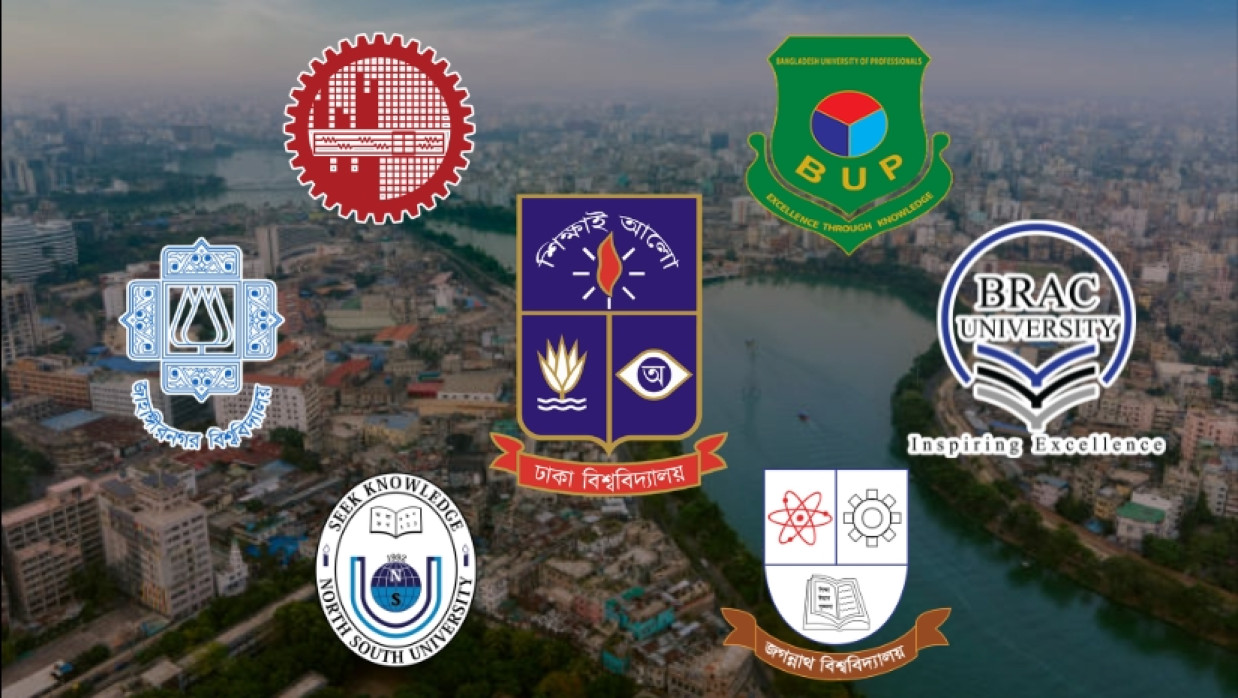
This includes the country’s first and premier university, the University of Dhaka, which is recognised not only in the country but as one of the best higher education institutions in South Asia. In addition, there are Bangladesh University of Engineering and Technology (BUET), Dhaka Medical College, and many other public and private universities.
According to the latest list from the University Grants Commission (UGC) of Bangladesh, the country has 171 universities in total — 55 public and 116 private. Out of these, 59 universities are located in the capital Dhaka. Online data analysis shows that there are 9 public general universities in Dhaka.
These include the University of Dhaka, Bangladesh University of Engineering and Technology, Jagannath University, Sher-e-Bangla Agricultural University, Bangladesh University of Textiles, Bangladesh Medical University, Islamic Arabic University, Bangladesh Maritime University, and Bangladesh University of Professionals.
Among the 50 private universities, prominent ones include North South University, Independent University Bangladesh, American International University-Bangladesh, East West University, BRAC University, Ahsanullah University of Science and Technology, Daffodil International University, Manarat International University, Stamford University Bangladesh, and University of Liberal Arts Bangladesh.
On the other hand, according to UniRank data, the total number of public and private universities in Dhaka is 69. Besides these, there are institutions like Dhaka Medical College and Shaheed Suhrawardy Medical College, along with more than 35 graduate and postgraduate colleges. Altogether, the number of higher education institutions in Dhaka exceeds 96. Some sources put the figure at 106. Additionally, according to honoursadmission.com, there are 67 degree-level colleges in Dhaka district.
The world’s 10 largest countries by area are Russia, Canada, China, the United States, Brazil, Australia, India, Argentina, Kazakhstan, and Algeria. Bangladesh ranks 94th in this list. According to EduRank data for 2025, Moscow, the capital of Russia, has 67 universities. However, StudyAbroadAide data shows 59 universities (46 public and 13 private) there.
According to Wikipedia, Beijing, the capital of China, has 90 universities. The same source shows 45 universities and higher education institutions in Washington DC, the capital of the United States. Brasília, the capital of Brazil, has 28 universities. Canberra, the capital of Australia, has 8 universities. Ottawa, the capital of Canada, has around 5 public and private universities along with one technical and vocational institution.
New Delhi, the capital of India, has 38 universities, while Buenos Aires, the capital of Argentina, has 51. Astana, the capital of Kazakhstan, has 19 universities according to UniPage, and Algiers, the capital of Algeria, has 25 universities.
Analysis of these statistics shows that among the world’s largest countries by area, only Moscow (Russia) and Beijing (China) have more universities than Dhaka. The capitals of the remaining 8 countries have fewer universities than Dhaka.
Although these countries are many times larger than Bangladesh, the fact that a small country like Bangladesh has so many universities in its capital is considered surprising by many. While Moscow and Beijing have more universities in absolute numbers, Bangladesh is ahead when considering the number of universities relative to the country’s area. Russia is 115 times larger than Bangladesh, and China is 65 times larger.
When looking at the number of universities in terms of city population, the picture becomes even more significant. In 2024, BBC Science Focus magazine published a list of the world’s top 10 most populous cities. These include Tokyo in Japan, Delhi in India, Shanghai in China, São Paulo in Brazil, Mexico City in Mexico, Cairo in Egypt, Dhaka in Bangladesh, Mumbai in India, Beijing in China, and Osaka in Japan.
Tokyo has 148 national, public, and private universities; Delhi has 38; Shanghai has 69; São Paulo has 92; Mexico City has 57; Cairo has 69; Dhaka has 59; Mumbai has more than 55; Beijing has 90; and Osaka has 69 universities. In this context, Dhaka ranks fourth.
Professor Mohammad Tanzimuddin Khan, Member of the University Grants Commission (UGC), told The Daily Campus: “The commercial aspect dominates in Dhaka. Universities have become business products. There is a severe shortage of qualified teachers. One teacher often takes classes in three or four different universities. Quality takes a backseat to business.”
The large number of universities in Dhaka highlights the commercial aspect more than anything else. Universities have become commercial products. With so many institutions, there is also a need for quality teachers. However, it is seen that one teacher is taking classes in three or four different universities. In these institutions, the commercial aspect gets more importance than quality.
On this issue, educationist, researcher, and political thinker Professor Abul Kashem Fazlul Haque said: “There are mainly two reasons behind so many universities coming up in Dhaka — political and business interests. The main businessmen, with political connections, are establishing these institutions for their own benefit. In this, quality is being ignored in favour of commerce.”
To come out of such a situation, an education-friendly political government is needed, according to this educationist. He said Dhaka does not need this many universities. They should be established in other major cities outside. At the same time, the entire system needs to be restructured. Although it is very difficult. The goodwill of global powers like India, the United States, and China is also needed for political stability in the country.
Note: In preparing this report, various online sources were used to compile statistics on universities in different cities of the world. Some sources may have slight gaps or variations in the exact number of institutions in different cities.
 Follow The Daily Campus on Google News