Government Faces Heavy Pressure in Just 45 Days
Only 45 days after forming the government, Bangladesh’s newly elected democratic government has fallen into severe pressure and crisis on multiple fronts. Economic pressure, dollar and import crisis, skyrocketing prices of goods, fuel crisis, disruption of industrial production due to shortage of electricity and gas, public health and social pressure (measles outbreak), limitations of the healthcare system, rumors and crisis of public confidence, political and administrative pressure, opposition movements, and administrative paralysis have collectively put the new government under deep and widespread strain.
However, the most intense pressure has come from two major factors: the joint US-Israel attack on Iran in the Persian Gulf, which has caused a sharp rise in global fuel oil prices and supply disruptions, and the sudden outbreak of measles that has led to the untimely deaths of a large number of children.
The 13th National Parliament election was held on February 12 this year. After the election, the BNP-led new government was formed. The new Prime Minister and cabinet members took oath before President Md. Shahabuddin on February 17. The interim government led by Nobel laureate Professor Dr. Muhammad Yunus, which had been in power for 18 long months (558 days), formally ended its term on February 16.
It is worth noting that from February 17 to today, Friday (April 3), a total of 46 days have passed. Excluding the oath-taking day itself, today marks the effective completion of the government’s 45th day in office. In the new cabinet, BNP Chairman Tarique Rahman took oath as Prime Minister.
Since assuming power, the new government has come under intense pressure on several issues. Among them, the economic pressure (fuel and inflation), dollar and import crisis is the biggest headache. Due to the lack of dollars, the government is unable to open LCs (Letters of Credit) despite rising international oil prices.
There is fear that this could break the fuel supply chain. Additionally, the sharp rise in commodity prices is another major concern. If transportation costs increase due to the fuel crisis, the prices of daily essentials will go beyond the reach of ordinary people, which could spark strong public anger. There are also fears of disruption in industrial production. If factories shut down due to lack of electricity and gas, export earnings will decline and unemployment will rise, putting the government under severe pressure.
At the same time, the new public health and social pressure caused by the measles outbreak is worrying the government. Due to limitations in the healthcare system, managing the shortage of hospital beds and ICUs and ensuring rapid vaccine supply have become major challenges.
If child deaths continue to rise, strong moral pressure and criticism will mount against the government. The government also believes there is a crisis of rumors and public confidence. Restoring public trust in the vaccination program and stopping misinformation is a difficult task for the government. Besides these, there is political and administrative pressure. Opposition parties may launch large-scale street movements over fuel and health sector mismanagement, which could challenge the stability of the new government.
Administrative Paralysis
Preventing chaos and black marketing of fuel and keeping field administration and law enforcement agencies active round the clock is a major test for the government. To tackle this multi-dimensional crisis, the government is currently focusing on finding alternative fuel sources and allocating emergency health budgets.
According to relevant sources, on one hand, the international market instability has caused fuel supply shortages, and on the other hand, the sudden nationwide spread of measles has put the government under immense pressure.
Fuel Crisis and Long Queues at Pumps
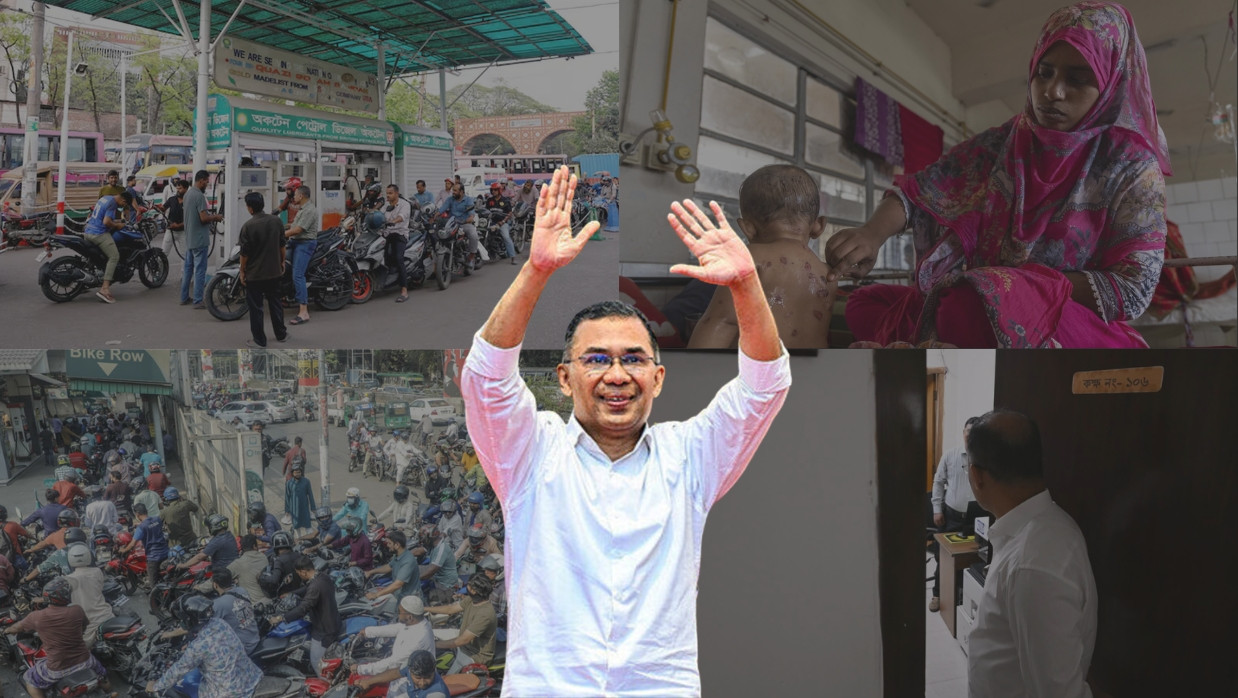
In the scorching heat of April 2026, Bangladesh’s fuel crisis has taken an unprecedented form. Long queues of vehicles now stretch for miles in front of petrol pumps at every intersection in the cities. The scene is not just of traffic congestion but of deep public distress.
In areas like Tejgaon and Kalyanpur in the capital, trucks and covered vans start gathering from midnight. Drivers are dozing off with their heads on the steering wheel because there is no fuel at the pumps. For the past few days, the government has started rationing fuel, allocating a fixed amount to each pump daily, which runs out within a few hours. Bottled octane and petrol are being sold at exorbitant prices in the retail market, causing immense hardship for low and middle-income people.
The severity of the crisis can be understood from some of the government’s recent tough decisions. To save electricity, shops across the country have been ordered to close after 8 PM, and area-based load shedding has been made mandatory once a week. Changes in school and college timings and even a return to online classes in many cases are also under consideration. Due to diesel shortage, irrigation pumps are on the verge of shutting down, leaving Boro rice farmers in despair. This is feared to directly affect the rice market.
Due to rising prices in the international market and the dollar crisis, timely LC opening has become impossible. Stocks have reached rock bottom. To manage the situation, the government is going to introduce a Digital Fuel Pass or QR Code system so that a customer cannot buy more than a specified amount of fuel per week.
Overall, the fuel crisis has not only stopped vehicle wheels but has also slowed down the wheels of the country’s economy. The only question in the minds of ordinary people now is — how much longer will these long queues continue?
Political and Social Pressure
Due to the dual crises of fuel and measles, the government is under significant administrative pressure. To prevent chaos and hoarding, BGB has been deployed across the country. Public anger has grown due to vaccine shortages in the health sector and mismanagement in the fuel sector. Prime Minister Tarique Rahman has ordered urgent investigations into these matters.
The government has already started implementing measures such as reduced office hours and online classes to save fuel, effective from today, Friday, April 3.
Meanwhile, on April 2, in the 7th session of the 13th National Parliament, Energy and Mineral Resources Minister Iqbal Hasan Mahmud Tuku stated that there is no real shortage of fuel in the country. He claimed that the long queues are mainly due to “panic buying” by the public.
Geopolitical Tension and War in the Middle East
Due to geopolitical tensions and war in the Middle East, fuel oil prices and supply have become unstable in the world market. This has directly affected Bangladesh’s market. As a result of supply shortages, the government has started rationing fuel oil. Long queues for fuel are now visible at filling stations across the country.
To keep the situation under control, the government is planning to introduce a Digital ‘Fuel Pass’ (QR Code) system and is conducting drives nationwide to stop hoarding. To tackle hoarding and black marketing of fuel, the government has already appointed ‘Tag’ officers. Incidents of violence, clashes, and even deaths over fuel have been reported from various parts of the country.
Despite the global fuel crisis, to maintain public support and confidence, the government and Prime Minister Tarique Rahman have repeatedly rejected proposals and demands to increase fuel prices.
Even though prices have risen in the international market, the government has decided to keep fuel prices unchanged in April to reduce pressure on ordinary citizens.
Search for Alternative Sources
To reduce import dependency, the government is now trying to bring oil through alternative routes, including from Saudi Arabia and other countries.
Key Impacts of the Fuel Crisis:
- Panic and Rationing at Pumps: Most filling stations in the country are facing severe shortages of diesel and octane. The government has introduced a ‘Fuel Pass’ (QR Code) system, limiting personal cars to 20 liters per week and motorcycles to only 5 liters.
- Rise in Transport and Commodity Prices: Reduced movement of trucks and covered vans due to fuel shortage has disrupted the supply of daily essentials. As a result, prices of vegetables, rice, lentils, and other goods have risen abnormally.
- Power and Irrigation Crisis: Many power plants have reduced production due to diesel shortage, leading to 5-6 hours of load shedding daily. The biggest crisis is in agriculture; farmers are in despair as irrigation pumps for the Boro season cannot be operated.
- Dollar and Import Complications: Rising international oil prices and dollar shortage have made timely LC opening impossible. Stocks are depleting rapidly and new imports are delayed.
- Emergency Measures: To control the situation, the government has already closed shops after 8 PM and is considering reducing government office hours. In many areas, BGB (Border Guard Bangladesh) has been deployed at pumps to prevent disorder.
The government is now trying to import oil directly from Russia or other countries as an alternative.
Measles Outbreak and Health Sector Crisis
Due to prolonged stagnation in vaccination programs and political instability during 2024-25, a severe measles outbreak has erupted across the country. In the first three months of this year, at least 38 to 52 children have died from measles. The number of cases has increased nearly 75 times compared to last year. The disease has spread to around 56 districts, including Dhaka and Rajshahi.
Hospitals are facing acute shortages of ICU beds and ventilators. The government has allocated Tk 604 crore for emergency vaccine procurement and launched a special vaccination drive for children aged 6 months to 10 years.
All leave for doctors, officers, and health workers under the Directorate General of Health Services has been cancelled to tackle the emergency.
On the Measles Outbreak
According to various sources, between 38 and 52 children have died due to measles in the first three months of 2026. A large number of these deaths (at least 32) occurred in March alone. The highest number of deaths was recorded at Mohakhali Infectious Disease Hospital.
The Directorate General of Health Services has cancelled all leave for health workers to ensure uninterrupted service and strengthen the vaccination campaign.
BNP’s Health Affairs Secretary Dr. Rafiqul Islam told The Daily Campus that the government is taking necessary steps to control the measles outbreak. He visited Rajshahi Medical College Hospital, spoke with doctors, and emphasized the need for isolation, proper treatment, and public awareness rather than panic.
 Follow The Daily Campus on Google News