God Save the King
The roar started before the ball even crossed the line.
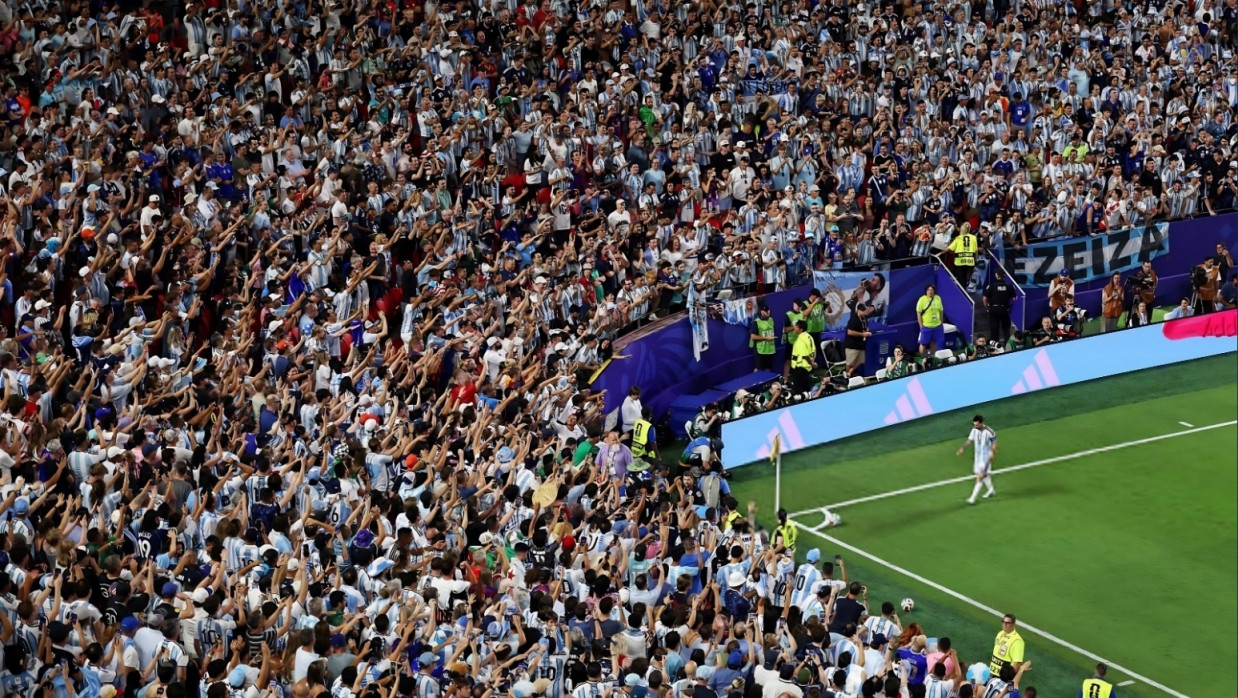
Arrowhead Stadium holds 76,000 people. On Tuesday night, it felt like it held the whole of humanity, pressed together in the June heat of Kansas City, Missouri, necks craning, arms raised, every throat open. Argentina's sky-blue and white flickered in every corner of the upper deck. Families in Dhaka had gathered around screens in living rooms and tea stalls since sunrise, Bangladesh time being what it is. In Buenos Aires, the city stopped. Even people who do not follow football found themselves drawn to a television, the way you walk toward a window when the thunder sounds different.
Lionel Messi scored three goals against Algeria. He is 38 years old. He has now played in six World Cups. He has 16 goals in the tournament's history, tying Germany's Miroslav Klose for the most ever scored at any World Cup in the sport's century-and-a-quarter of existence. And when he scored the first of those three goals Monday night, on a left-footed strike from outside the box in the 17th minute, he cried.
Not because Argentina had scored. He cried because of something that had nothing to do with football, something personal and heavy that he carried into that stadium and set down, briefly, on the pitch. He explained it afterward, his voice measured, his words careful. He had been going through a difficult period. His teammates had surrounded him. And then he walked into Arrowhead, into the noise and the light and the grass, and did what he has always done: he played.
There is a broadcast clip that circulates every few years among football fans, a piece of audio that has aged from prophecy to punchline. It is from the 2018 World Cup in Russia, the round of 16, the moments after France knocked Argentina out and Messi walked off the pitch having won nothing at a World Cup yet again. An English commentator, Derek Rae, delivered the eulogy.
"The final World Cup match for Lionel Messi," Rae said. "His final appearance in the colors of his country.”
The logic was sound. Messi was 30. Qatar would come four years later, and he would be 35, theoretically possible but unlikely. Beyond that, the math seemed impossible. Rae spoke as someone reasoning from evidence. He was wrong in a way that should feel instructive to the rest of us permanently.
Messi went to Qatar. He won the World Cup. He scored twice in the final against France, a match so wild and improbable that it required a penalty shootout to resolve, a match that Argentine fans will reconstruct from memory for the rest of their lives. He raised the trophy. And then he did not stop.
Monday was the 20th anniversary, to the day, of Messi's first World Cup goal. He scored it on June 16, 2006, against Serbia and Montenegro, coming off the bench at 18 years and 358 days old and immediately assisting one goal before scoring his own. He became the youngest Argentine to score at a World Cup.
On June 16, 2026, at 38 years and 358 days old, he scored a hat-trick. He is now also the oldest Argentine to score at a World Cup. The same date. The same distance from his birthday. Twenty years apart.
If a novelist submitted this plot point, an editor would reject it as contrived.
Consider what 38 means in football. Ronaldo Nazario, the Brazilian striker many consider the greatest pure goal-scorer in the game's history, had retired years before this age. Zlatan Ibrahimovic played deep into his late 30s and was celebrated as a freak of nature for doing so. Roger Milla of Cameroon became famous for scoring at 38 at the 1994 World Cup, a record for the oldest player to score at the tournament that stood as a monument to the absurd.
Messi did not just break that record Monday. He broke it with a hat-trick.
He now holds the record for the oldest player to score a hat-trick at a World Cup: 38 years and 358 days. The previous holders, Oleg Salenko of Russia in 1994 and Cristiano Ronaldo in 2018, were both 33 when they managed the feat. Messi surpassed them by nearly six years.
He also holds the record for most World Cup assists. He now has eight, tying Diego Maradona's all-time record set more than three decades ago. The symmetry is almost savage: the man who spent his whole career measured against Maradona's ghost has drawn level with Maradona's own assist tally at the World Cup, in what is likely his final tournament, in the same match where he tied Klose's goals record.
Two monuments. One night. One 38-year-old man from Rosario who still has not gotten around to slowing down.
Zlatan Ibrahimovic, working as a studio analyst for Fox Sports, spoke about Messi after the final whistle with the blunt clarity Ibrahimovic has always preferred.
"If he wins this World Cup," Ibrahimovic said, "it will just be another trophy on his shelf. It doesn't matter anymore whether he wins it or not. He is beyond football now."
This is not hyperbole from a former rival. It is an accurate description of what happens when someone has played at the highest level long enough, and well enough, and consistently enough, that the sport's traditional scorekeeping no longer captures the point. Messi won the World Cup in 2022. He has won the Ballon d'Or eight times. He has scored more goals for club and country than any player in recorded history. The question stopped being whether he was the greatest a long time ago. Now the question is something different, something harder to frame: what does it mean to watch someone keep doing this at an age when it should be impossible?
Erling Haaland, the Norwegian forward many believe will carry the game after Messi and Ronaldo's era closes, posted three words on social media after Tuesday's match. The translation from Norwegian is approximate but captures the spirit: "Messi is a Madman." He is not wrong.
Eighty thousand people were inside Arrowhead Stadium on Monday. Tens of thousands more stood outside in viewing areas. In Dhaka, the obsession with this particular Argentine has been building for over two decades, the kind of devotion that crosses cultural and geographic borders in a way that nothing except music and football can.
Young men who were not yet born when Messi made his World Cup debut in 2006 wear his number ten on their backs. His face appears on murals. The fact that Argentina plays its World Cup matches in American time zones that require Bangladeshi fans to wake before sunrise has not dampened the crowds. It has deepened them.
This is the other thing about Messi that resists rational explanation. His appeal is not national. It is not South American. It is not even tied to a specific style of play that might suit one fan over another. Fans who cannot name another Argentine player know his name. Children in countries that have never qualified for a World Cup weep when he loses and celebrate when he wins.
After the match, Messi spoke about the supporters in the stadium with the same quiet sincerity he brings to everything.
"Whether it's Qatar or the United States," he said, "they always make huge sacrifices to come and be there. Because of them, it feels like we're playing at home."
He paused the way he always does before saying something that matters to him. "These people never stopped believing."
The specifics of the goals are worth recording.
The first came in the 17th minute. Rodrigo De Paul played a pass through Algeria's defensive line and Messi met it just outside the penalty area. Goalkeeper Luca Zidane had no time. The shot was left-footed, precise, and went to the far post. Messi ran to the corner, pumped his fist, and then the tears came. He stood there with his face doing something complicated, the way faces do when emotion has been held back for days.
The second goal, in the 60th minute, was simpler and more clinical. Alexis Mac Allister's shot was parried by the goalkeeper; Messi was already where the ball was going to land, and he tapped it in before anyone could react.
The third goal, in the 76th minute, was the one that completed the hat-trick and broke the records. He received the ball at the edge of the penalty area, shifted his weight to create a half-yard of space that should not have existed given where the defenders were standing, and then hit a diagonal shot across goal into the far corner.
The stadium did not just roar. It shook. Arrowhead is a venue built for American football, for noise, and it has hosted concerts and major events across its decades of existence. The sound on Monday night at the 76th minute was something the people inside will remember as unlike anything they had heard there before.
When he left the pitch in the 80th minute, substituted off with the result decided, every person in the stadium rose. This happens in sport when a crowd decides that something warrants acknowledgment beyond cheering for a team. It happened Monday in Kansas City.
Messi was asked afterward about passing Ronaldo Nazario on the all-time World Cup scoring list. In reaching 16 goals, he had also surpassed the Brazilian's 15.
His answer was typical of him. He said that competing with great players on lists like this was itself an honor. He mentioned Ronaldo Nazario by name, called him one of the greatest players in history, and then said something that captures everything about the way Messi approaches his own record-breaking: "At the end of the day, these are just statistics."
He does not say this to seem modest. He says it because he means it. The goals matter because they help Argentina win. The records matter because they mark the distance traveled. What Messi has always seemed to care about is the actual playing, the movement and the decision and the instant when the ball goes where he decided it should go. Everything else is annotation.
In 2018, Derek Rae looked at a 30-year-old Messi leaving the pitch in Russia and saw an ending. This was understandable. Endings are what you expect at a certain point, and expecting them is reasonable. What was not reasonable, and what no reasonable analysis could have predicted, was that the ending would keep not arriving.
He played in 2022. He won. He was named the best player of the tournament. At the end of the 2022 World Cup final in Lusail, Messi lifted the trophy and France striker Kylian Mbappé — who had scored a hat-trick to nearly drag the game from Argentina's grasp — embraced him. Two years later, Mbappé was asked what it had been like to play against Messi at his peak.
"I'm not sure that was his peak," Mbappé said.
Messi is still playing in 2026. He is 38. He has just scored a hat-trick in the opening match of what he has indicated will be his last World Cup, tying two all-time records in a single game, making his teammates cry, making 80,000 strangers in Kansas City stand up, making fans in Dhaka and Buenos Aires and Tokyo and Lagos feel something they will tell people about for years.
The tournament has barely begun. There is more football left to play. Klose's mark is tied, not broken, and the group stage has two matches remaining. But even if Messi were to stop right now, even if the 76th minute of a June night in Missouri were the last time he ever sent a ball into a net, what he did Monday would stand as one of the stranger and more beautiful things that sport has produced.
Not because of the records, though the records are extraordinary. Because of the specificity of it: a 38-year-old man, carrying something private and painful, walking out onto a pitch in the American Midwest in front of a crowd that loves him the way crowds rarely love anyone, and scoring three goals, and crying during the first one, and then answering questions afterward with the same plain honesty he has had since he was 18.
Ibrahimović is right. Messi is bigger than football now. Even another World Cup wouldn't redefine his legacy; it would merely add another trophy to an already overflowing cabinet. But the more fitting word may be irreplaceable. Fans can only hope he stays fit for as many days as possible, because he is certainly the last of his kind.
 Follow The Daily Campus on Google News