
CAMEL Ratings Provide Strategic Roadmap for Banking Sector Stability

The banking sector remains the backbone of the economy, playing a vital role in ensuring financial stability and driving macroeconomic growth. A recent study has shed new light on the performance of commercial banks in the country, using the internationally recognized CAMEL framework—which evaluates banks based on Capital adequacy, Asset quality, Management efficiency, Earnings, and Liquidity.
In Bangladesh, where the banking sector is both a driver of growth and a source of vulnerability, CAMEL provides a roadmap for stability. By focusing on capital adequacy, asset quality, management efficiency, earnings, liquidity, and sensitivity to market risk, it helps banks identify weaknesses, regulators enforce sound practices, and policymakers design effective reforms.
Performance of the Types of Banks Based on Different Components of CAMEL
CAMEL is used to measure the overall performance of the banking system as well as to find out strengths and weaknesses which ensures the safety and financial stability of a banking company. The CAMELS rating system is an internationally recognized tool that evaluates financial institutions based on six critical factors: capital adequacy, asset quality, management, earnings, liquidity, and sensitivity. A low CAMELS score indicates a financially solid institution, while a high score signals potential weaknesses, helping regulators and stakeholders identify and address issues proactively.
The performance of different types of banks regarding the CAMEL components has been analyzed below. The financial indicators used to evaluate bank performance are summarized in the following table:
| Key Indicator | Ratios & Metrics Used |
| Capital Adequacy | Capital to Risk Weighted Assets Ratio |
| Assets Quality | Non-performing Loan Rate |
| Management Soundness | Expenditure-Income Ratio |
| Earning Performance | Return on Assets, Return on Equity, Net Interest Income |
| Liquidity | Liquid Assets/Deposit Ratio, Excess Liquidity/Deposit Ratio |
Parameters and Sub-parameters of the CAMEL Model
The detailed integration of quantitative metrics with qualitative assessments in the CAMEL model helps determine the key determinants of bank health and efficient operations:
| Acronym | CAMEL Parameters | Ratios used to measure CAMEL Parameters |
| C | Capital Adequacy |
i. Capital Adequacy Ratio (CAR) ii. Debt-Equity Ratio iii. Loan & Advances to Total Assets Ratio iv. Govt. Securities to Total Investment Ratio |
| A | Asset Quality |
i. Net NPA to Total Assets ii. Gross NPA to Total Loan iii. Net NPA to Total Loan iv. Total Investment to Total Assets Ratio |
| M | Management Quality |
M – Management Quality: i. Loan & Advances to Deposit Ratios ii. Return on Equity (ROE) iii. Net Profit per Employee E – Earning Ability: i. Return on Asset (ROA) ii. Net Profit Margin Ratio |
| E | Earning Ability |
i. Return on Assets (ROA) ii. Net Profit Margin Ratio iv. Net Interest Margin to Total Assets Ratio/(Spread) v. Earnings Per Share (EPS) |
| L | Liquidity |
i. Liquid Assets to Total Assets Ratio ii. Liquid Assets to Total Deposits Ratio |
Rating Analysis and Composite Ranges
There are five categories of composite CAMEL ratings shown in the range table below:
| Rating | Composite Range | Description |
| 1 | 1.00 – 1.49 | Strong |
| 2 | 1.50 – 2.49 | Satisfactory |
| 3 | 2.50 – 3.49 | Fair |
| 4 | 3.50 – 4.49 | Marginal |
| 5 | 4.50 – 5.00 | Unsatisfactory |
Banks use a scale from 1 to 5, with 1 being the highest quality, to rate a bank's assets. CAMEL ratings consider factors like loan repayment capacity, collateral, and banking industry-related risk factors. A "1" rating can be considered to be a strong mortgage loan without default risk. On the other hand, a "5" rating could represent a high-risk unsecured personal loan. CAMELS stands for capital adequacy, asset quality, management, earnings, liquidity, and sensitivity. Let's look at each factor in more detail.
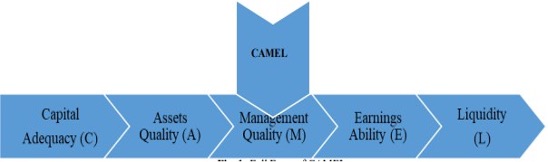
Core CAMEL Parameters Explained
-
Capital Adequacy (C): Capital adequacy measures the total financial position of banks that express a ratio of shareholders' funds to total assets. This ratio indicates all possible financial risks like credit risk, market risk, operational risk, residual risk, liquidity risk, strategic risk, interest rate risk, environment & climate change risk, etc.
-
Asset Quality (A): Asset quality is the important indicator of financial performance of banks. This ratio is the relationship between non-performing loans and advances to total assets. This ratio measures the extent of asset development in earning assets.
-
Management Quality (M): Management efficiency is the most essential part of financial performance. This ratio will identify the efficiency of financial management which will be considered total loans and advances to total deposits, interest expenses to total deposits, and operating cost to total asset. Management quality is the nature of a qualitative indicator which will positively influence the financial management system.
-
Earning Performance (E): Earning ability is the most reflecting ability to support present and future sound operation. Here ROA and ROE are two strong indicators, which determine the capacity to absorb losses by building an adequate capital base, finance base expansion, and adequate dividends payment to absorb losses by creating an adequate capital base finance.
-
Liquidity (L): There are two indicators of liquidity level of the banks. One is total liquid assets to total assets. The second ratio is liquid assets to customer deposits. The study highlights that while many banks maintain adequate liquidity, some face challenges in balancing loan growth with deposit mobilization. Excess liquidity can signal inefficiency, while shortages may indicate vulnerability. Effective liquidity management is therefore critical to ensuring stability and maintaining depositor confidence.
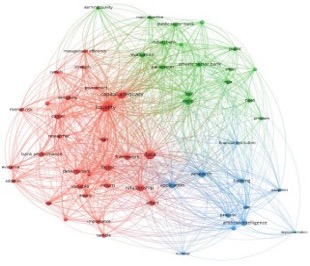
Bibliometric Network Visualization Analysis
The bibliometric network visualization developed through VOSviewer gives a comprehensive overview of all the interrelations existing between different keywords and subjects within the academic literature:
-
Red Cluster: Mainly analyzes the performance of banks, including fundamental themes like capital adequacy, market risk, liquidity, and the CAMELS rating framework, which is an important criteria for the evaluation of the financial health of the bank.
-
Green Cluster: Focused on the banking sector of Bangladesh, bringing out very well the interaction between public and private sector banks, discussing critical challenges like NPAs, and evaluating overall performance.
-
Blue Cluster: Emphasizes the influence of technological innovations in banking and shows ways artificial intelligence can be included, improvements in banking procedures, and relevant developments toward financial institutions.
This graph represents the co-occurrence and relationship of topics in a piece of literature as lines connecting nodes, where thicker lines show closer relations. Overall, the visualization serves as a valuable tool for understanding the complicated interplay of performance between banking and technology.
Limitations of the CAMELS Framework
The effectiveness of CAMELS varies profoundly between countries in relation to underlying regulatory frameworks, economic conditions, as well as practices of banking in each country. It is less applicable to emerging markets with less reliable data compared to developed markets.
Despite the great emphasis of the CAMELS model on financial metrics, it does not consider non-financial risks, including any type of operational or reputational risk, which have become increasingly significant aspects of banking more recently. Regulators and analysts have been known to overly rely on CAMELS ratings while overlooking other critical factors that might show the health of a bank or its risk exposure.
Banks Classification Levels according to the CAMELS Model
| Estimation | Description |
| Classification 1 | Strong (Excellent) |
| Classification 2 | Satisfying (Very Good) |
| Classification 3 | Reasonable (Good) |
| Classification 4 | Marginal (Limitative) |
| Classification 5 | Unsatisfying (Weak) |
Interpreting Market Risk Indicators in CAMEL Rating
Market risk indicators are one of the critical components in assessing the overall risk profile of a bank. Market risk arises from the potential loss in the bank's trading and investment portfolios due to adverse movements in market prices such as interest rates, foreign exchange rates, and equity prices. Therefore, banks must have appropriate policies, procedures, and risk management systems in place to identify, measure, monitor, and control market risks.
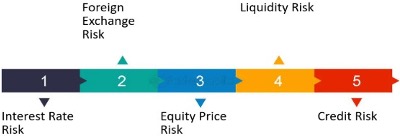
Market risk indicators are essential to evaluate the overall risk analysis of the banking sector. Interpreting market risk indicators and risk management systems in CAMEL rating measures, monitors, and controls market risk. The CAMEL model is more than just a rating system; it is a comprehensive framework for understanding the health of financial institutions.
Regulatory Transition: Bangladesh Bank Replaces CAMELS with CRR
Bangladesh Bank has replaced the CAMELS rating system with a new forward-looking Composite Risk Rating (CRR) framework under its Risk-Based Supervision approach, effective from January 2026. Unlike CAMELS, which focused mainly on historical financial indicators, the CRR will evaluate banks based on inherent risks, governance, risk management, and financial resilience to identify potential problems earlier.
The change follows concerns that CAMELS failed to reflect the true financial condition of many banks due to hidden bad loans and regulatory leniency. While the new framework aims to strengthen banking supervision, experts emphasize that its success will depend on consistent and impartial enforcement by Bangladesh Bank. On the other hand, CRR alone cannot improve the banking sector. Its success depends on Bangladesh Bank applying the framework fairly, independently, and consistently. If regulatory forbearance, selective enforcement, or political influence continues, CRR could face the same credibility issues that weakened CAMELS.
Inclusion of Green Financing Mandates
Recently, Bangladesh Bank has announced that green financing performance by banks and non-bank financial institutions (NBFIs) will be considered in their CAMELS ratings. Under the new directive, banks and NBFIs must allocate at least 5% of their term loans (excluding employee loans) to green financing. Failure to meet this requirement could negatively affect their CAMELS ratings, leading to indirect penalties and broader operational challenges.
Ultimately, CAMEL ratings are more than an assessment tool; they are a strategic guide for improving bank performance, mitigating risks, and fostering a robust and sustainable financial system. The effective implementation of the CAMEL rating system supports informed decision-making, reinforces public confidence, and contributes significantly to the stability and resilience of the banking industry.
Disclaimer: Written by Dr. Farhana Yasmin Liza, Associate Professor, Department of Business Administration, Shanto-Mariam University of Creative Technology. The views and opinions expressed in this article are solely those of the author and do not necessarily reflect the views, policies, or editorial position of The Daily Campus.
 Follow The Daily Campus on Google News