Confucius Institute launched at the University of Chittagong
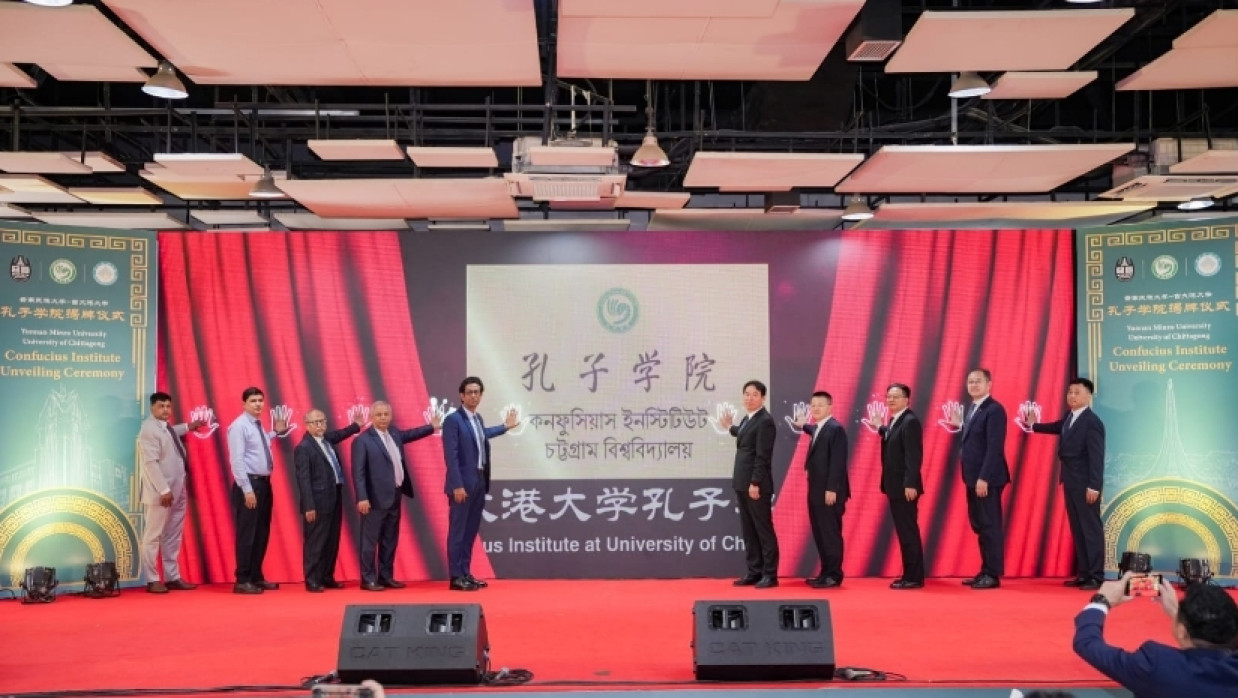
The Confucius Institute at the University of Chittagong was formally inaugurated in Dhaka on Saturday, marking a new development in educational and cultural cooperation between Bangladesh and China.
The inauguration ceremony was held at the International Convention City Bashundhara (ICCB), where the University of Chittagong and China's Yunnan Minzu University jointly established the institute. It is the fourth Confucius Institute in Bangladesh and the first in the country's southeastern region.
The institute received approval from the Chinese International Education Foundation in October 2025. The two universities later signed a cooperation agreement at the World Chinese Language Conference in Beijing in November 2025.
Zhao Junmin, member of the Standing Committee of the Communist Party of China Yunnan Provincial Committee, attended the ceremony as chief guest. Chinese Ambassador to Bangladesh Yao Wen, University Grants Commission member Professor Dr Abdullah-Al-Mamun and University of Chittagong Vice-Chancellor Professor Dr Mohammad Al-Forkan were present as special guests.
Among others, University of Chittagong Pro-Vice-Chancellor (Academic) Professor Dr Mohammad Al-Amin, Pro-Vice-Chancellor (Administration) Professor Dr Md Shafiqul Islam, Yunnan Minzu University Party Committee Secretary Ruan Chaoqi, Confucius Institute at the University of Chittagong Director Professor Dr Md Kamal Uddin and Bangladesh Krira Shikkha Protishtan Director General Brigadier General Mohammad Saif Ullah attended the event.
Representatives from universities and educational institutions in Bangladesh and China, other Confucius Institutes, Chinese organisations and media outlets also attended the ceremony.
Ruan Chaoqi said Yunnan Minzu University would support the institute by sending more qualified teachers to Bangladesh and helping expand opportunities for Bangladeshi young people to pursue higher education in China.
He said the Confucius Institute would serve as an important bridge for young people of the two countries to learn Chinese while strengthening friendship and mutual understanding between Bangladesh and China.
Zhao Junmin said Yunnan province would continue to support the activities of the Confucius Institute. The province would also help the two universities further develop the institute by drawing on their respective strengths and expertise, he said.
Chinese Ambassador Yao Wen said the institute could play an important role in developing skilled human resources needed for industrial development in the Chattogram region and for Bangladesh-China trade and economic cooperation.
He also said the institute could contribute to building a community with a shared future between Bangladesh and China in the new era.
Professor Dr Abdullah-Al-Mamun expressed hope that the Confucius Institute at the University of Chittagong would set an example for other higher education institutions in Bangladesh through new initiatives and experiences.
The guests later jointly unveiled the nameplate of the Confucius Institute at the University of Chittagong, formally marking its inauguration.
The ceremony also featured cultural performances by students and institutions from both countries. Yunnan Minzu University presented a traditional lion dance and a martial arts performance titled “The Wushu Spirit of China”, while the Bangladesh Krira Shikkha Protishtan presented “The Rhythms of Bangladesh”.
Chinese students studying Bengali at Yunnan Minzu University also performed Bengali songs at the event. The performances showcased cultural traditions from Bangladesh and China and highlighted the countries' growing cultural exchanges.
As the first Confucius Institute in southeastern Bangladesh, the institute is expected to provide Chinese language education while serving as a platform for broader educational and cultural exchange. Through language and cultural programmes, it is also expected to promote greater mutual understanding and people-to-people exchanges between Bangladesh and China.
 Follow The Daily Campus on Google News