How to Get Up to Tk 50,000 Digital Loan from Home
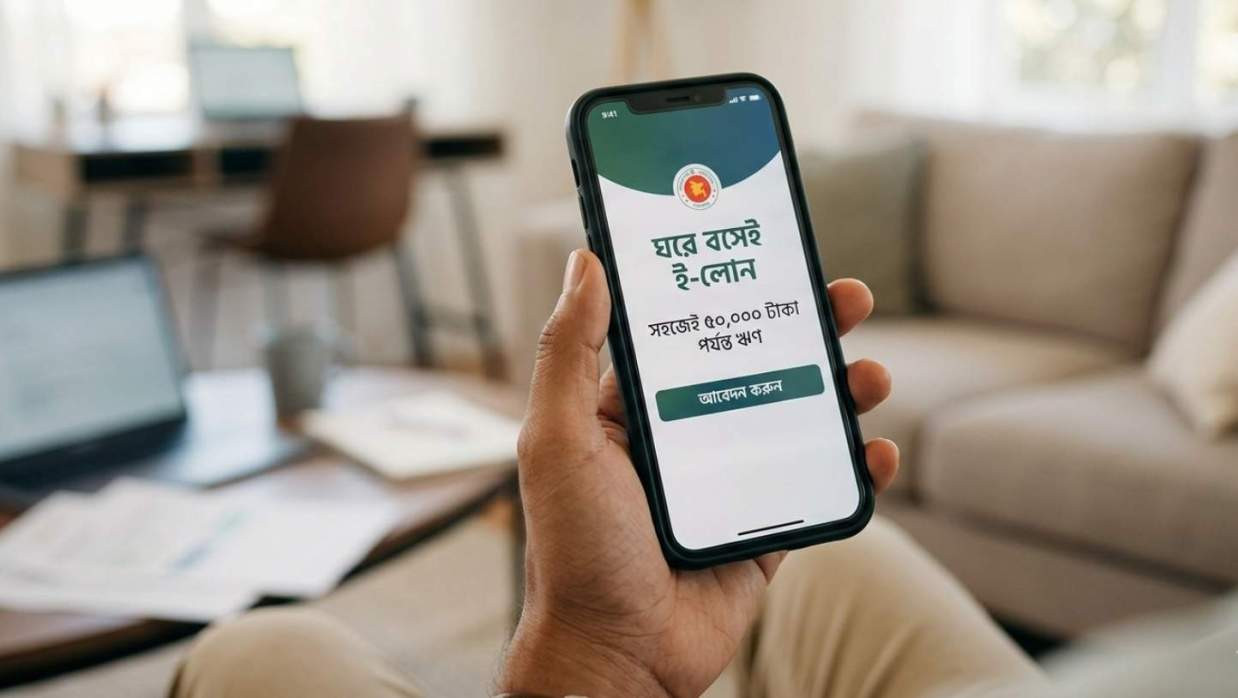
The traditional landscape of securing a bank loan—characterized by physical visits, meticulous paperwork, long queues, and prolonged waiting times—is undergoing a rapid technological transformation. Individuals can now navigate the entire lending sequence, from application to verification and final disbursement, entirely from the comfort of their homes using mobile devices. This completely paperless ecosystem is officially recognized as an "E-Loan" or digital lending.
Financial institutions and commercial banks in Bangladesh are systematically scaling up these digital services following a comprehensive regulatory circular issued by the central bank. On May 11, Bangladesh Bank formulated a structural policy under Section 45 of the Bank-Company Act, 1991, establishing a standardized framework for digital loans.
An E-Loan is an end-to-end digital credit facility where the complete lifecycle—including application, credit assessment, approval, and fund transfer—is executed online through a bank’s designated mobile application, web portal, or digital platform without requiring any physical presence at a brick-and-mortar branch.
While the central bank’s recent policy standardizes this for the entire banking industry, digital lending is not entirely unprecedented in Bangladesh. Leading commercial banks, in bilateral partnerships with prominent Mobile Financial Services (MFS) providers like bKash, have pioneered micro-loans over the last few years.
The initial credit ceiling of 20,000 BDT has already been scaled up to 50,000 BDT. The newly issued central bank circular officially transitions this from bilateral corporate arrangements into an industry-wide regulatory framework, allowing any commercial bank to offer these digital facilities independently.
Industry specialists clarify that an E-Loan does not constitute a distinct asset category; rather, it represents an optimized, digital delivery process. It operates primarily within the Cottage, Micro, Small, and Medium Enterprises (CMSME) segment, targeting small-scale credit requirements digitally.
Per the mandatory directives of Bangladesh Bank, this specific credit instrument must be officially branded as an "E-Loan" across all platforms. The structural terms of the facility stipulate that an individual borrower can access a maximum credit limit of 50,000 BDT. The maximum maturity period for repayment is strictly capped at one year or 12 months.
The pricing of these loans will generally align with market-based interest rates. However, if a commercial bank utilizes the central bank’s dedicated refinance scheme to fund these digital assets, the maximum interest rate chargeable to the end consumer is strictly capped at 9 percent.
The entire operational workflow from onboarding to disbursement will remain entirely online, eliminating the need for physical signatures on loan agreements or instruments. Instead, consumer consent will be executed legally using authenticated biometric data and two-factor authentication (2FA).
To manage credit risk, banks are mandated to conduct a comprehensive Credit Information Bureau (CIB) inquiry to assess the applicant's historical repayment track record prior to formal approval. Notably, no inquiry fees or additional processing charges will be levied on either the bank or the consumer for these digital CIB verifications.
The central bank policy enforces a strict risk-mitigation clause regarding defaulted borrowers. In accordance with Section 27AA of the Bank-Company Act, 1991, financial institutions are legally barred from extending digital credit facilities to any classified or defaulted loan recipient. To ensure absolute compliance, banks are required to aggregate existing liability data from other commercial banks, non-bank financial institutions (NBFIs), and MFS platforms before executing the final disbursement.
Although a capital ceiling of 50,000 BDT appears modest compared to corporate financing, financial experts believe it will act as a critical catalyst for financial inclusion. By offering a structured, low-interest annual repayment model, it provides a viable alternative to informal microcredit and NGO models that often demand rigid weekly installments.
The primary objective is to bridge the gap for unbanked and underbanked demographics—such as students, marginal populations, and micro-entrepreneurs—who typically lack access to conventional banking corridors. Unlike traditional credit cards that require extensive documentation, employment proofs, and stable salary flows, an E-Loan can be accessed seamlessly by an individual holding a valid, verified bank account.
The central bank notes that the E-Loan framework will play a decisive role in building a cashless society by integrating marginalized populations into formal banking operations and promoting digital financial literacy.
However, sector specialists have voiced certain structural concerns regarding the current interest rate ceiling. Financial analysts argue that a rigid 9 percent cap on collateral-free, unsecured digital assets might disincentivize commercial banks from aggressively scaling their portfolios.
Given that these micro-loans carry no physical collateral or asset backing, a higher default rate could directly impact a bank's operational profitability. Furthermore, managing high volumes of small-ticket loans incurs notable administrative and technology maintenance expenses. Experts point out that globally, small-scale digital consumer loans generally command higher interest rates to absorb potential credit risks and cover operational overheads, contrasting with secure, corporate lending structures.
Despite these underlying operational risks for banking institutions, the framework presents minimal risk to consumers. Financial leaders maintain that navigating toward automated, paperless systems is the inevitable future, especially as the regulatory landscape accommodates full-fledged digital banking licenses.
 Follow The Daily Campus on Google News