What is the Padma Barrage and where will it be built?
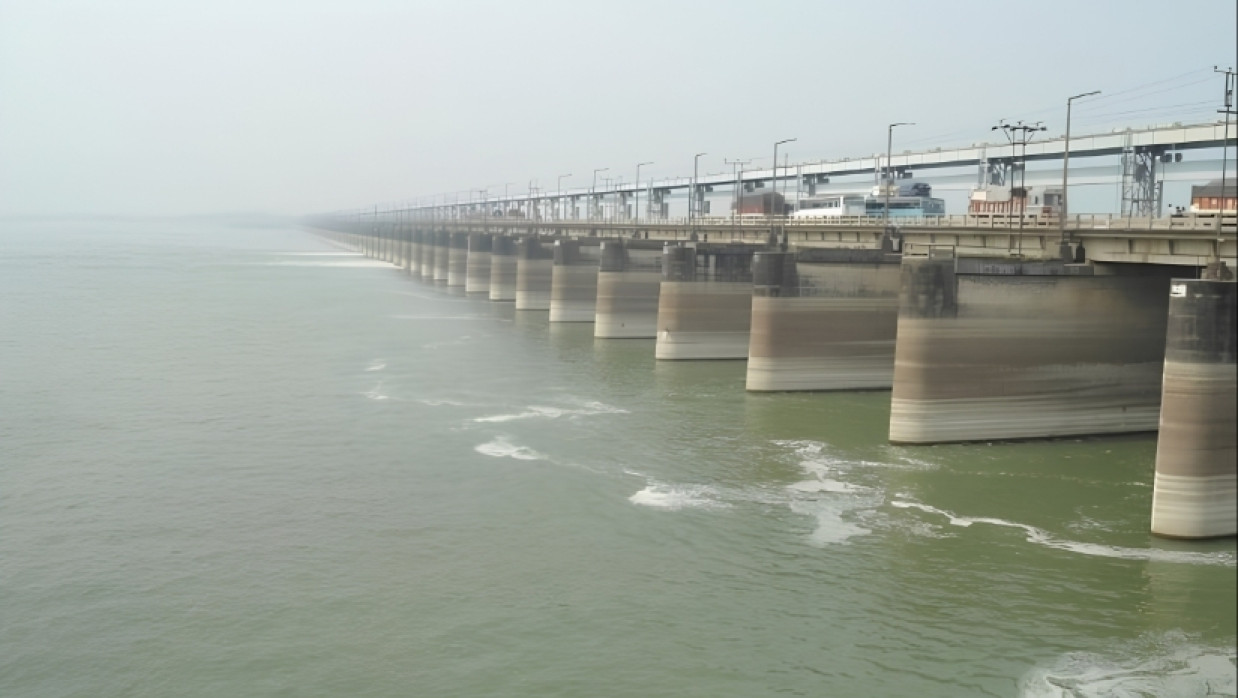
The Government of Bangladesh is set to construct a new barrage over the Padma River at an estimated cost of approximately 35,000 crore BDT. Dubbed the "Padma Barrage," this mega project is planned for implementation over the next seven years through self-funding. Through this initiative, the government aims to revive five dying rivers in the country’s southwest and alleviate water crises across 24 districts.
The Executive Committee of the National Economic Council (ECNEC), chaired by Prime Minister Tarique Rahman, approved the project during a meeting at the Secretariat on Wednesday, May 13.
Water Resources Minister Shahid Uddin Chowdhury Annie stated that approximately 70 million people will benefit once the project is realized. He noted that the Farakka Barrage has caused severe drought conditions in the southwest during the dry season, leading to the drying up of various Padma-linked rivers. This has increased salinity in coastal areas and caused waterlogging in some regions during the monsoon.
Speaking to journalists after the ECNEC meeting, the Water Resources Minister described the project as a "mastermind" initiative. He added that it was a key electoral pledge, noting that Prime Minister Tarique Rahman had personally committed to it in Rajshahi before the elections.
According to government plans, the first phase of the project will commence in the coming fiscal year. Along with completing the barrage by 2033, there are plans to establish three hydroelectric power plants and seven satellite towns in the region.
A barrage is an infrastructure built across a river or waterbody to regulate water flow. Unlike a dam, which completely blocks the flow, a barrage allows water to flow in a controlled manner through multiple gates, managing both speed and distribution.
Experts explain that artificial canals are typically excavated upstream before a barrage is built, allowing controlled water to be diverted for agricultural irrigation. In many cases, it is used to keep river flows active by transferring water from one river to another—a strategy that will be central to the Padma Barrage project.
Professor Dr. Anisul Haque of the Institute of Water and Flood Management at BUET noted that while a strategically placed barrage offers numerous benefits, its success depends on proper utilization to avoid wasting funds or harming the river.
Bangladesh built its first barrage on the Manu River in Moulvibazar in 1983, followed by the Teesta Barrage in Lalmonirhat and the Tangon Barrage in Thakurgaon in 1990. The idea of a Padma Barrage is not new, with feasibility studies dating back to the 1960s. A detailed study began in 2005, and a team of local and international experts submitted a report between 2009 and 2013, with the Water Development Board finalizing designs by 2016.
The expert report highlighted that increased upstream water withdrawal due to India's Farakka Barrage has significantly reduced dry-season water flow in Bangladesh. This has severely impacted agriculture, fisheries, navigation, and biodiversity.
The Padma Barrage will be constructed in the Pangsha Upazila of Rajbari district. The 2.1 km long structure will feature 78 spillways, 18 under-sluices, and two fish passes. Spillways will handle excess water discharge, while under-sluices will manage siltation. The government expects the barrage to store approximately 290 crore cubic meters of water, distributed through three offtake structures.
The first phase involves dredging 135.6 km of the Gorai-Madhumati River and 246.46 km of the Hisna River. The second phase will focus on restoring the Chandana-Barasia, Baral, and Ichamati rivers. Once completed, these rivers will see a dry-season flow of approximately 800 cusecs.
This water will facilitate irrigation for 2.9 million hectares of farmland across districts including Jessore, Khulna, Kushtia, Magura, Meherpur, Chuadanga, Jhenaidah, Narail, Bagerhat, Satkhira, Rajbari, Faridpur, Gopalganj, Pabna, Rajshahi, Natore, Naogaon, Chapainawabganj, and Pirojpur.
Officials claim the project could yield an additional 2.4 million tons of rice and 225,000 tons of fish annually. It is also expected to protect the Sundarbans, reduce salinity, and preserve riverine biodiversity. Minister Annie emphasized that the project would be a major contributor to the economy and provide water security for the G-K Irrigation Project, North Rajshahi Irrigation Project, and the Rooppur Nuclear Power Plant. Government estimates suggest the project will provide socio-economic benefits worth 8,000 crore BDT annually.
 Follow The Daily Campus on Google News