Two Pharmaceutical Factories Catch Fire in Three Days, Raising Questions Over US Tariff Exemption
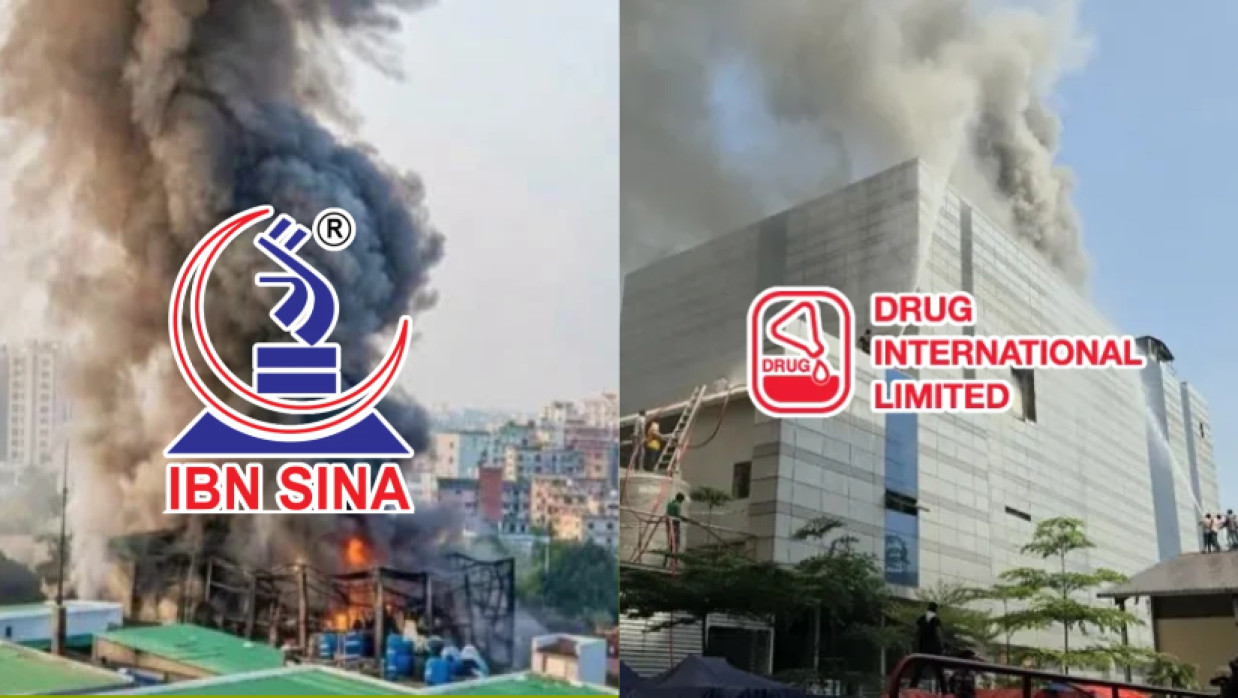
The US Department of Commerce granted Bangladesh and several other countries a 100% tariff exemption on specialised medicines on September 29, opening the door for Bangladeshi pharmaceutical companies to export high-tech, high-value medicines to the American market without additional tariffs. But just 20 days after the milestone, a devastating fire broke out at a pharmaceutical factory in Tongi, Gazipur. Three days later, another factory in the same district caught fire, fuelling speculation over the incidents at two major pharmaceutical manufacturers within a short period.
Some security analysts say the fires cannot be viewed in isolation, particularly given their timing after the US tariff exemption. They also point to the intense public debate over other issues around the time of the incidents, arguing that the circumstances warrant closer scrutiny.
Others, however, urge caution, noting that industrial fires have become frequent in Bangladesh. They recommend strengthening fire safety and investigating the incidents where necessary rather than giving in to panic.
Fires at two factories and what the companies and Fire Service say
The first fire broke out at 10:15am on October 14 in a chemical warehouse at the Unit-2 building of Drug International Ltd in Cherag Ali, Tongi. Twenty-one Fire Service units, along with members of the Army, Border Guard Bangladesh (BGB) and police, worked for around four hours to bring the blaze under control.
Chemicals used in medicine production, aluminium and rubber materials used for packaging, and valuable production equipment were damaged by the fire and smoke. The company has yet to provide an exact estimate of the losses.
Keeping our entire nation busy with something else, they have hit us at the real target. We have noticed that, at a particular time, we were kept occupied with side issues, sometimes Rabindranath, sometimes Jinnah, sometimes cow slaughter. We go overboard with these side issues. Everyone remains busy with them, as if those are the interests of the state, as if those are the interests of politics - Abu Rushd, editor, Bangladesh Civil Defence Journal
Three days later, at 4:20pm on October 17, a fire broke out at The Ibn Sina Pharmaceuticals in Shafipur, Kaliakair, in the same district. The fire started in a raw-materials store in the herbal section on the ground floor. Six Fire Service units brought it under control within an hour. Preliminary estimates put the damage to medicines, raw materials and machinery at Tk 20 crore to Tk 25 crore. The two factories are approximately 22.7 kilometres apart by road.
The Fire Service and the factory authorities have cited electrical short circuits and the unsafe storage of chemicals and flammable materials as possible causes. However, their accounts of the Drug International fire differ.
The company's senior administrative official, Shahidul Islam, told the media at the time that workers noticed smoke suddenly emerging from the fourth floor of the four-storey building and began shouting, prompting the emergency alarm to sound. He also claimed that there were no flammable materials or chemicals on that floor. The company believed the fire had started because of an electrical short circuit.
The Fire Service, however, said the fire originated on the third floor and that flammable materials and chemicals were present inside the factory. At the time, Fire Service and Civil Defence Director General Brigadier General Sultanul Afreen Junaid and media cell official Talha Bin Jasim told the media that the fire started on the third floor of the four-storey building before spreading to an adjacent building. They disputed the company's account, saying large quantities of flammable materials and chemicals had fuelled the blaze and made firefighting difficult.
Drug International subsequently announced an indefinite closure of the factory. A notice signed by factory in-charge Mohammad Abu Saeed on the morning of October 15 confirmed the decision. The factory has yet to resume operations, and no visible initiative has been taken by the company to establish the cause of the fire or determine the precise extent of the damage.
The Fire Service and Civil Defence later formed a five-member high-level investigation committee headed by Lieutenant Colonel Mohammad Mahmudul Hasan, director of its Operations and Maintenance Department, to determine the cause and assess the losses.
If there is any safety lapse or a criminal attack, it certainly falls within the responsibility of the police. But what we are seeing at first glance is that incidents of this kind happen frequently. In the past, many incidents have also occurred at the same time. You cannot treat every incident as a security issue or criminal activity. Therefore, the matter should be investigated to determine the cause. More importantly, what is needed now is to bring everything under a standard and bring all these factories into compliance with international standards - Professor Dr Sahab Enam Khan, Department of International Relations, Jahangirnagar University
Senior Tongi Fire Service Station Officer Shaheen Alam told the media on Sunday evening that the company had been unable to identify the cause of the fire or quantify the damage. He said the authorities had not taken any initiative in that regard and were instead occupied with resuming factory operations. As the Fire Service is required to submit a detailed report to the government on such incidents, a five-member investigation committee had been formed, he added.
Field-level officials provided further details about the Ibn Sina fire, saying it broke out at around 4:20pm in the raw-materials store in the herbal section on the ground floor of the company's six-storey main building. The factory's automatic safety protocol triggered an alarm, and its in-house firefighting team began initial containment efforts.
Preliminary estimates put the damage at Ibn Sina Pharmaceuticals at Tk 20 crore to Tk 25 crore.
Fire Service and Civil Defence media official Talha Bin Jasim told the media that the blaze remained largely confined to the ground-floor storeroom and was extinguished within an hour by six units. The exact cause, whether an electrical short circuit or another mechanical fault, could not immediately be confirmed. He said the smoke was caused by vines and other herbal raw materials stored in the room.
Asked about the incident on Monday, October 19, Talha told The Daily Campus that the Ibn Sina fire was relatively minor compared with the Drug International incident.
"There was some damage, but this was smaller than the Drug International fire. The team involved in firefighting identified a short circuit as a possible cause. However, as it was a small incident, there may not be any further investigation," he said.
He added that an investigation committee had been formed to examine the Drug International fire, describing it as a "big event" that had caused substantial damage. The cause would become clearer once the committee submitted its report, he said.
What security analysts and pharmaceutical industry figures say
The fires at the two pharmaceutical factories in Gazipur within three days have sparked speculation on social media, particularly Facebook. Some users have suggested that a rival country may have conducted an intelligence operation to undermine Bangladesh's pharmaceutical industry following the US tariff exemption. The timing of the incidents has become a central point in these discussions.
According to available information, Bangladesh and the United States signed a bilateral trade agreement on February 9 this year. Since 2015, trade relations between the two countries had largely been governed by the Trade and Investment Cooperation Forum Agreement (TICFA). Following the Trump administration's imposition of a 20% tariff on Bangladeshi goods in 2025, the two countries began negotiations on a new reciprocal trade agreement, which was finalised on February 9.
On April 2 this year, US President Donald Trump issued a measure under Section 232, announcing a 100% tariff on certain patented and high-tech specialised medicines imported from outside the United States. Under that arrangement, a specialised medicine manufactured in Bangladesh and priced at Tk 100 would have incurred another Tk 100 in tariffs upon entering the US market, effectively doubling its price to Tk 200. Such a price increase could have made Bangladeshi medicines less competitive in the American market.
However, the final exemption announced by the US Department of Commerce on September 28-29 excluded Bangladesh from the 100% tariff on the relevant category of medicines.
As a result, Bangladeshi pharmaceutical companies would be able to export medicines for rare diseases, cancer therapies and fertility treatments to the United States without the additional tariff. This could help keep the prices of Bangladeshi products lower in the US market and make them more affordable for American buyers.
Those highlighting the commercial implications say the exemption could give Bangladesh a competitive advantage in the world's largest pharmaceutical market, potentially placing it in a more favourable position than major producers such as India and China.
They also point out that Bangladesh has traditionally exported generic medicines, including paracetamol and medicines for gastric problems, generating around $20 million annually. The exemption could potentially open up a path to billions of dollars in future exports of high-value specialised medicines, including cancer drugs and gene therapies. Some security analysts believe rival countries could therefore have an incentive to undermine Bangladesh's pharmaceutical industry, although no evidence has established a connection between the fires and such activity.
Abu Rushd, a security analyst and editor of Bangladesh Defence Journal, told The Daily Campus that major pharmaceutical manufacturers, including Opsonin and Beximco, had also experienced fires in the past. The latest incidents involved Drug International and Ibn Sina, both major players in Bangladesh's pharmaceutical industry.
"These incidents have happened at a time when the United States has given us zero-tariff benefits. There could be commercial competition. Perhaps someone does not want Bangladeshi medicines to enter those markets because that would reduce their market share. This is what is called economic intelligence," he said.
Rushd also expressed concern that public attention had been diverted towards what he described as less important issues before and after the fires.
Keeping our entire nation busy with something else, they have hit us at the real target. We have noticed that, at a particular time, we were kept occupied with side issues, sometimes Rabindranath, sometimes Jinnah, sometimes cow slaughter. We go overboard with these side issues. Everyone remains busy with them, as if those are the interests of the state, as if those are the interests of politics. But we have issues of public safety and law and order, as well as security concerns arising from various incidents in the Chittagong Hill Tracts. These are not being adequately covered by the media or discussed publicly.
However, another security analyst, Professor Dr Sahab Enam Khan of Jahangirnagar University's Department of International Relations, urged the public not to treat the fires as evidence of a security threat without further investigation.
"I do not think there is any reason to panic at this point," he told The Daily Campus.
He said fire safety arrangements across Bangladesh's industrial areas were generally inadequate. While many garment factories had achieved global compliance standards, he argued, other types of factories often paid insufficient attention to fire safety. Many factories were also situated in locations that were difficult for fire engines to access, while industrial areas lacked adequate hospital facilities. As a result, he said, factories had often developed without proper planning.
Khan said poor-quality electrical equipment and the lack of effective quality control in Bangladesh contributed to recurring industrial fires. Such incidents had become routine, he added.
He stressed that any safety lapses or criminal activity should be investigated by the police, but warned against automatically treating every fire as a security incident. Instead, he called for proper investigations and stronger enforcement of international compliance standards across factories.
Pharmaceutical industry says tariff link is unproven
Dr Md Zakir Hossain, former secretary general of the Bangladesh Association of Pharmaceutical Industries (BAPI), said pharmaceutical factories generally had strong fire and disaster safety systems, but acknowledged that accidents remained possible.
"Although fire and disaster safety arrangements in pharmaceutical factories are much stronger, accidents can still happen. Pharmaceutical factories contain many chemicals, and primary packaging materials can have faults and vulnerabilities. Therefore, it is not impossible for fires to occur. From what I have learned from the owners of the two companies, they said it was an accident," he told The Daily Campus.
Hossain also disputed the suggestion that the fires were connected to the US tariff exemption. He said most of the specialised medicines covered by the US measure were not currently manufactured in Bangladesh.
"Most of the drugs being discussed under the US tariff issue are not medicines that we manufacture in Bangladesh in that way. What this has done is open up an opportunity for the future. If more products are covered later, the opportunity will expand for us. We are not manufacturing these medicines now. If we can start producing them in two years, we will benefit from the zero tariff. Therefore, we cannot link these fires to the tariff or any other decision," he said.
He argued that the trade agreement had put Bangladesh in a comparatively favourable position. While the United States had threatened a neighbouring country with 100% tariffs, Bangladesh's tariff position had been brought down to a more reasonable level under the bilateral agreement, he said. Bangladeshi garment exports to the US had increased following the agreement, and the pharmaceutical sector could also expand if local manufacturers began selling more medicines in the market.
Hossain acknowledged that commercial rivals existed but said that alone was not proof of deliberate attacks.
"We need to pay attention to who our competitors are. They may try to strike back. This happens everywhere," he said.
He added that, if anything unusual had occurred at either factory, the relevant security agencies would be better placed to determine it.
With investigations still pending, the causes of the two fires and the full extent of the damage remain to be established. Neither the timing of the incidents nor the tariff exemption, on its own, establishes a connection between the fires and commercial or foreign intelligence activity.
 Follow The Daily Campus on Google News