Part 2
One Home One Solar : Crisis Management Of Electricity in Bangladesh
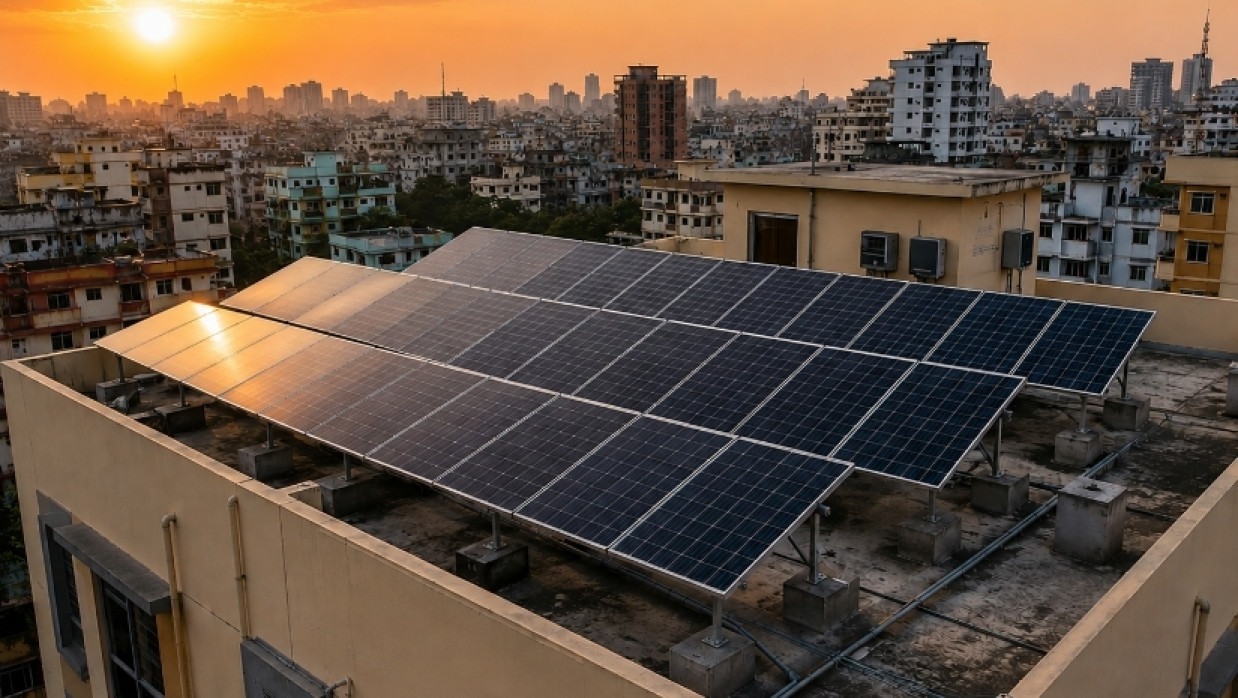
Rooftop solar can play a significant role in reducing pressure on Bangladesh’s electricity grid, but its success will depend on how effectively the programme is designed and implemented. The focus must now shift from the idea of “One Home, One Solar” to practical issues such as system selection, net metering, financing, safety, solar-powered charging and grid integration.
Read Part 1 of the series here
Selecting the Appropriate Solar System
Different households require different types of solar systems. An on-grid system is suitable for consumers who want to reduce daytime electricity bills and can remain connected to the national grid. An off-grid system may serve remote areas where grid electricity is unavailable or unreliable. A hybrid system combines solar panels, the grid and battery storage to offer greater energy security.
Batteries should not automatically be included in every installation. They can be expensive, require maintenance and eventually create recycling challenges. If a household’s main objective is to reduce daytime electricity costs, an on-grid system may be more economical. Batteries should be used when uninterrupted power for lights, fans, medical equipment, internet connectivity or other essential services is genuinely required.
Net Metering and Grid Partnership
Net metering can transform rooftop solar from an isolated household technology into a national energy resource. Under an effective net-metering arrangement, a household or institution first consumes the electricity generated by its solar system. Any surplus can then flow into the national grid through an approved meter, allowing the consumer to receive bill credits or adjustments.
This creates a partnership between citizens and the electricity system. Consumers become both users and producers of energy. During sunny hours, thousands of rooftop systems could collectively reduce the demand placed on central power plants and distribution networks.
However, net-metering procedures must be simple, transparent and quick. Complicated applications, lengthy approvals and uncertainty about financial credits discourage participation. Applications should be processed within a defined period, preferably through a digital platform that allows users to track approval, inspection, connection and payment status.
Solar Charging Hubs and Battery Swapping
Electric rickshaws can be integrated into the power system through registered solar charging hubs. Such centres should combine solar panels, grid electricity and battery storage. They should have commercial meters, fire-safety equipment, efficient chargers and trained operators.
Charging schedules can prevent all vehicles from charging simultaneously. Digital controls and off-peak tariffs can encourage charging when electricity demand is comparatively low. Battery-swapping systems can provide an additional solution. Instead of keeping a vehicle connected to a charger for several hours, drivers could exchange a discharged battery for a safely charged one. Standardised swapping stations would enable centralised charging, quality control and responsible recycling.
Solar Energy for Agriculture and Industry
The benefits of solar power should extend beyond households. Solar irrigation can reduce dependence on imported diesel and lower agricultural production costs. During periods when irrigation pumps are not operating, surplus electricity could support nearby homes, shops or a community microgrid.
Factories, warehouses, universities, schools, hospitals and shopping centres also have large rooftops and significant daytime electricity demand. Installing solar systems on these buildings would reduce grid pressure without occupying agricultural land. Industrial rooftop solar can additionally improve business competitiveness by lowering energy costs and supporting environmental commitments.
Public buildings should lead by example. Schools and government offices can function as demonstration sites where citizens observe the performance, savings and safety standards of solar technology.
Financing an Inclusive Energy Transition
The initial cost of solar installation remains one of the greatest barriers to expansion. Many middle- and low-income households cannot afford to purchase a complete system in a single payment. The transition will become socially unequal if rooftop solar remains limited to affluent families and large companies.
The government, banks, development partners and private companies should introduce accessible financing models, including: Low-interest green loans, Affordable monthly instalments, Lease-to-own arrangements, Pay-as-you-save programmes, Community purchasing schemes, Targeted subsidies for low-income households, Climate finance and green bonds.
Monthly instalments can be linked to expected electricity-bill savings so that households do not face an excessive additional burden. Smaller systems designed for essential appliances should also be made available to poorer families.
Quality, Safety and Consumer Protection
Rapid expansion without regulation could create serious risks. Low-quality panels, defective inverters, undersized cables, weak mounting structures and untrained installers may cause poor performance, financial loss or fire. Every installation should therefore comply with national technical and safety standards.
Proper earthing, circuit breakers, surge protection, quality cables and fire-safety measures must be mandatory. Roofs should be inspected for structural capacity, shade, orientation, slope and maintenance access before panels are installed.
Only approved equipment and certified installers should be eligible for government incentives or bank financing. Consumers should receive written warranties, clear performance estimates and access to after-sales service. A national online complaint platform could help resolve disputes involving defective equipment, misleading sales claims and poor installation.
Every solar system could also receive a digital identity or QR code containing information about its owner, generating capacity, installer, warranty, safety inspection and electricity production. This system would protect consumers while providing valuable national energy data.
A Phased Implementation Roadmap
The programme should be introduced gradually to test its financial, technical and administrative mechanisms.
The First 100 Days: During the first 100 days, the government should conduct a nationwide rooftop and demand assessment, finalise equipment and safety standards, develop a registry of qualified installers and launch pilot projects in ten representative districts. Digital registration and accessible loan packages should be introduced at the same time.
The First Year: During the first year, demonstration systems should be installed in public buildings, educational institutions and selected urban and rural households. Pilot solar charging hubs and agricultural microgrids should also be established. An open national dashboard should publish data on electricity generation, household savings and reduction of peak demand.
The First Three Years: Over three years, the programme should expand across the country. District-level service centres should be created, local technicians should be trained and women entrepreneurs should be encouraged to participate in installation, maintenance and energy services. A formal collection and recycling system must be established for used batteries, panels and electronic components.
Immediate Policy Priorities
Five policy measures deserve immediate attention. First, net-metering approval should be simplified and completed within a specific period. Second, duties and taxes on essential solar equipment should be reviewed to make quality systems more affordable. Third, public projects should use transparent competitive procurement. Fourth, renewable electricity should receive fair access to the grid. Finally, the national grid must be modernised to accommodate decentralised generation, storage and smart energy management.
Long-term policy consistency is critical. Investment will not grow if regulations, tariffs and incentives change without warning. Bangladesh should learn from international experience but design policies suited to its own economic and social realities. Locally appropriate loans, cooperative ownership, climate finance and community-based models may be more effective than simply copying foreign systems.
Monitoring Success and Managing Risks
The success of the programme should be measured through transparent indicators: the number of homes and institutions equipped with solar systems, daily electricity generation, consumer bill savings, reduction of peak demand, decrease in fuel imports and avoided carbon emissions.
Risks must also be monitored from the beginning. These include poor-quality equipment, inaccurate system sizing, unsafe roofs, excessive household debt, policy uncertainty and unmanaged battery waste. Clear standards, independent inspection, public reporting and consumer education can keep these risks under control.
Bangladesh’s electricity crisis cannot be resolved through a single technology or policy. The country must improve fuel planning, modernise transmission and distribution, reduce technical and non-technical losses, collect unpaid bills fairly, regulate electric-vehicle charging and promote efficient use of electricity. At the same time, it must rapidly expand domestic renewable-energy generation.
The “One Home, One Solar” programme offers a practical foundation for such a transformation. Every suitable rooftop can become a small power plant, every consumer can become an energy partner and every community can contribute to national energy security. With inclusive financing, strong safety standards, reliable technology, digital monitoring and consistent public policy, rooftop solar can lower household costs, reduce pressure on the grid and strengthen Bangladesh’s energy independence.
A household roof is therefore more than an unused physical space. It can become a source of family savings, community resilience, environmental protection and national prosperity. The time has come for Bangladesh to plan today, generate tomorrow and build a cleaner, safer and more self-reliant energy future.
Disclaimer: Written by Dr. Saiful Islam, Political Analyst and Professor at the University of Dhaka. The views and opinions expressed in this op-ed are solely those of the author and do not necessarily reflect the views, policies, or editorial position of The Daily Campus.
 Follow The Daily Campus on Google News